Discovering the Meaning of ‘Abiyhuwd in Hebrew
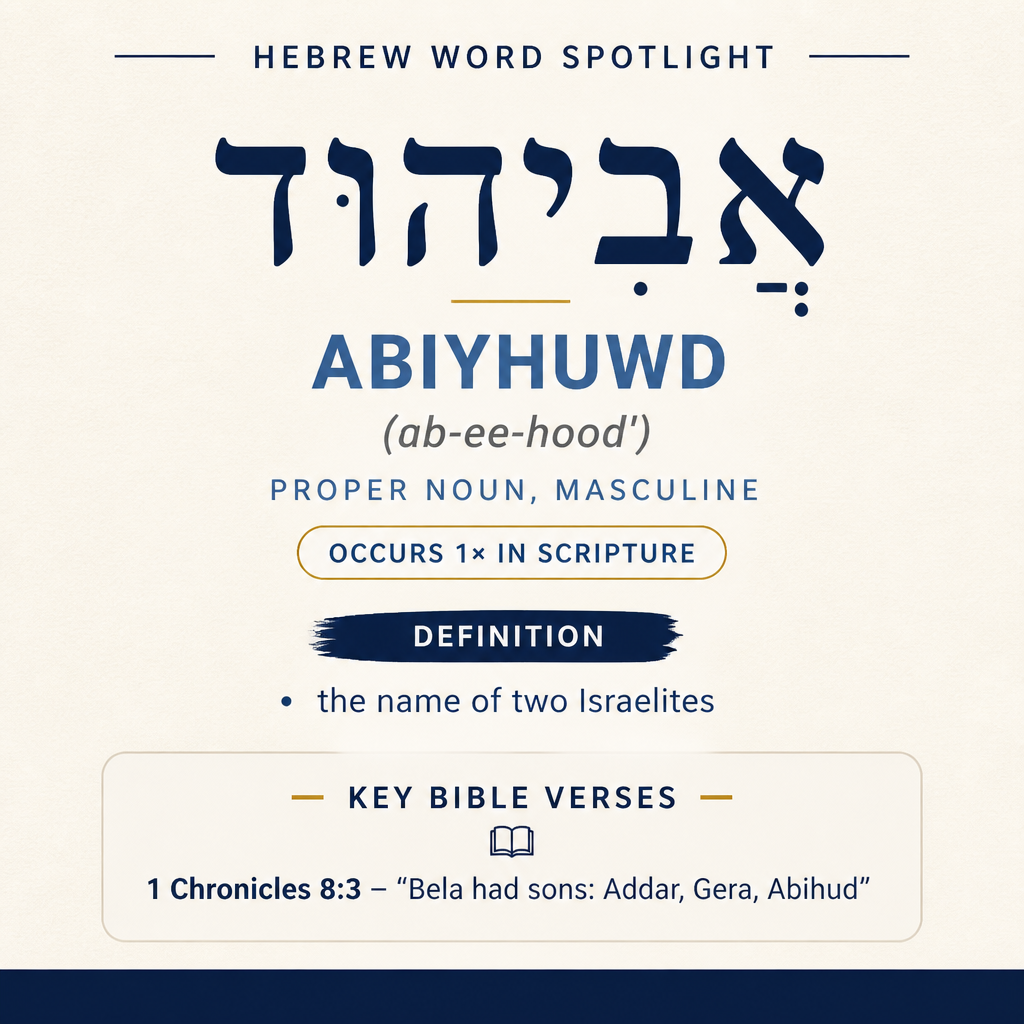
אֲבִיהוּד (Abiyhuwd) is the name of two Israelites, appearing in 1 Chronicles 8:3.
Verse Context
In 1 Chronicles 8:3, Abihud is listed among the sons of Bela alongside Addar and Gera.
Learn More →אֲבִיהוּד (Abiyhuwd) is a personal name used of Israelites. It appears in a genealogical list in 1 Chronicles 8:3, where it identifies one of the sons of Bela.
Occurrences
1 Chronicles 8:3
“Bela had sons: Addar, Gera, Abihud,” (1 Chronicles 8:3)
In this verse, אֲבִיהוּד functions as a single item within a compact roster of names. The clause “Bela had sons” sets a family frame, and the sequence that follows—“Addar, Gera, Abihud”—places Abihud as one of Bela’s sons alongside two brothers named in the same breath. The name therefore contributes to the structure of descent: it specifies an individual within a lineage, and it does so by standing as a bare proper noun without further description (no age, deeds, titles, or location are attached here). The punctuation and list format present the three sons as coordinate entries, so Abihud’s role is to complete the enumeration of Bela’s sons as this verse reports it.

Sense and Usage
As a masculine proper name, אֲבִיהוּד serves an identifying purpose rather than a descriptive one. In 1 Chronicles 8:3 it is not used to label an office, a clan, or a place, but to name a person in a chain of family relationships. The immediate wording—“had sons”—makes the name relational: it is meaningful in the verse as a marker of belonging within a father’s household. Because the verse offers only the parent’s name (Bela) and the children’s names (Addar, Gera, Abihud), the name’s communicative force lies in differentiation: it distinguishes this son from his brothers and fixes him as a distinct node in the genealogy.
The definition describes אֲבִיהוּד as “the name of two Israelites.” Within the genealogical style seen here, such a definition fits the way personal names operate across lists: a name can be shared by more than one individual in Israel, and context—such as parentage, surrounding names, or placement within a list—serves to identify which individual is intended in a given line. In this specific citation the context is purely familial and immediate: Abihud is the one placed as a son of Bela, between Addar and Gera in the naming sequence.
Genealogical naming also carries a literary function in Chronicles: lists compress generations into a few words, and the selection and ordering of names provide continuity within the narrative world. In that compressed space, a proper name like Abihud bears the weight of representation: it stands for a life and a place in a family’s unfolding story, even though the verse itself refrains from supplying biographical detail. The verse thus uses the name as a stable reference point—something that can be remembered, recorded, and connected to other names in the broader genealogical framework.
Genealogical Imagery
In 1 Chronicles 8:3, the imagery attached to אֲבִיהוּד is the imagery of lineage itself: a father named, sons named, and the family line advanced through a short list. The verse portrays identity as something located in relationship—Abihud is presented not in isolation but as one of the sons Bela “had,” set within a simple chain of descent.
Sources: Lexical data from Strong’s Exhaustive Concordance and the Open Scriptures Hebrew Lexicon. Occurrence data from the Westminster Leningrad Codex with STEPBible reference data (CC BY). Scripture quotations from the World English Bible (public domain).