
Discovering the Meaning of ‘Abiyhayil in Hebrew
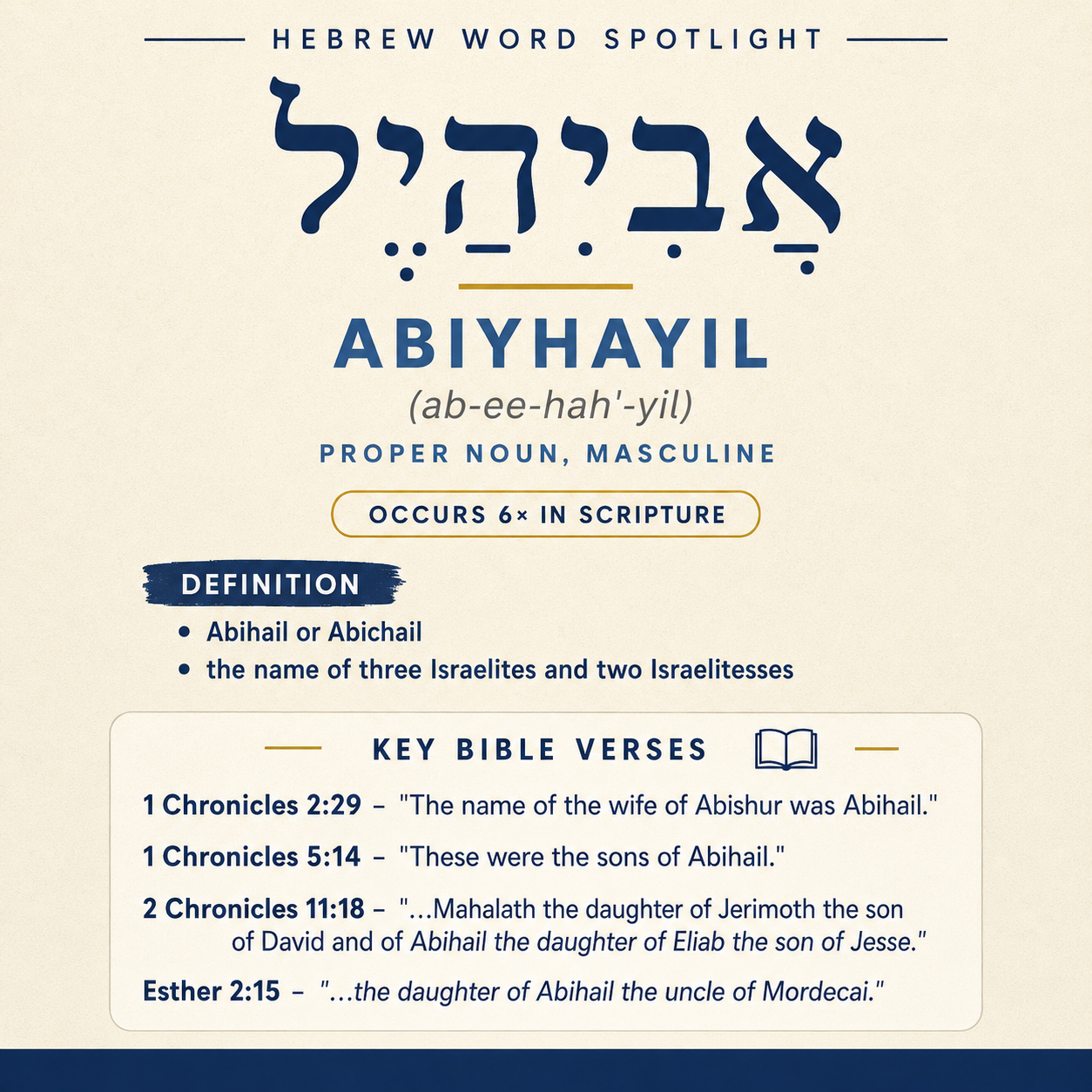
אֲבִיהַיִל (Abiyhayil) is the name Abihail/Abichail, borne by three Israelites and two Israelitesses, appearing in Numbers, Chronicles, and Esther.
Meaning
Abiyhayil is given as “Abihail or Abichail,” a personal name. It is used of multiple individuals in Scripture.
Learn More →Biblical Appearances
It occurs 6 times: Numbers 3:35; 1 Chronicles 2:29; 1 Chronicles 5:14; 2 Chronicles 11:18; Esther 2:15; Esther 9:29.
Learn More →Named Individuals
Abihail names family members in genealogical and royal contexts, including Zuriel’s father (Numbers 3:35) and Esther’s father (Esther 2:15; 9:29).
Learn More →אֲבִיהַיִל (Abiyhayil) is a personal name borne by multiple individuals in Scripture—men and women—appearing in genealogical notices and in the narrative of Esther. Across its occurrences it functions to locate people within families and to anchor authority, marriage, and lineage in named relationships.
Occurrences
“The name of the wife of Abishur was Abihail; and she bore him Ahban and Molid.” (1 Chronicles 2:29)
Here Abihail identifies a wife within a clan list. The sentence uses her name to connect Abishur to the next generation: by naming Abihail, the text specifies which woman is the mother of “Ahban and Molid,” and so clarifies descent through a particular marriage.
“These were the sons of Abihail, the son of Huri, the son of Jaroah, the son of Gilead, the son of Michael, the son of Jeshishai, the son of Jahdo, the son of Buz;” (1 Chronicles 5:14)
In this chain of ancestry, Abihail is a male forebear positioned among successive “son of” links. The name functions as one node in an extended pedigree; the verse frames an identifiable group (“These were the sons of Abihail”) by attaching them to Abihail and then pushing backward through earlier ancestors, placing the family within a larger genealogical structure.
“Rehoboam took a wife for himself, Mahalath the daughter of Jerimoth the son of David and of Abihail the daughter of Eliab the son of Jesse.” (2 Chronicles 11:18)
Abihail appears here as a woman named in the maternal line of Rehoboam’s wife. The verse presents Mahalath’s parentage in two lines at once: she is “the daughter of Jerimoth” and also “of Abihail,” and Abihail herself is further located as “the daughter of Eliab the son of Jesse.” In this setting the name Abihail helps define a royal marriage by tracing connections through both father and mother.
“Now when the turn of Esther, the daughter of Abihail the uncle of Mordecai, who had taken her for his daughter, came to go in to the king, she required nothing but what Hegai the king’s eunuch, the keeper of the women, advised. Esther obtained favor in the sight of all those who looked at her.” (Esther 2:15)
In Esther’s introduction at the point of her presentation to the king, Abihail is named to identify Esther’s family: she is “the daughter of Abihail,” and Abihail is further described as “the uncle of Mordecai.” The naming ties Esther to Mordecai’s household (“who had taken her for his daughter”) while also preserving her paternal identification, situating her within a web of kinship at the moment she enters a decisive court setting.
“Then Esther the queen, the daughter of Abihail, and Mordecai the Jew, wrote with all authority to confirm this second letter of Purim.” (Esther 9:29)
Abihail is repeated in a formal, administrative context: “Esther the queen” is still designated “the daughter of Abihail” at the moment she and Mordecai issue an authoritative written confirmation. The name functions as a stable personal marker for Esther even in her royal role, linking the queen’s public authority to a remembered family identity within the narrative’s official correspondence.
“The prince of the fathers’ house of the families of Merari was Zuriel the son of Abihail. They shall encamp on the north side of the tabernacle.” (Numbers 3:35)
In this organizational notice concerning the Levite families, Abihail appears as the father of a leader: “Zuriel the son of Abihail.” The name anchors Zuriel’s office (“The prince of the fathers’ house”) in lineage, and the verse immediately associates that leadership with ordered placement—“They shall encamp on the north side of the tabernacle”—so that Abihail serves as part of the identification of an encamped community within Israel’s worship-centered arrangement.

Sense and Usage
Abiyhayil serves as a recurring name attached to more than one person, and the passages show how such a name works in different literary environments. In the genealogies of Chronicles (1 Chronicles 2:29; 1 Chronicles 5:14), Abihail is embedded in the mechanics of descent: in one case as a wife whose children are named, and in another as a male ancestor around whom a group is defined (“These were the sons of Abihail”). The name thus participates in the Bible’s careful practice of fixing identity by placing individuals within networks of parentage and offspring.
In royal and political settings, Abihail continues to function as an identifier through family connection. In 2 Chronicles 11:18, the name belongs to a woman whose relationship (“the daughter of Eliab the son of Jesse”) is used to describe the parentage of Mahalath, whom Rehoboam takes as a wife. The verse’s layered formulation—linking Mahalath to Jerimoth and to Abihail—shows how personal names can carry relational weight: a marriage is presented not merely as an individual choice but as a joining of lines.
In Esther, Abihail appears as the father of Esther and as a relative marker connected to Mordecai (Esther 2:15; Esther 9:29). The narrative first introduces Esther’s turn “to go in to the king” while naming her as “the daughter of Abihail the uncle of Mordecai,” combining paternal identification with an explanation of guardianship (“Mordecai, who had taken her for his daughter”). Later, when Esther acts in the full stature of queenship, the designation “the daughter of Abihail” is retained as she and Mordecai “wrote with all authority.” The usage highlights the way a personal name can remain part of an individual’s formal identification across changing circumstances—private family life, public selection, and official decree.
Numbers 3:35 places Abihail within a community structure organized around the tabernacle. Here the name is not narrated for its own sake but used to establish Zuriel’s identity and legitimacy as “prince of the fathers’ house of the families of Merari.” In such a context, the name functions as a credential embedded in the phrase “son of,” and it sits beside directives about encampment. Abihail thus participates in the text’s pattern of linking appointed responsibility with recognized lineage.
Taken together, these occurrences show Abiyhayil operating as a name that crosses gender and social station: a mother in a clan list, a male ancestor in a longer pedigree, a woman situated in the lines that frame a king’s marriage, the father of a queen, and the father of a Levitical leader. In each case the name does the same basic work: it specifies which person is in view and positions that person among relatives so the reader can trace connections—children to parents, spouses to families, leaders to houses, and a queen to her family origin even while she acts “with all authority.”
Imagery in Context
The word’s imagery in these passages is the imagery of belonging and placement: children named from a marriage (1 Chronicles 2:29), generations arranged in a chain (1 Chronicles 5:14), a royal union described through parents and grandparents (2 Chronicles 11:18), and a community camped in ordered relation to the tabernacle (Numbers 3:35). In Esther, the name marks continuity of identity from a young woman’s “turn…to go in to the king” to the queen’s signature in an authoritative letter (Esther 2:15; Esther 9:29), tying public events to the steadier bonds of family naming.
Sources: Lexical data from Strong’s Exhaustive Concordance and the Open Scriptures Hebrew Lexicon. Occurrence data from the Westminster Leningrad Codex with STEPBible reference data (CC BY). Scripture quotations from the World English Bible (public domain).





