Exploring the Meaning of Huperoche in Greek
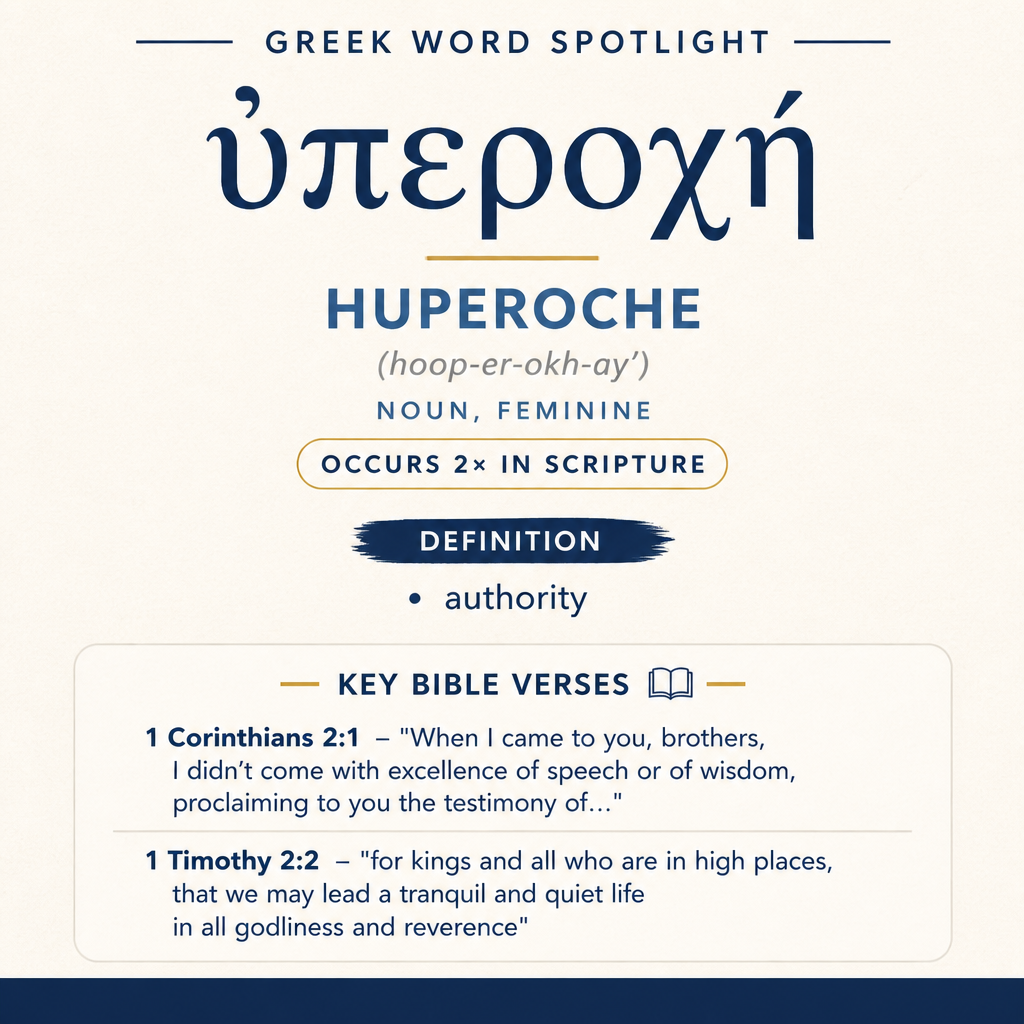
ὑπεροχή (Huperoche) means “authority” and appears twice in Scripture: 1 Corinthians 2:1 and 1 Timothy 2:2.
Scripture Occurrences
It occurs 2 times in Scripture: 1 Corinthians 2:1 and 1 Timothy 2:2.
Learn More →Context Snapshot
In 1 Timothy 2:2 it appears with “kings and all who are in high places.” In 1 Corinthians 2:1 it occurs in Paul’s statement about not coming with excellence of speech or wisdom.
Learn More →ὑπεροχή means “authority.” It appears twice in the New Testament: once in Paul’s comments on his manner of preaching, and once in an instruction about prayer for rulers and those positioned above others.
Root and Related Words
ὑπεροχή is related to hyperechō (ὑπερέχω), “be higher” (Strong’s G5242). The relationship points to a conceptual link between being “higher” and the social reality of those who hold authority.

Occurrences
“When I came to you, brothers, I didn’t come with excellence of speech or of wisdom, proclaiming to you the testimony of God.” (1 Corinthians 2:1)
In this setting Paul describes how he “came” and what he refused to rely on in his proclamation. The sentence contrasts his arrival and message with what could have impressed an audience: “excellence of speech” and “wisdom.” Within that contrast, ὑπεροχή contributes the idea of authority as something that can be displayed, claimed, or projected through outward rhetorical force—an approach Paul deliberately sets aside as he “proclaim[s] … the testimony of God.” The point is not that speech and wisdom are absent from speaking, but that his proclamation is not framed as an assertion of personal authority grounded in impressive performance. The word therefore functions in a context where authority is a quality that can attach to public communication, shaping how a messenger is perceived and how a message is received.

The verse’s paired phrases (“excellence of speech” and “of wisdom”) show how authority can be socially constructed: eloquence and learned argument can carry an aura of authority in themselves. Paul’s description works by negation (“I didn’t come with…”), so ὑπεροχή is felt as the rejected posture—authority as a humanly elevated stance presented in the act of speaking—over against his chosen posture of simple proclamation.
“for kings and all who are in high places, that we may lead a tranquil and quiet life in all godliness and reverence.” (1 Timothy 2:2)
Here ὑπεροχή lies behind “high places,” locating authority in the public ordering of society. The focus is not on a speaker’s manner but on people who occupy recognized positions: “kings” and “all who are in high places.” Authority is treated as something held by identifiable persons within a community, and it has real effects on ordinary life. The aim clause (“that we may lead a tranquil and quiet life…”) ties the presence of authority to the conditions in which the community lives. The verse does not describe the exercise of authority in detail; it frames authority as a governing reality that can either permit or hinder a “tranquil and quiet life,” and therefore becomes a proper object of prayer.
The wording also expands the category: not only the singular, prominent figure (“kings”) but “all” who share in elevated position. ὑπεροχή thus covers a range of officials and leaders whose authority, by virtue of their “high places,” touches the daily experience of others. In this scene authority is neither asserted nor renounced; it is acknowledged as a social fact that shapes public peace and the community’s ability to live out “godliness and reverence.”
Sense and Usage
Across these two occurrences, “authority” is presented as something recognizable in two arenas: public communication and public office. In 1 Corinthians 2:1, authority is the sort of elevated stance that can be projected through impressive speech and intellectual display. Paul’s statement shows that such authority can be adopted as a persuasive strategy, a way of coming to others with a posture that places the speaker above the hearers. His refusal to come in that mode highlights that authority, even when it can be communicated by style and technique, is not the foundation he wants associated with “the testimony of God.”
In 1 Timothy 2:2, authority is embedded in governance—attached to “kings” and to the broader set of people “in high places.” It is the kind of authority that affects public conditions, not merely perceptions of a message. The purpose clause connects this authority to the possibility of living “tranquil” and “quiet,” suggesting that authority is a force that can shape social stability. The verse treats authority as a practical reality: it is consequential for the community’s way of life, and so it appropriately becomes part of communal concern and intercession.
Taken together, these passages show that ὑπεροχή is not limited to one narrow setting. It can describe authority as displayed (an elevated posture carried by rhetorical excellence) and authority as situated (an elevated position within societal structures). The related verb hyperechō (“be higher”) helps illuminate why both settings fit the same term: authority is what belongs to those who stand “higher,” whether by self-presentation in speech or by recognized placement “in high places.” In each case the “higher” status is not abstract; it has effects—either on how a proclamation is framed and heard, or on how a community is able to live.
Imagery
The imagery around ὑπεροχή is spatial and social: it evokes what is “higher” over others. In 1 Corinthians 2:1 that height would be the platform created by “excellence of speech” and “wisdom,” a height Paul refuses as the defining feature of his coming. In 1 Timothy 2:2 it is the height of office—“kings and all who are in high places”—a height that stands over public life and can affect whether that life is “tranquil and quiet.”
Sources: Lexical data from Strong’s Exhaustive Concordance and the Translators Brief Lexicon of Extended Strongs for Greek (STEPBible, CC BY). Occurrence data from the Translators Amalgamated Greek New Testament (STEPBible, CC BY). Scripture quotations from the World English Bible (public domain).