Exploring the Meaning of Huperoon in Greek
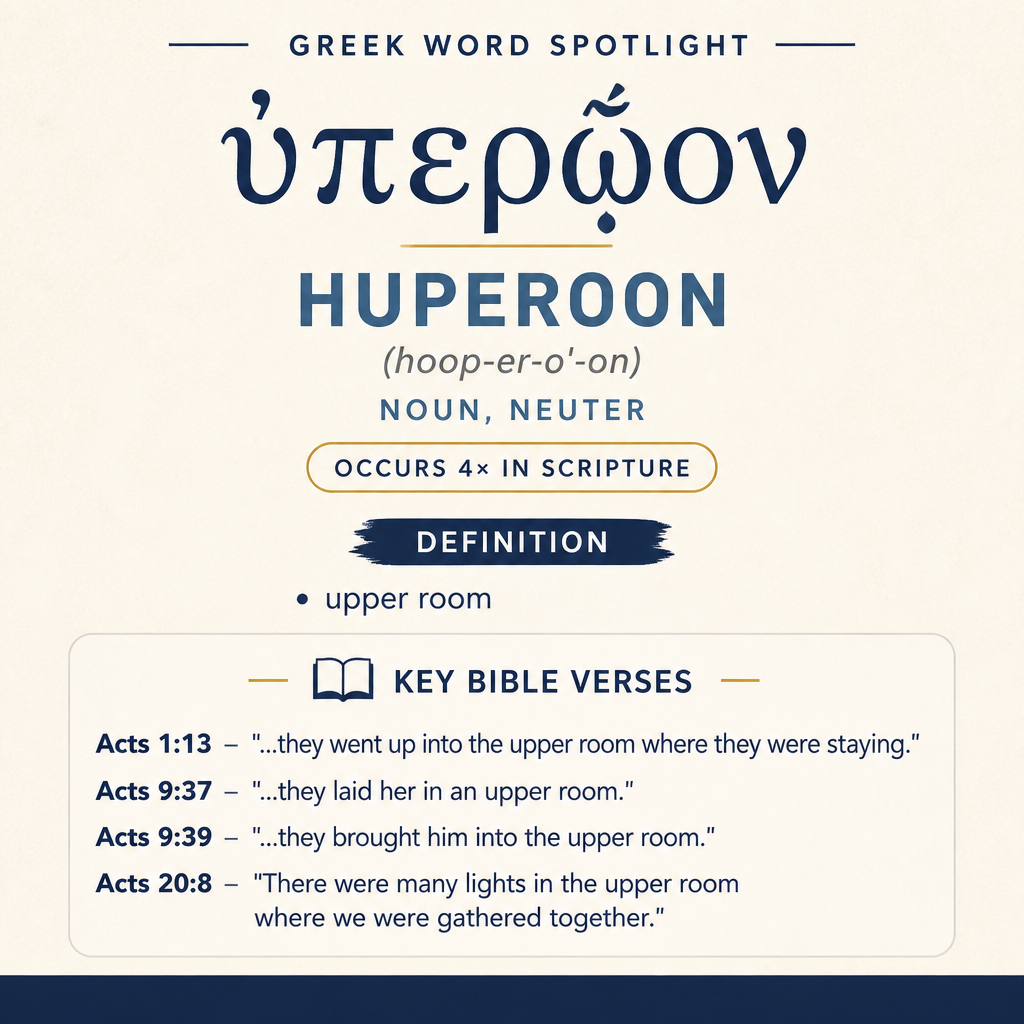
ὑπερῷον means “upper room” and appears four times in Scripture: Acts 1:13; 9:37; 9:39; 20:8.
Scene Details
In Acts 1:13 it is where the disciples were staying; in Acts 9:37 and 9:39 it is where Tabitha was laid and where widows gathered; in Acts 20:8 it is the gathering place with many lights.
Learn More →ὑπερῷον refers to an “upper room,” a space located above the main level of a house or building. In Acts it appears in scenes of gathering, lodging, mourning, and night meeting, where the elevated setting frames what happens there.
Root and Related Words
ὑπερῷον is connected with the preposition hyper (ὑπέρ), “above/for” (Strong’s G5228), highlighting the idea of location “above” in relation to other spaces.

Occurrences
“When they had come in, they went up into the upper room where they were staying; that is Peter, John, James, Andrew, Philip, Thomas, Bartholomew, Matthew, James the son of Alphaeus, Simon the Zealot, and Judas the son of James.” (Acts 1:13)
Here the “upper room” is reached by going up, so the word naturally fits the movement and the location within the building. It is also described as the place “where they were staying,” so it functions as lodging as well as a base of operations. The list of named individuals anchors the scene in a concrete setting: the upper room is not merely architectural detail, but the lived-in space where this identifiable group resides together.
“In those days, she became sick, and died. When they had washed her, they laid her in an upper room.” (Acts 9:37)
In this account the “upper room” becomes the place where the dead woman is laid after being washed. The word marks the setting for careful, respectful handling of her body, and the elevated room serves as the immediate location for what follows in the narrative. By specifying the upper room, the verse points to a particular, enclosed space within the house—distinct from wherever the washing occurred—where she is placed and kept.
“Peter got up and went with them. When he had come, they brought him into the upper room. All the widows stood by him weeping, and showing the coats and garments which Dorcas had made while she was with them.” (Acts 9:39)
The same “upper room” becomes the setting for a communal display of grief and testimony. Peter is brought into it, implying the group is already gathered there and that the room is the focal point of the household at this moment. Within this upper room, the widows’ weeping and their showing of “coats and garments” gives the space a social function: it is large enough, or at least suitable, for people to stand around Peter and to present tangible reminders of Dorcas’s work. The word thus contributes a sense of a defined interior location where the mourners assemble and where their actions are staged.
“There were many lights in the upper room where we were gathered together.” (Acts 20:8)
Here the “upper room” is explicitly the meeting place “where we were gathered together,” and it is illuminated by “many lights.” The word identifies the room as the setting for a group assembly, while the mention of numerous lights fills out the scene with the practical details of an interior space prepared for extended activity. The upper room is not described as incidental background; it is the container for the gathering, and the lighting underscores that the room is actively used and occupied.
Sense and Usage
Across these passages, ὑπερῷον consistently functions as a specific kind of interior room defined by its position above other parts of a building. The definition “upper room” is not treated abstractly; it repeatedly appears with verbs of movement and placement that assume a recognizable layout: people “went up” to it (Acts 1:13), a body is “laid” there (Acts 9:37), a visitor is “brought” into it (Acts 9:39), and a group is “gathered together” there (Acts 20:8). In each case, the word helps the narrative mark off a distinct setting within a household or building—an upstairs space that can serve multiple purposes without changing what it is.
The usages also show the upper room’s flexibility as a setting. It can be a place of ongoing residence (“where they were staying,” Acts 1:13), a place to keep the deceased after washing (Acts 9:37), a place where mourners gather and display meaningful items (Acts 9:39), and a place arranged for a meeting with significant lighting (Acts 20:8). The same kind of room accommodates private and communal moments alike, suggesting that what matters in these narratives is not a specialized function but the room’s suitability as a defined, set-apart space within the structure.
Another recurring feature is how the word supports scene organization. By naming the upper room, the text creates a stable point of reference: once the action is located there, people come into it, stand by someone within it, and gather in it. The upper room becomes the narrative “stage” for the human actions described—staying together, mourning together, and meeting together—without the term itself needing extra explanation. Its contribution is spatial clarity and a sense of being “above,” which coheres with the movement described in Acts 1:13 and with the room’s recurring role as a place where groups can be present together.
Imagery in Acts
The imagery attached to ὑπερῷον in these passages is domestic and concrete: stairs or upward movement, an interior room, and people gathered within it. In Acts 9 the upper room holds both grief and remembrance as widows weep and show garments (Acts 9:39), while in Acts 20 it is bright with “many lights” during a gathering (Acts 20:8). In Acts 1 it is simply the upstairs place where named individuals are staying together (Acts 1:13), giving the word a lived-in, communal feel shaped by the scenes it hosts.
Sources: Lexical data from Strong’s Exhaustive Concordance and the Translators Brief Lexicon of Extended Strongs for Greek (STEPBible, CC BY). Occurrence data from the Translators Amalgamated Greek New Testament (STEPBible, CC BY). Scripture quotations from the World English Bible (public domain).