Exploring the Meaning of Huperogkos in Greek
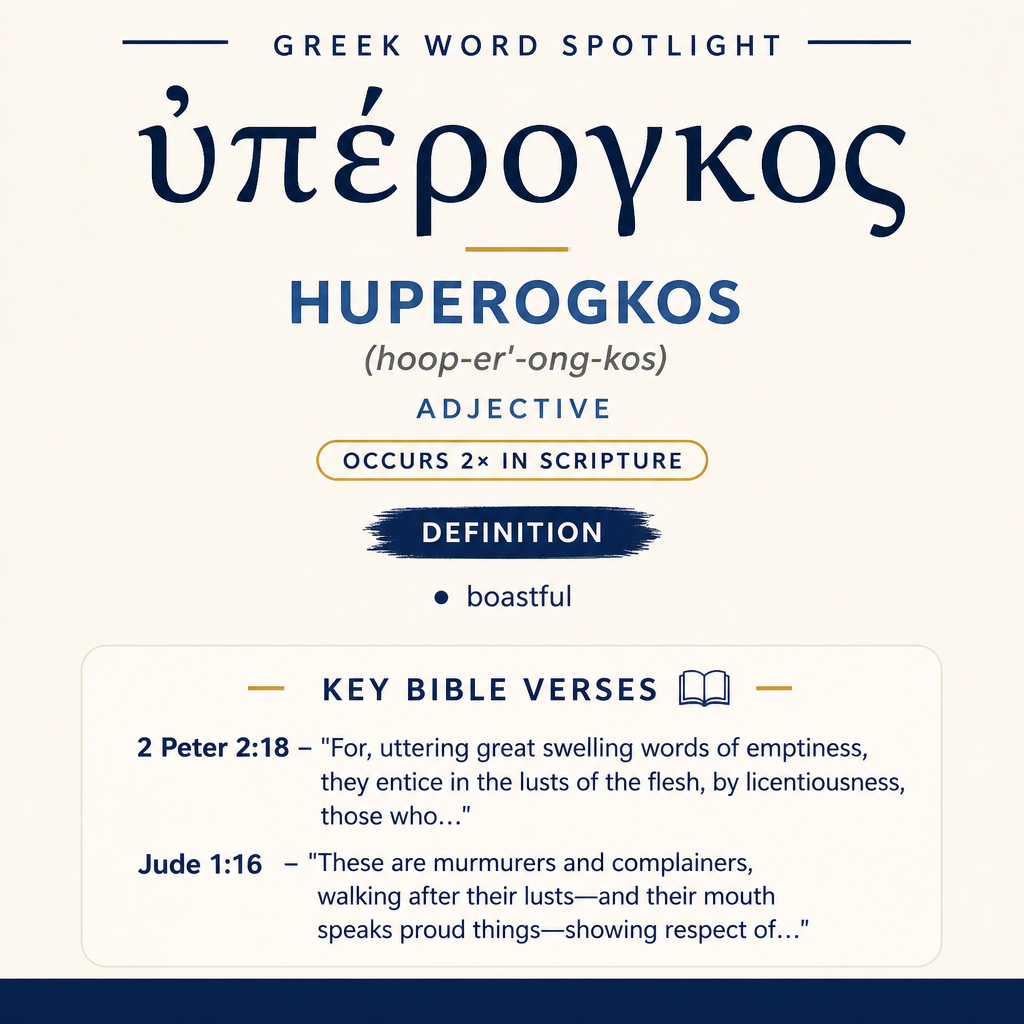
ὑπέρογκος means “boastful” and appears twice in Scripture, in 2 Peter 2:18 and Jude 1:16.
Scripture Occurrences
This word occurs 2 times in Scripture: 2 Peter 2:18 and Jude 1:16.
Learn More →Verse Context
In 2 Peter 2:18 it describes “great swelling words of emptiness,” and in Jude 1:16 it describes a mouth that “speaks proud things.”
Learn More →ὑπέρογκος describes speech or claims marked by boastfulness, especially when words are made larger than their substance. In the New Testament it appears in two close contexts that expose the moral and social effects of such talk: it is used of empty, enticing rhetoric in 2 Peter and of self-serving, advantage-seeking speech in Jude.
Root and Related Words
ὑπέρογκος (Huperogkos) is related to ὑπέρ (hyper), “above/for” (Strong’s G5228), and ὄγκος (onkos), “impediment” (Strong’s G3591). The combination naturally suggests something carried “above” what is fitting, an overgrown weightiness that presents itself as impressive.

Occurrences
“For, uttering great swelling words of emptiness, they entice in the lusts of the flesh, by licentiousness, those who are indeed escaping from those who live in error;” (2 Peter 2:18)
Here ὑπέρογκος characterizes the sound of the teachers’ speech: it is “great” and “swelling,” but at the same time “of emptiness.” The boastfulness, then, is not merely a tone of confidence; it is the inflated manner of words that promise more than they deliver. Within the sentence, that verbal inflation functions as a tool of manipulation—“they entice”—and the target is morally vulnerable: “those who are indeed escaping from those who live in error.” The verse places the boastful rhetoric alongside “lusts of the flesh” and “licentiousness,” so that the reader hears ὑπέρογκος as part of an overall strategy: verbal grandness coupled with sensual appeal, meant to draw people back into what they are leaving.

The phrase “great swelling words” also frames boastfulness as an audible phenomenon: language that takes up space, sounds weighty, and projects an aura of authority. Yet the line immediately punctures that aura by calling it “emptiness,” so ὑπέρογκος contributes a sense of conspicuous bigness that proves hollow at the center. In this setting, boastfulness is not only a personal vice but a persuasive instrument—rhetoric designed to capture attention and gain influence over others.
“These are murmurers and complainers, walking after their lusts—and their mouth speaks proud things—showing respect of persons to gain advantage.” (Jude 1:16)
Jude places ὑπέρογκος in a compact portrait of character. The boastful element comes from “their mouth speaks proud things,” set amid several traits: they are “murmurers and complainers,” their conduct follows desire (“walking after their lusts”), and they are socially calculating (“showing respect of persons to gain advantage”). In this cluster, ὑπέρογκος is not an isolated habit of speech; it matches a life-orientation. The “proud things” the mouth speaks fit with a pattern of dissatisfaction and self-interest, where the tongue serves the same impulses that guide the walk.
The final phrase, “to gain advantage,” clarifies the practical aim of the boastful speech in Jude. ὑπέρογκος contributes the sense of talk that lifts the speaker up—through posturing, self-promotion, or grand claims—so that people can be impressed, swayed, or treated preferentially. Jude’s line does not describe mere candor or strong assertion; it presents boastful speech as part of a broader posture of using relationships for profit, with “respect of persons” functioning as a social tactic. Thus ὑπέρογκος names an outward display that serves inward desire.
Sense and Usage
Across these two occurrences, ὑπέρογκος consistently belongs to the realm of speech—words that project more greatness than is warranted. The adjective’s force shows itself by the company it keeps: in 2 Peter it modifies “words,” and those words are simultaneously expansive (“great swelling”) and void (“of emptiness”). In Jude it is paired with moral and interpersonal distortions: complaint, lust-driven living, and favoritism practiced for personal gain. In both passages, boastfulness is not presented as harmless personality; it has an effect on others.
2 Peter highlights the seductive dynamic of boastful rhetoric. The words are “swelling,” and their swell serves the act of “entice[ment].” That movement is important: ὑπέρογκος speech is portrayed as something that reaches beyond the speaker, aiming to capture those who are “escaping.” The reader is meant to sense the danger of verbal size—language that sounds grand can mask emptiness, and emptiness can still be powerful when it is dressed in impressive form.
Jude, by contrast, stresses the social mechanics. The mouth speaks “proud things,” and the same people “show[] respect of persons to gain advantage.” Boastful talk here is compatible with flattery or partiality, because both are forms of speech and behavior that seek benefit from other people. ὑπέρογκος therefore functions as a diagnostic word: it identifies a kind of speech that does not merely communicate but performs—projecting an elevated image, magnifying the speaker, and serving appetite and advantage.
Taken together, the two uses show boastfulness as inflation: words made to appear larger than they are, or speakers making themselves appear larger than they are, often with the aim of moving others. 2 Peter underscores the contradiction of magnitude and emptiness, while Jude underscores the linkage between proud speech and a life of self-seeking. In both, ὑπέρογκος belongs to a moral vocabulary in which the mouth reveals the direction of the heart and the tactics of influence.
Imagery
The passages that use ὑπέρογκος paint boastful speech with a physical feel: it is “swelling,” it fills the air, it takes up room. Yet it is also “emptiness,” like something puffed up without substance. Jude adds the picture of a mouth producing “proud things” while its owner maneuvers among people “to gain advantage,” so the inflated speech becomes a kind of social instrument—expansive words used to pull others closer, impress them, or position the speaker above them.
Sources: Lexical data from Strong’s Exhaustive Concordance and the Translators Brief Lexicon of Extended Strongs for Greek (STEPBible, CC BY). Occurrence data from the Translators Amalgamated Greek New Testament (STEPBible, CC BY). Scripture quotations from the World English Bible (public domain).