Exploring the Meaning of Huperecho in Greek
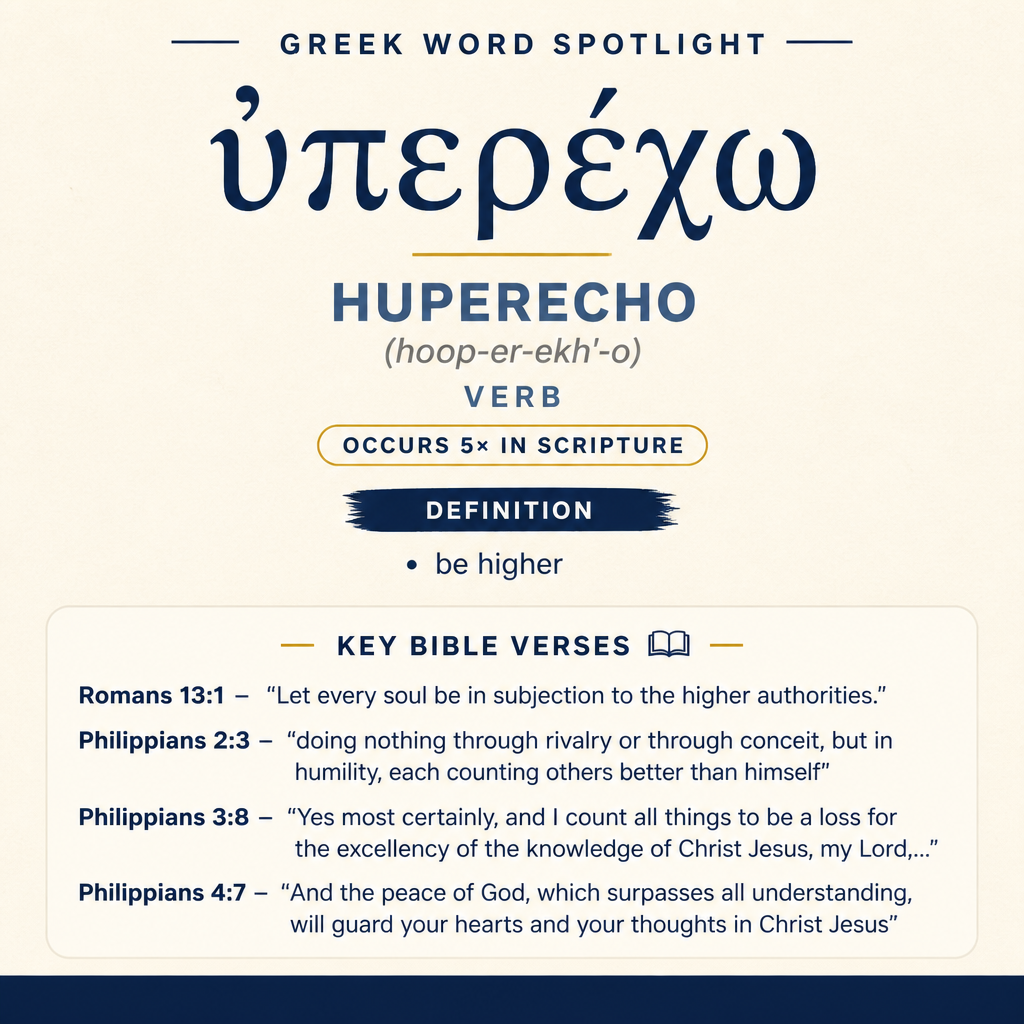
ὑπερέχω means “be higher” and occurs five times in Scripture: Romans 13:1; Philippians 2:3; 3:8; 4:7; 1 Peter 2:13.
Where It Appears
It occurs 5 times in Scripture: Romans 13:1; Philippians 2:3; 3:8; 4:7; 1 Peter 2:13.
Learn More →Verse Contexts
It is used of “higher authorities” (Romans 13:1) and the king “as supreme” (1 Peter 2:13). It also appears in Philippians 2:3; 3:8; and 4:7.
Learn More →ὑπερέχω expresses the idea of being higher. It appears in passages that speak of higher authorities, surpassing peace, and the evaluation of people and things as “better” or “excellent.”
Root and Related Words
ὑπερέχω (Huperecho) is derived from hyper (ὑπέρ), “above/for” (Strong’s G5228), and echo (ἔχω), “to have/be” (Strong’s G2192).

Occurrences
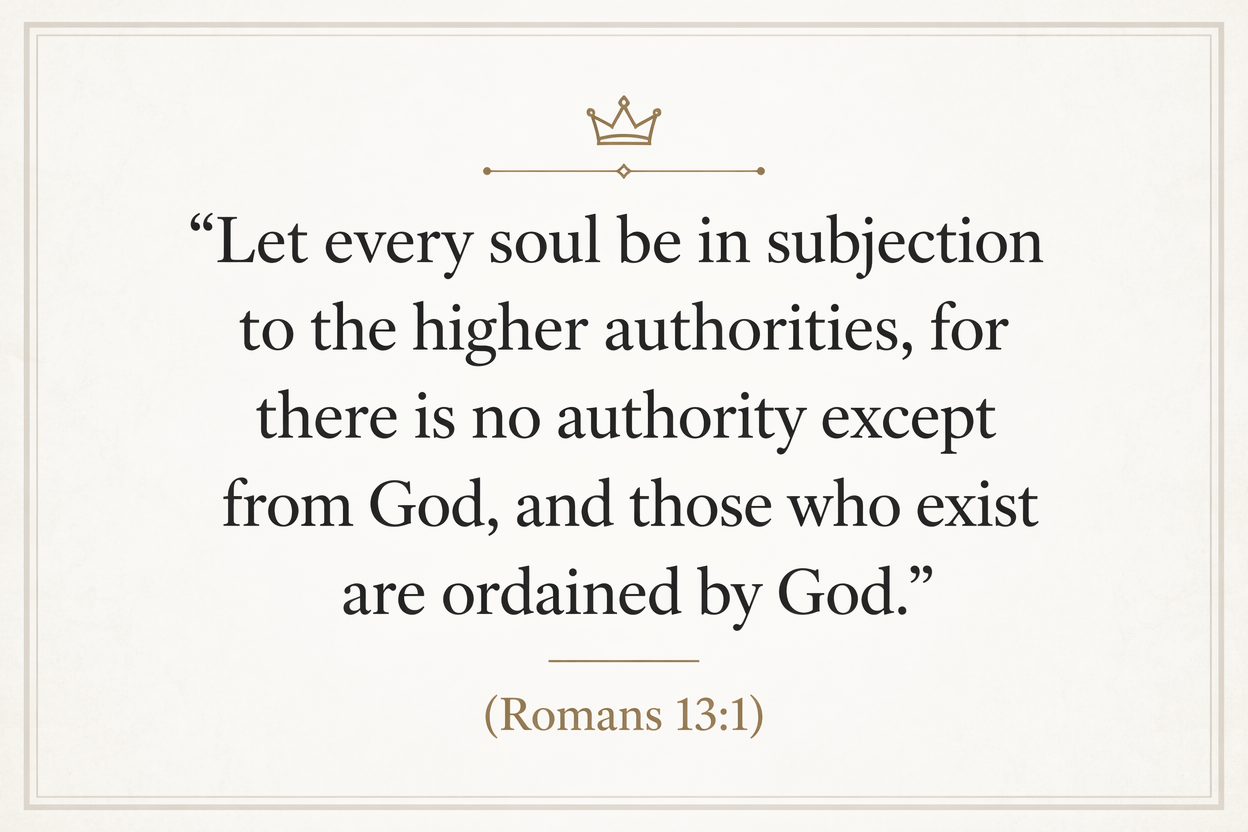
“Let every soul be in subjection to the higher authorities, for there is no authority except from God, and those who exist are ordained by God.” (Romans 13:1)
Here ὑπερέχω marks authorities as “higher,” framing the relationship between “every soul” and governing power as one of ordered rank. The verse’s logic depends on that vertical arrangement: subjection is urged because authority stands above, and because such authority is understood within God’s ordering (“there is no authority except from God”). In this scene, the word’s contribution is not a description of personal worth but of position—authorities are placed over others, and that “higher” placement grounds the call to be “in subjection.”
“doing nothing through rivalry or through conceit, but in humility, each counting others better than himself;” (Philippians 2:3)
In Philippians 2:3, the “higher” idea is applied to interpersonal evaluation: each person is to “count” others “better than himself.” The verse places this alongside the rejection of “rivalry” and “conceit,” so the “higher” assessment of the other functions as a practical expression of “humility.” The word’s force is seen in the deliberate mental act (“counting”): one treats the other as higher in the comparative sense implied by “better,” and this reorients conduct away from self-promotion.
“Yes most certainly, and I count all things to be a loss for the excellency of the knowledge of Christ Jesus, my Lord, for whom I suffered the loss of all things, and count them nothing but refuse, that I may gain Christ” (Philippians 3:8)
Here ὑπερέχω is heard in “the excellency of the knowledge of Christ Jesus.” The verse contrasts two kinds of valuation: “all things” are counted “loss,” even “refuse,” when set against what is “excellent.” The language of counting and comparison dominates the sentence (“I count… I count… and count”), and the “higher” quality of this “knowledge” drives the drastic reassessment of everything else. The term thus contributes a sense of surpassing value within the narrator’s stated calculus—what is “excellent” stands higher in the scale of worth, and that height explains why other items can be relinquished.
“And the peace of God, which surpasses all understanding, will guard your hearts and your thoughts in Christ Jesus.” (Philippians 4:7)
In Philippians 4:7, ὑπερέχω characterizes “the peace of God” as surpassing “all understanding.” The scene is not about rank between people but about the quality of God’s peace relative to human comprehension. The word’s “higher” idea is expressed as a peace that rises above the limits of “understanding,” and the verse links this surpassing peace to a protective effect: it “will guard your hearts and your thoughts in Christ Jesus.” The “higher” peace is not merely described; it is presented as active, standing over inner life like a sentry over “hearts” and “thoughts.”
“Therefore subject yourselves to every ordinance of man for the Lord’s sake: whether to the king, as supreme;” (1 Peter 2:13)
In 1 Peter 2:13, the word appears in the political-social realm again, now tied to the king “as supreme.” The instruction to “subject yourselves” is specified by examples (“whether to the king”), and “supreme” signals the top of the civic hierarchy in view. The “higher” sense functions to identify the one who stands at the uppermost point in the relevant chain of authority, sharpening what “subject yourselves” looks like when directed toward the highest human office mentioned here.
Sense and Usage
Across these five passages, “be higher” operates along two closely connected lines: hierarchy and comparison. In Romans 13:1 and 1 Peter 2:13, the word’s “higher” sense identifies an elevated position within an ordered structure—“higher authorities” and the king “as supreme.” The texts treat that elevation as socially real and consequential, because it defines appropriate posture (“be in subjection,” “subject yourselves”) and clarifies the direction of responsibility.
In Philippians, the same “higher” notion shifts into the realm of valuation. Philippians 2:3 uses it for the comparative assessment of persons, where humility is enacted by reckoning the other as “better.” Philippians 3:8 uses it for the comparative assessment of things, where “the excellency of the knowledge of Christ Jesus” stands higher than “all things,” prompting loss and reclassification as “refuse.” Philippians 4:7 uses it for a quality that rises above a human capacity—peace that “surpasses all understanding”—and then depicts that higher reality as guarding the inner person. In each case, “higher” is not an isolated description; it sets a scale (rank, worth, or reach) and then shapes conduct, priorities, or inner security within that scale.
Imagery
These passages repeatedly evoke a vertical world: authorities are “higher,” a king is “supreme,” one person is treated as “better,” one object of knowledge is held as “excellent,” and God’s peace stands above “all understanding.” The effect is to picture life as lived under and before what is higher—sometimes expressed as public order requiring subjection, sometimes as a chosen humility that elevates the other, sometimes as a surpassing peace that stands over the heart and mind as a guard.
Sources: Lexical data from Strong’s Exhaustive Concordance and the Translators Brief Lexicon of Extended Strongs for Greek (STEPBible, CC BY). Occurrence data from the Translators Amalgamated Greek New Testament (STEPBible, CC BY). Scripture quotations from the World English Bible (public domain).