Exploring the Meaning of Hupereido in Greek
ὑπερείδω means “to overlook” and appears once in Scripture in Acts 17:30.
ὑπερείδω means “to overlook,” and it appears in the New Testament in Paul’s address at Athens. In its single attested use, it describes God’s action toward “times of ignorance” in contrast to a present command to repent.

Root and Related Words
ὑπερείδω (Hupereido) is connected with εἴδω (eido), “to perceive: understand” (Strong’s G1492), and with ὑπέρ (hyper), “above/for” (Strong’s G5228). These related elements place the verb within a word-family that speaks in terms of perception and a perspective marked by “above/for.”

Occurrences
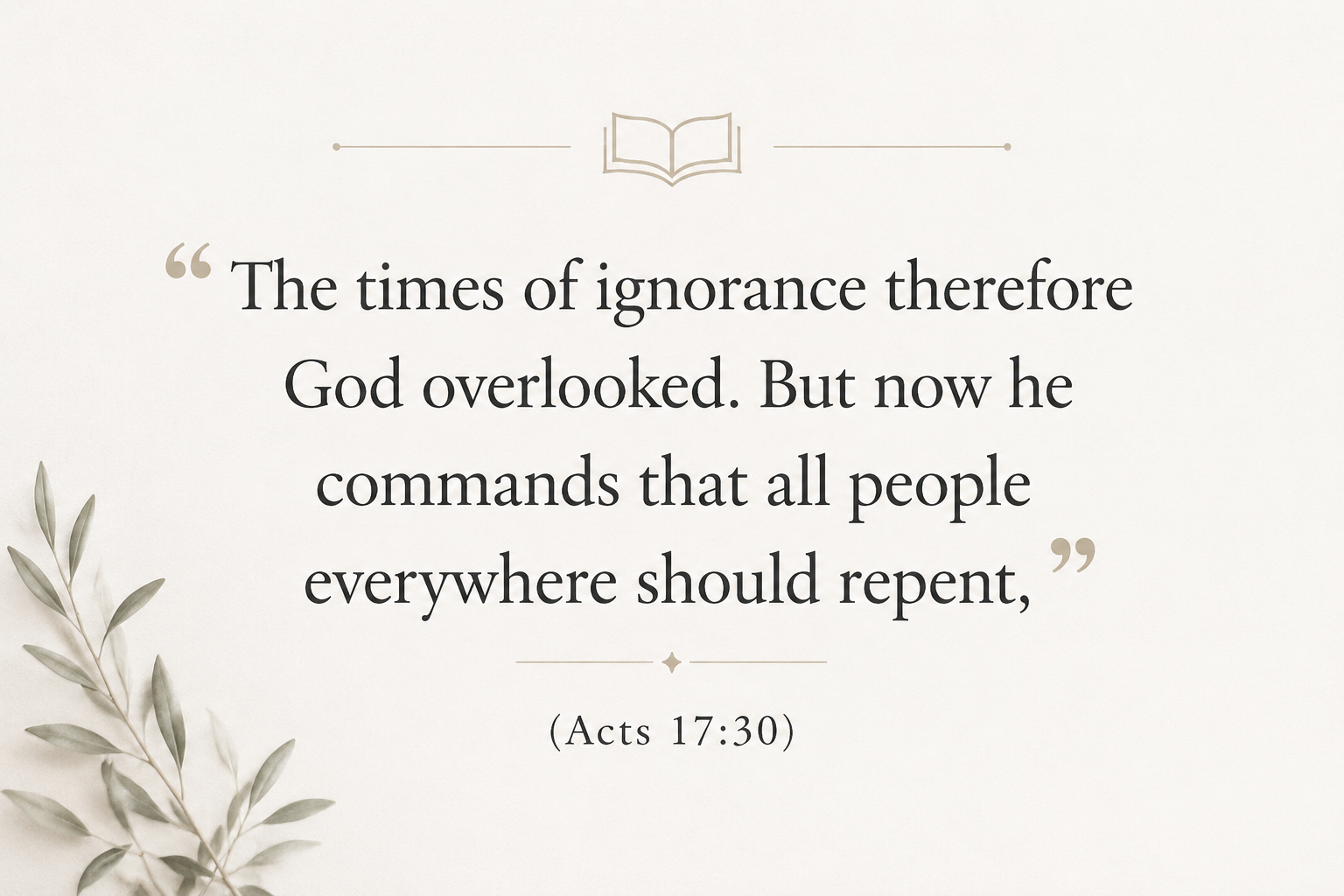
“The times of ignorance therefore God overlooked. But now he commands that all people everywhere should repent,” (Acts 17:30)
In Acts 17:30, “overlooked” is set in a carefully shaped contrast: “The times of ignorance therefore God overlooked. But now…” The verb names an action God took with respect to a defined period—“the times of ignorance.” In the sentence as given, the “therefore” ties that period to the preceding line of thought in the speech, and the verb expresses God’s posture toward that period: he did not treat it as the controlling issue in the moment being described. The point is not merely that ignorance existed, but that it belonged to an identifiable “times,” and God’s response to those “times” is described as overlooking.
The second sentence sharpens the function of the verb by juxtaposition: “But now he commands…” The overlooked “times” belong to a “therefore” and an earlier era; the command belongs to the “now.” The verb, then, is not an isolated statement about divine attitude in general, but a pivot that helps the speech move from past conditions to present obligation. Its placement before a universal summons (“all people everywhere”) gives it rhetorical weight: the overlooking of ignorance is not presented as the final word but as the backdrop against which a clear command is now issued.
Within the quoted line, the word also contributes to the moral logic of the exhortation. Repentance is framed as a response demanded in the present, and “overlooked” explains why the speaker can address hearers who have been characterized by ignorance without making that ignorance the excuse that ends the conversation. The verb supports the transition from description (“times of ignorance”) to imperative (“should repent”) by indicating that God has not left humanity permanently defined by the earlier condition. The clause is brief, but it does substantial work: it identifies a divine action toward the past and thereby intensifies the seriousness of the current command.
Sense and Usage
The single use of ὑπερείδω in Acts 17:30 shows “to overlook” functioning in a temporal and exhortational frame. The object of the overlooking is not a person or a single act but “the times of ignorance,” a phrase that treats ignorance as a broad condition with a recognizable season. In this context, “overlook” works as a verb of divine governance over history and responsibility: it marks a way God dealt with a former situation, while the immediate “now” establishes a new situation in which a direct command is given.
Because the verse pairs “overlooked” with “commands,” the sense is not merely observational; it is directional. “Overlooked” does not end the moral argument; it clears the ground for it. The overlooking belongs to the “therefore” statement about what has been true up to this point, and the command belongs to the present moment that the speaker presses upon the audience. The logic of the line depends on this distinction: God’s overlooking relates to what was, and God’s command addresses what is. The verb thus carries a forward-driving force in the discourse, moving the hearers from a description of past ignorance into the urgency of repentance.
The universality of the command (“all people everywhere”) also helps define how “overlooked” is heard. The overlooking is not restricted to a narrow group in this sentence; it is set before an all-encompassing summons. As used here, “overlooked” is compatible with a broad scope, because it pertains to “times” rather than to a particular local circumstance. The verb therefore contributes to the speech’s global horizon: it frames a transition that touches human ignorance as a widespread reality and then addresses humanity with a comprehensive command.
Imagery
Acts 17:30 gives “overlooked” a historical horizon: the phrase “times of ignorance” evokes an earlier stretch of human life characterized by not knowing, and the verb portrays God as standing over that stretch without letting it prevent the present summons. The imagery is not visual but temporal—an earlier period receding behind the “now,” with the verb marking the divine response that allows the speech to press immediately toward repentance.
Sources: Lexical data from Strong’s Exhaustive Concordance and the Translators Brief Lexicon of Extended Strongs for Greek (STEPBible, CC BY). Occurrence data from the Translators Amalgamated Greek New Testament (STEPBible, CC BY). Scripture quotations from the World English Bible (public domain).