Exploring the Meaning of Nephaleos in Greek
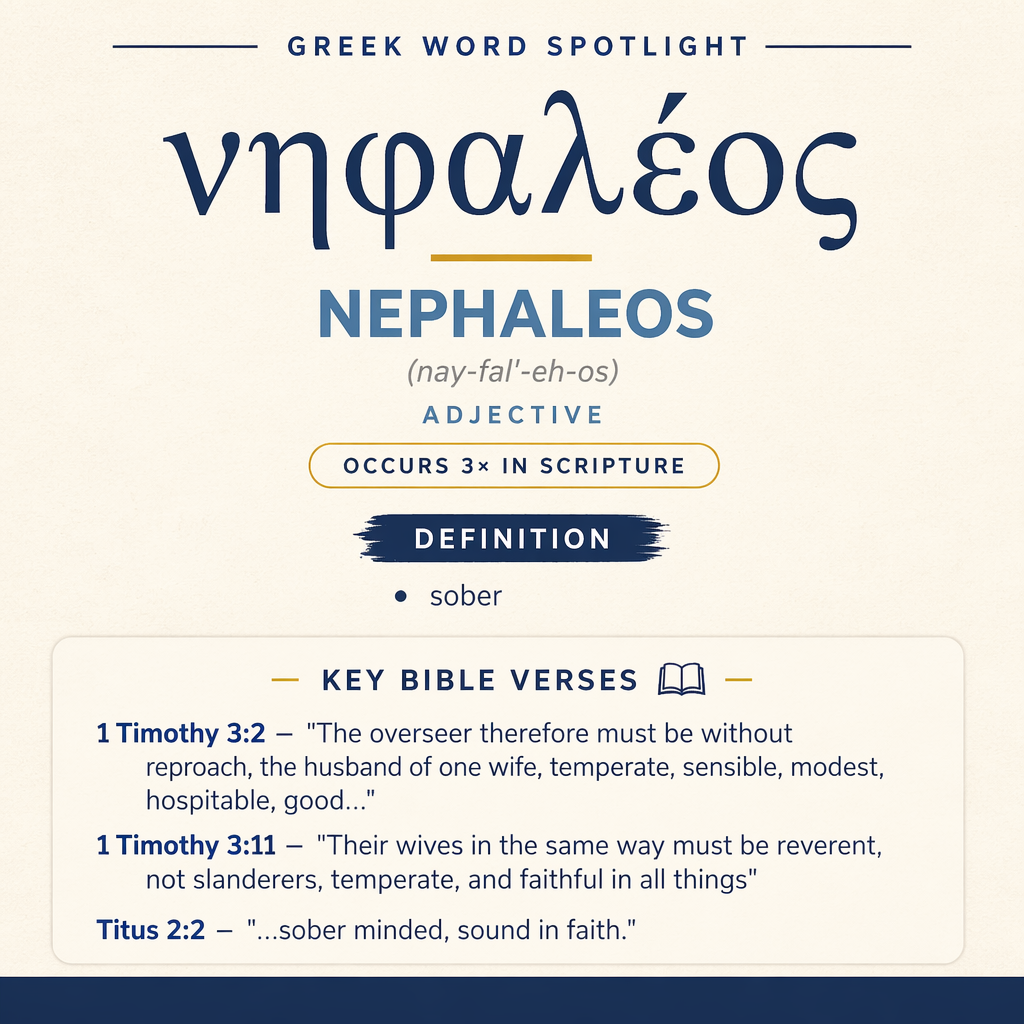
νηφαλέος means “sober” and occurs three times in Scripture: 1 Timothy 3:2, 1 Timothy 3:11, and Titus 2:2.
Where It Appears
This word occurs 3 times in Scripture: 1 Timothy 3:2, 1 Timothy 3:11, and Titus 2:2.
Learn More →Verse Contexts
In 1 Timothy 3:2 and 3:11 it is listed among qualifications for overseers and their wives. In Titus 2:2 it is applied to older men alongside soundness in faith, love, and perseverance.
Learn More →νηφαλέος means “sober” and appears in three pastoral exhortations that describe the character expected of church leaders and mature believers in 1 Timothy and Titus. In these lists, the word functions as a practical quality that stands alongside other observable patterns of life.
Root and Related Words
νηφαλέος is related to the verb nephō (νήφω), “be sober” (Strong’s G3525).

Occurrences
“The overseer therefore must be without reproach, the husband of one wife, temperate, sensible, modest, hospitable, good at teaching;” (1 Timothy 3:2)
Here “sober” is placed within a tightly packed profile of an “overseer.” The verse frames these qualities as necessities (“must be”), not optional strengths. In the flow of the line, sobriety belongs with traits that express steady judgment and public credibility: “without reproach” sets the overarching aim, then the list names a faithful household situation (“the husband of one wife”) and a cluster of measured virtues (“temperate, sensible, modest”). Within that cluster, “sober” contributes the idea of a life that is not clouded or destabilized, fitting a role that also requires outward-facing practices (“hospitable”) and competence in instruction (“good at teaching”). The arrangement presents sobriety as a stabilizing disposition that supports the overseer’s reliability in both conduct and teaching.
“Their wives in the same way must be reverent, not slanderers, temperate, and faithful in all things.” (1 Timothy 3:11)
In this instruction, the virtue is applied to “their wives,” introduced by the phrase “in the same way,” which links this set of expectations to the broader discussion of qualified leadership and service. The verse pairs sobriety with speech and trustworthiness. “Not slanderers” narrows the focus to restraint in what is said about others, and “faithful in all things” widens it again to comprehensive dependability. Between those poles stands “temperate,” where sobriety fits naturally as an ordered inner life that avoids the kind of impulsiveness that can spill into harmful talk or inconsistent conduct. The result is a portrait of women whose presence strengthens the integrity of the household and the credibility of the community’s leadership through steadiness, careful speech, and broad faithfulness.
“that older men should be temperate, sensible, sober minded, sound in faith, in love, and in perseverance:” (Titus 2:2)
This occurrence places sobriety within guidance specifically for “older men.” The list begins again with measured traits (“temperate, sensible”), then adds “sober minded,” and then moves into durable spiritual qualities: “sound in faith, in love, and in perseverance.” In this setting, sobriety is not isolated as a single private discipline; it is bound to long-term stability (“perseverance”) and to healthiness and firmness (“sound”) in the enduring centers of life—faith and love. The sequence reads like a movement from outward self-control toward inward solidity, where sobriety serves as a bridge between practical restraint and sustained, tested reliability over time.
Sense and Usage
Across these three passages, sobriety is presented as a settled steadiness that belongs to a life fit for responsibility. The contexts are all evaluative: “must be” (1 Timothy 3:2), “must be” (1 Timothy 3:11), and “should be” (Titus 2:2). In other words, sobriety is treated as a recognizable trait by which people can be assessed for suitability and maturity.
The word also consistently appears in clusters rather than standing alone. In 1 Timothy 3:2 it is intertwined with qualities that support public trust—irreproachability, propriety, hospitality, and teaching ability. In 1 Timothy 3:11 it is framed by reverence, restraint from slander, and comprehensive faithfulness, suggesting an ordered self that expresses itself in guarded speech and consistent dependability. In Titus 2:2 it is set alongside temperance and good sense and is followed by being “sound” in faith, love, and perseverance, suggesting that sobriety is part of the practical architecture of endurance.
Because each list includes both inward and outward elements, sobriety functions as more than a momentary state. It belongs to the kind of character that supports clear judgment, measured action, and stability under the demands of relationships and service. The repeated companionship with “temperate” and “sensible” reinforces that sobriety is envisaged as a pattern of life that avoids being carried away—whether in conduct, in speech, or in the long course of persevering faithfulness.
Imagery and Emphasis
Although the passages are presented as plain instruction rather than narrative, they create a concrete impression: a household and a congregation marked by steadiness. The overseer is pictured as someone whose life can be scrutinized without shame and whose home and public actions hold together (1 Timothy 3:2). The wives are pictured as reverent, guarded in speech, and reliable “in all things” (1 Timothy 3:11). The older men are pictured as sound and enduring, carrying faith and love with perseverance (Titus 2:2). In all three, sobriety is part of the texture of a community where maturity shows itself in stable, trustworthy lives.
Sources: Lexical data from Strong’s Exhaustive Concordance and the Translators Brief Lexicon of Extended Strongs for Greek (STEPBible, CC BY). Occurrence data from the Translators Amalgamated Greek New Testament (STEPBible, CC BY). Scripture quotations from the World English Bible (public domain).