Exploring the Meaning of Nephthaleim in Greek
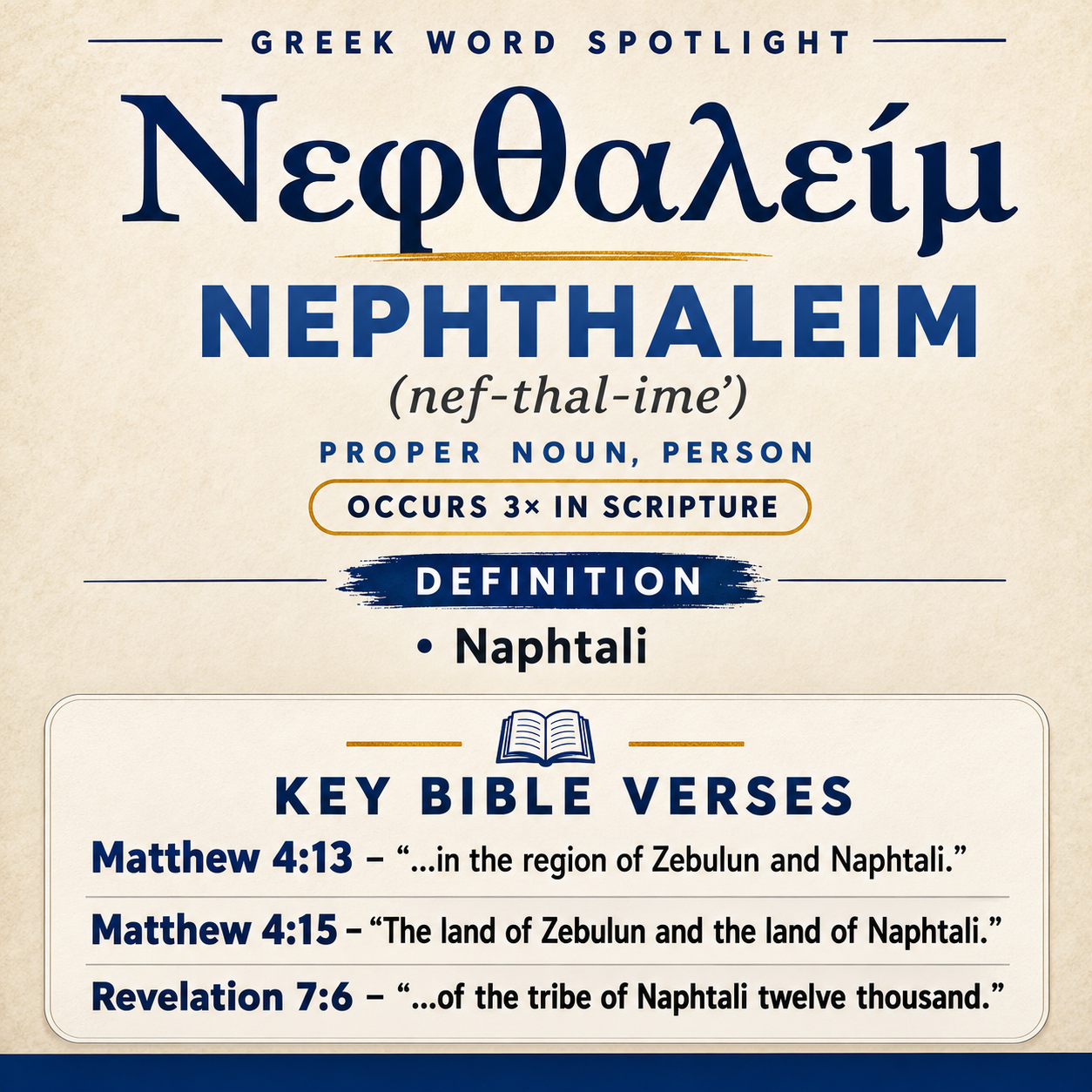
Νεφθαλείμ (Nephthaleim) means Naphtali and appears in Matthew 4:13, Matthew 4:15, and Revelation 7:6.
Gospel References
In Matthew 4:13 and 4:15, Naphtali is named with Zebulun in a regional description.
Learn More →Tribal Listing
In Revelation 7:6, Naphtali is listed among the tribes with twelve thousand counted.
Learn More →Νεφθαλείμ means “Naphtali,” a name that appears in the New Testament in two geographic descriptions in Matthew and once in a tribal listing in Revelation. In each context it functions as a marker of place or lineage, helping locate events or identify a counted group.
Occurrences
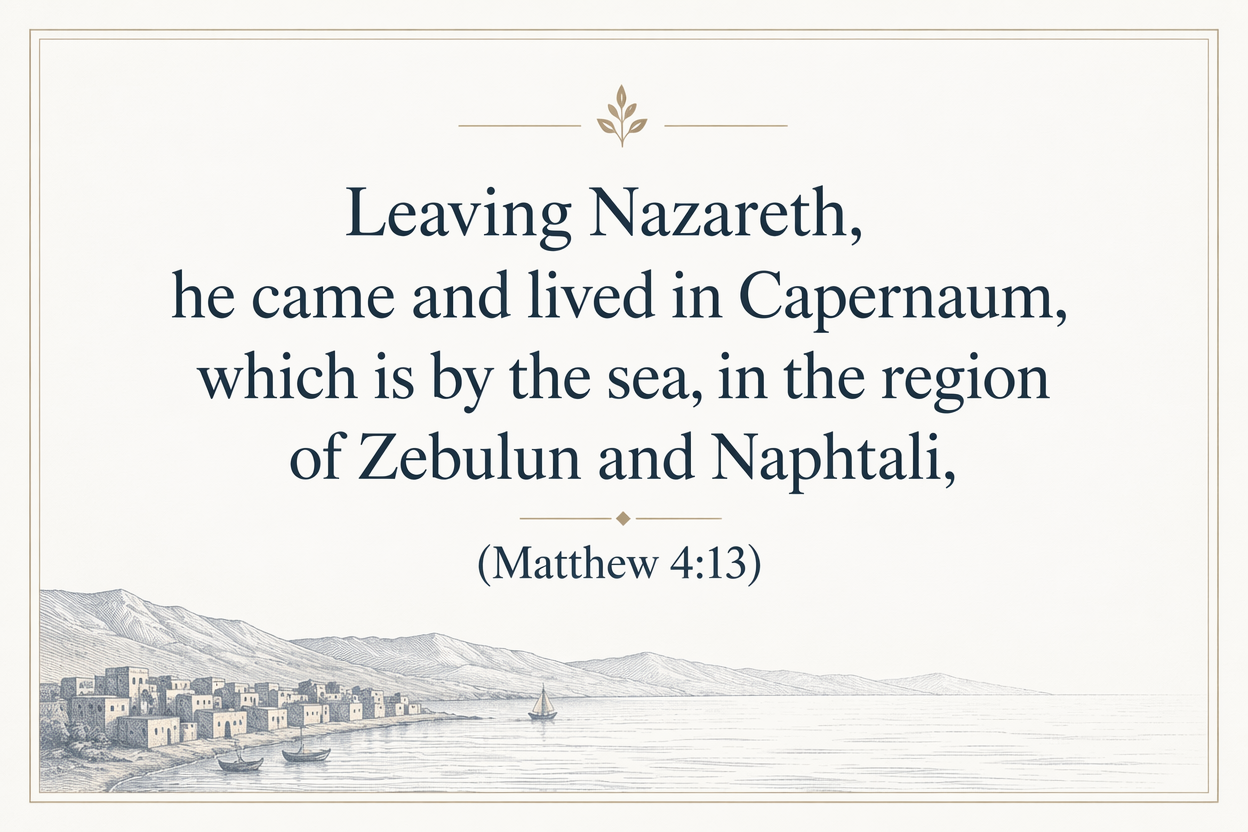
Leaving Nazareth, he came and lived in Capernaum, which is by the sea, in the region of Zebulun and Naphtali, (Matthew 4:13)
Here Νεφθαλείμ helps define where Jesus “came and lived” after leaving Nazareth. The verse names Capernaum, adds the orienting detail “by the sea,” and then further situates the town “in the region of Zebulun and Naphtali.” Within this layered location description, Naphtali functions as a regional label: it places Capernaum inside a recognized area defined by tribal names. The point is not to describe Naphtali itself, but to anchor the move to Capernaum within a mapped landscape that a reader can imagine as more precise than a city name alone.
“The land of Zebulun and the land of Naphtali, toward the sea, beyond the Jordan, Galilee of the Gentiles, (Matthew 4:15)
In this quotation, Νεφθαλείμ appears in a set of phrases that present a territory in carefully bounded terms. The word is paired with “Zebulun” and attached to “land”: “The land of Zebulun and the land of Naphtali.” That doubling (two lands named side-by-side) portrays the area as composed of adjoining or associated portions. The subsequent modifiers—“toward the sea, beyond the Jordan, Galilee of the Gentiles”—continue the work of orientation by direction (“toward the sea”), relative position (“beyond the Jordan”), and regional designation (“Galilee of the Gentiles”). Within that chain, Naphtali supplies a traditional name for a portion of the wider setting being described, contributing to a picture of Galilee that is both geographically and culturally framed in the sentence itself.
of the tribe of Asher twelve thousand, of the tribe of Naphtali twelve thousand, of the tribe of Manasseh twelve thousand, (Revelation 7:6)
In Revelation, Νεφθαλείμ no longer serves as a regional locator but as a tribal identifier in a numbered list. The structure is repetitive and formal: “of the tribe of X twelve thousand,” then the next tribe, then the next. Inserted between Asher and Manasseh, “the tribe of Naphtali” is presented as one unit among others in an ordered catalog. The name functions to distinguish one counted group from neighboring groups named in the same verse. The emphasis falls on identification and enumeration: Naphtali marks which tribe the “twelve thousand” belong to, placing Naphtali within a larger sequence that is organized by tribal names.

Sense and Usage
Across these passages, “Naphtali” works as a proper name that can be applied in two related but distinct ways: as the name attached to a “region” or “land,” and as the name attached to a “tribe.” Matthew uses the name in territorial language (“region,” “land”) to make place descriptions more exact. In Matthew 4:13, the name helps interpret where Capernaum sits: the city’s position is traced by moving from a town name, to a shoreline feature (“by the sea”), to a broader regional designation that uses tribal names. In Matthew 4:15, the name appears within an even more explicit territorial formula—“the land of … and the land of …”—and then is followed by direction and boundary markers that further constrain what “land” is being talked about. In both verses, the name “Naphtali” contributes to the mental map created by the words around it; it is part of the vocabulary that turns narrative movement into movement within an identifiable landscape.
Revelation 7:6 uses “Naphtali” in a genealogical-administrative register rather than a geographic one. The key phrase “of the tribe of Naphtali” signals that the name is functioning as a collective designation for a people-group. The verse’s grammar makes this plain by repeating “of the tribe of …” in a counting scheme. In this setting, the name does not locate a city or describe a land; it marks membership and identity in a list where each named tribe is linked with an equal number (“twelve thousand”). The effect is that “Naphtali” becomes a label for an organized group recognized alongside other tribes.
These uses sit close to each other conceptually: a tribal name naturally carries both people and place associations in the way it can be used in discourse. Matthew’s “region of Zebulun and Naphtali” and “land of … Naphtali” show the name functioning as a territorial marker, while Revelation’s “tribe of Naphtali” shows it functioning as a marker of lineage and corporate identity. The shared feature in all three contexts is referential clarity: the name specifies which region is meant in a geography-rich description and which group is meant in a list of tribes. In both genres—narrative setting (Matthew) and enumerated catalog (Revelation)—the name’s job is to distinguish, to delimit, and to identify within a broader frame of reference already present in the sentence.
Imagery
In Matthew, the imagery surrounding “Naphtali” is shaped by movement and boundaries: leaving one hometown, settling “by the sea,” and situating that settlement within named lands “toward the sea” and “beyond the Jordan.” Naphtali belongs to the vocabulary of that landscape, helping the reader picture a specific portion of Galilee. In Revelation, the imagery shifts from land to ledger: “Naphtali” appears not with seas and rivers but within a structured list where tribes are counted and named, giving the name the feel of an entry in a formal register rather than a point on a map.
Sources: Lexical data from Strong’s Exhaustive Concordance and the Translators Brief Lexicon of Extended Strongs for Greek (STEPBible, CC BY). Occurrence data from the Translators Amalgamated Greek New Testament (STEPBible, CC BY). Scripture quotations from the World English Bible (public domain).