Exploring the Meaning of Nepho in Greek
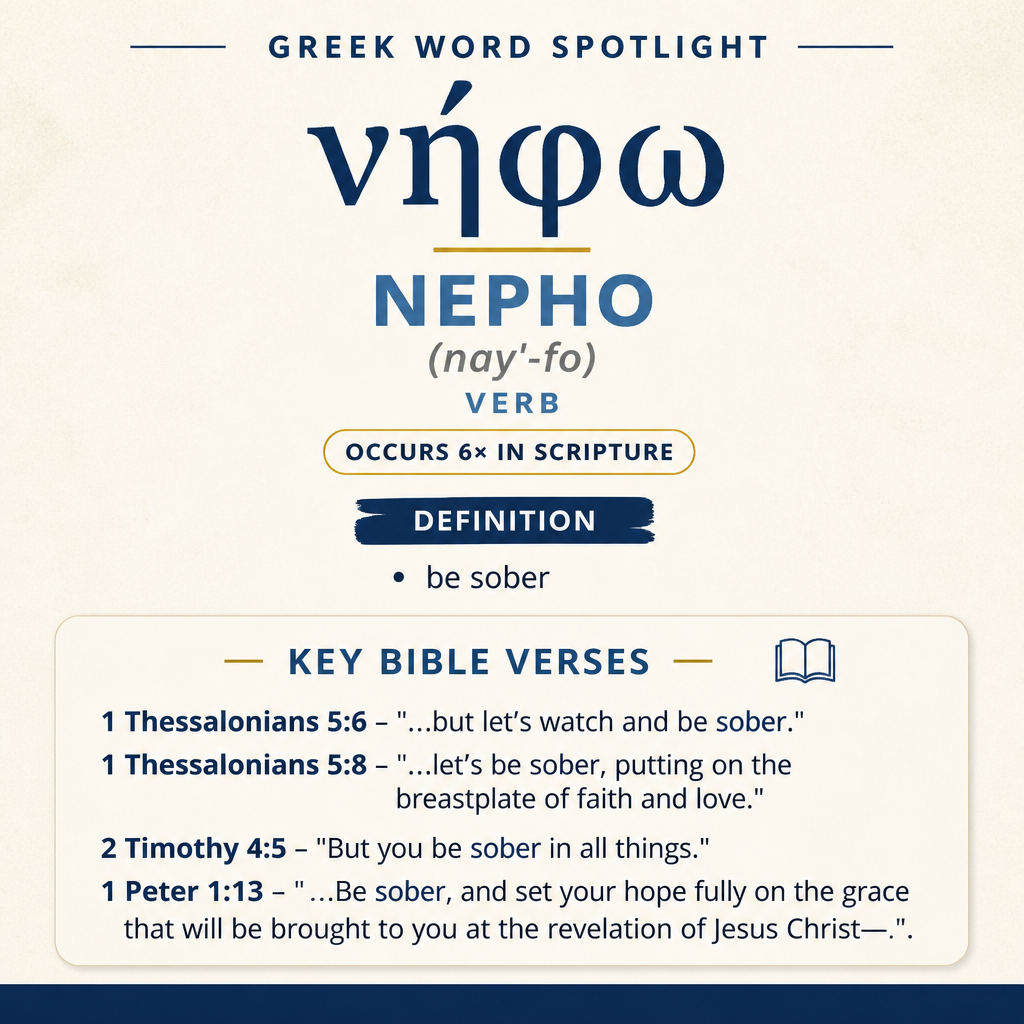
νήφω means “be sober” and occurs 6 times in Scripture: 1 Thessalonians 5:6, 5:8; 2 Timothy 4:5; 1 Peter 1:13, 4:7, 5:8.
Core Meaning
νήφω is defined as “be sober.” In its occurrences, it is given as an imperative call to sobriety.
Learn More →Where It Appears
It appears in 1 Thessalonians 5:6 and 5:8; 2 Timothy 4:5; and 1 Peter 1:13, 4:7, and 5:8. These six references contain the term’s full set of Scripture occurrences provided.
Learn More →How It’s Used
The word is used alongside watchfulness and readiness (1 Thessalonians 5:6; 1 Peter 5:8). It also appears with exhortations to ministry faithfulness and prayer (2 Timothy 4:5; 1 Peter 4:7).
Learn More →νήφω means “be sober,” and it is used as a direct exhortation in passages that call for alert, disciplined readiness. In its six New Testament occurrences, the command appears alongside watching, hope, prayer, ministry endurance, and vigilance against danger.
Occurrences
“so then let’s not sleep, as the rest do, but let’s watch and be sober.” (1 Thessalonians 5:6)
Here νήφω is paired with “watch” and set in contrast to “sleep.” The sentence draws a line between two patterns of life: the unwatchful posture of those who “sleep” and the deliberate posture of those who stay awake to what is happening. “Be sober” functions as a call to a clear, wakeful stance that matches the vigilance of “watch,” so the community’s conduct does not drift into the heedlessness implied by sleep.
“But since we belong to the day, let’s be sober, putting on the breastplate of faith and love, and for a helmet, the hope of salvation.” (1 Thessalonians 5:8)
νήφω again appears as an exhortation, but now it is framed by identity (“we belong to the day”) and by imagery of protective equipment (“breastplate,” “helmet”). “Be sober” stands at the head of a coordinated response: sobriety is expressed through a readiness that “puts on” faith and love and takes up “the hope of salvation” as a helmet. In this verse, sobriety is not isolated self-control; it is the composure and steadiness that fits people who live in the light of day and therefore dress for spiritual steadiness.
“But you be sober in all things, suffer hardship, do the work of an evangelist, and fulfill your ministry.” (2 Timothy 4:5)
In this charge, νήφω is broadened by the phrase “in all things,” placing sobriety over the whole range of situations that accompany ministry. The command is immediately followed by imperatives that describe costly perseverance: “suffer hardship,” “do the work of an evangelist,” and “fulfill your ministry.” Sobriety here contributes the steady-minded posture needed to continue doing the assigned work without being knocked off course by hardship or distraction. The verse presents sobriety as a governing condition for faithful endurance.
“Therefore prepare your minds for action. Be sober, and set your hope fully on the grace that will be brought to you at the revelation of Jesus Christ—” (1 Peter 1:13)
νήφω is tightly linked to mental readiness and hope. The flow moves from preparation (“prepare your minds for action”) to sobriety (“Be sober”) and then to a focused orientation of expectation (“set your hope fully on the grace that will be brought to you”). In this setting, sobriety is the mental clarity that supports concentrated hope; it belongs to a mind made ready for action rather than a mind scattered or dulled. The verse places sobriety at the pivot between preparation and a fully set hope.
“But the end of all things is near. Therefore be of sound mind, self-controlled, and sober in prayer.” (1 Peter 4:7)
Here νήφω appears in a triad of commands (“be of sound mind, self-controlled, and sober”), and its immediate sphere is “in prayer.” The nearness of “the end of all things” supplies the urgency for the exhortation. Within that urgency, sobriety contributes a clear, measured approach to prayer: prayer is to be offered with a steady and undistracted mind, in line with being “of sound mind” and “self-controlled.” The verse sets sobriety as part of a disciplined spiritual posture shaped by the awareness of approaching culmination.
“Be sober and self-controlled. Be watchful. Your adversary, the devil, walks around like a roaring lion, seeking whom he may devour.” (1 Peter 5:8)
In this warning, νήφω is placed at the front of a rapid series of urgent commands: “Be sober and self-controlled. Be watchful.” The reason follows immediately: an active threat (“Your adversary, the devil”) is pictured as a predator “like a roaring lion,” searching for someone to consume. Sobriety here contributes to watchfulness under danger; it is the state of being clear and steady enough to stay alert when a threat is real and immediate. The verse ties sobriety to survival-minded vigilance rather than casual awareness.

Sense and Usage
Across these passages, νήφω (“be sober”) functions as a command for a steady, clear posture that fits moments requiring alertness, focus, and endurance. It regularly appears alongside other verbs and phrases that sharpen its practical force. In 1 Thessalonians 5:6, sobriety is contrasted with “sleep,” marking it as the opposite of the dulled condition that prevents watching. In 1 Thessalonians 5:8, sobriety is the mindset that coheres with belonging “to the day,” and it is expressed through the deliberate act of “putting on” what protects and steadies: “the breastplate of faith and love” and “the hope of salvation” as a helmet.
When applied to personal calling and responsibility, νήφω is presented as comprehensive and durable. “Be sober in all things” (2 Timothy 4:5) treats sobriety as an all-situations readiness that enables hardship-bearing and the completion of assigned work. The surrounding imperatives emphasize that the sober person does not merely avoid impairment; the sober person continues, suffers, works, and fulfills. Sobriety is thus the inner steadiness that keeps a minister oriented to the task when pressure might otherwise shake perseverance.
In 1 Peter, sobriety is repeatedly associated with the life of the mind and the practice of prayer. “Prepare your minds for action. Be sober” (1 Peter 1:13) places sobriety in the realm of mental preparedness; it is a condition that supports decisive, purposeful action rather than drift. The same verse joins sobriety to hope: “set your hope fully” on what is to come. This pairing shows sobriety serving focus—hope is to be set “fully,” not half-held, and sobriety contributes to that undivided orientation.
Similarly, “sober in prayer” (1 Peter 4:7) locates sobriety in the practice of approaching God with a sound and controlled mind. The verse does not treat prayer as spontaneous overflow only; it calls for a measured, clear posture because “the end of all things is near.” The nearness of the end provides a horizon that can either unsettle or stabilize; the command to be sober channels that horizon into disciplined prayer rather than panic or distraction.
Finally, 1 Peter 5:8 frames sobriety as necessary under threat. The command is reinforced by the image of an adversary actively seeking a victim. Sobriety here serves watchfulness: it is the clear-headed state that resists being caught unawares. When set beside “self-controlled” and “watchful,” sobriety carries the idea of an unimpaired attentiveness that refuses to be lulled when danger prowls.
Taken together, these uses show νήφω as a sober-minded readiness appropriate to life lived in awareness—awareness of identity (“we belong to the day”), awareness of future hope (“the grace that will be brought to you”), awareness of urgency (“the end of all things is near”), awareness of hardship (“suffer hardship”), and awareness of opposition (a prowling adversary). The repeated co-texts—watching, putting on protective resources, preparing the mind, praying with soundness, enduring hardship—portray sobriety as the practical clarity that supports faithful action and guardedness.
Imagery
These passages repeatedly place sobriety in scenes of heightened attentiveness: wakefulness rather than sleep (1 Thessalonians 5:6), readiness pictured as armor worn in daylight (1 Thessalonians 5:8), the steady completion of ministry under hardship (2 Timothy 4:5), a mind prepared for action and hope fixed forward (1 Peter 1:13), prayer offered with soundness because the end is near (1 Peter 4:7), and alertness in the face of a predator-like adversary (1 Peter 5:8). The command “be sober” thus carries the feel of a settled, vigilant posture—clear enough to watch, focused enough to hope, and steady enough to endure.
Sources: Lexical data from Strong’s Exhaustive Concordance and the Translators Brief Lexicon of Extended Strongs for Greek (STEPBible, CC BY). Occurrence data from the Translators Amalgamated Greek New Testament (STEPBible, CC BY). Scripture quotations from the World English Bible (public domain).