Exploring the Meaning of Nephros in Greek
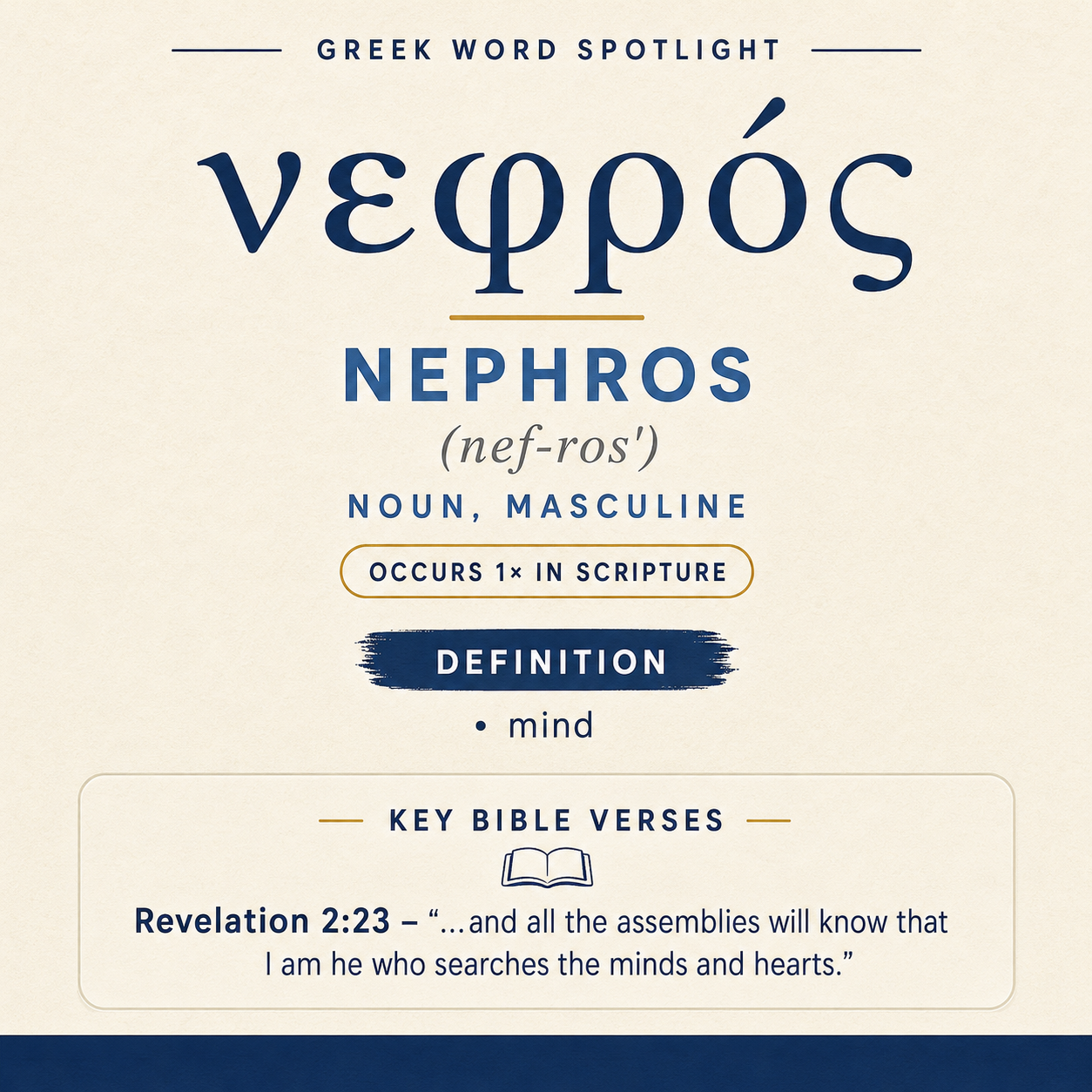
νεφρός (Nephros) means “mind” and appears once in Scripture, in Revelation 2:23.
Verse Context
In Revelation 2:23, it appears in the phrase “searches the minds and hearts.”
Learn More →νεφρός expresses “mind” and appears in a single New Testament context where the risen Christ describes his penetrating knowledge of the inner person. In that scene it is paired with “hearts,” forming a joined picture of what he searches and judges.
Occurrences
“I will kill her children with Death, and all the assemblies will know that I am he who searches the minds and hearts. I will give to each one of you according to your deeds.” (Revelation 2:23)
Here νεφρός stands within a solemn declaration of judgment and public vindication: “all the assemblies will know” the speaker’s identity through what he does. The statement “I am he who searches the minds and hearts” sets the grounds for the following line, “I will give to each one of you according to your deeds.” In this flow of thought, “minds” names an interior domain that the speaker actively “searches,” and that searching is presented as the basis for a just, individualized reckoning. The verse holds together three elements: decisive action (“I will kill…”), universal recognition (“all the assemblies will know…”), and discriminating evaluation (“to each one of you according to your deeds”). Within that frame, “minds” is not a detached faculty but a searched interior reality that makes the judgment intelligible as more than a reaction to outward appearances.

The pairing “minds and hearts” is also rhetorically important. The verse does not isolate one inner aspect as sufficient; rather, it presents two inner loci as the object of searching. That twofold wording strengthens the claim that the speaker’s knowledge reaches into the whole inner person. “Searches” implies thoroughness and intent: the speaker is not merely aware, but investigates. By naming “minds” alongside “hearts,” the verse portrays judgment as grounded in what lies within, even as the outcome is expressed in terms of “deeds.” Thus the mind, as an inner reality, stands in meaningful relation to outward actions without being reduced to them. The verse’s logic is: the one who searches the inner person is qualified to assign recompense that fits the deeds.

Sense and Usage
In Revelation 2:23, “mind” functions as a term for inward life that can be examined. The speaker claims the role of a searcher: one who probes what is not immediately visible to others. The effect is twofold. First, it creates accountability that cannot be avoided by managing appearances; the assemblies’ knowledge of the speaker rests on his demonstrated ability to reach the interior. Second, it frames “deeds” as the outward expression that will be evaluated in light of what the search uncovers. The verse does not present deeds as random events; it places them in a moral economy where the inner person is open to scrutiny and the outer life is recompensed accordingly.
The sense “mind” here is not merely the capacity to think in an abstract sense; it is the inner sphere that can be searched in a judicial setting. The verb “searches” governs both “minds and hearts,” so the mind is one of the targets of this probing. That makes the term strongly relational within the sentence: it is defined by being the object of the search. It is also strongly ethical within the verse’s argument: what is searched belongs to the arena in which judgment is rooted. The verse places this searching activity within the self-revelation of the speaker (“I am he who…”), making the search of minds a distinctive mark of who he is as he addresses the assemblies.
Because the verse joins “minds” with “hearts,” the meaning of mind is shaded by this companionship. The two are coordinated as parallel objects, suggesting that the inner person is not one-dimensional. “Mind” contributes a specific angle within that interior pair: the verse’s phrasing implies that the searching extends to the mental interior as well as to what “hearts” represents in the same line. In other words, the claim is comprehensive, reaching the interior where intention and inner disposition reside, and not stopping at what can be measured externally.
The final sentence, “I will give to each one of you according to your deeds,” provides the practical outcome of the searching. The mind, as an inner reality, stands behind a principle of individualized judgment (“to each one of you”), not merely collective assessment. The searching of minds supports that individualization: it is a basis for distinguishing one person from another beyond general reputations or group identities. The verse therefore presents the mind as part of what makes moral evaluation personal and exact.
Imagery
The imagery attached to νεφρός in this verse is investigative and judicial: a searching that reaches inward and a giving that matches deeds. The assemblies are depicted as learning who the speaker is through the visibility of his judgment, but the judgment itself is rooted in what he searches within. “Minds and hearts” thus function as the hidden field brought under scrutiny, so that recompense is portrayed as informed, deliberate, and fitted to each person’s works.
Sources: Lexical data from Strong’s Exhaustive Concordance and the Translators Brief Lexicon of Extended Strongs for Greek (STEPBible, CC BY). Occurrence data from the Translators Amalgamated Greek New Testament (STEPBible, CC BY). Scripture quotations from the World English Bible (public domain).