Exploring the Meaning of Nephele in Greek
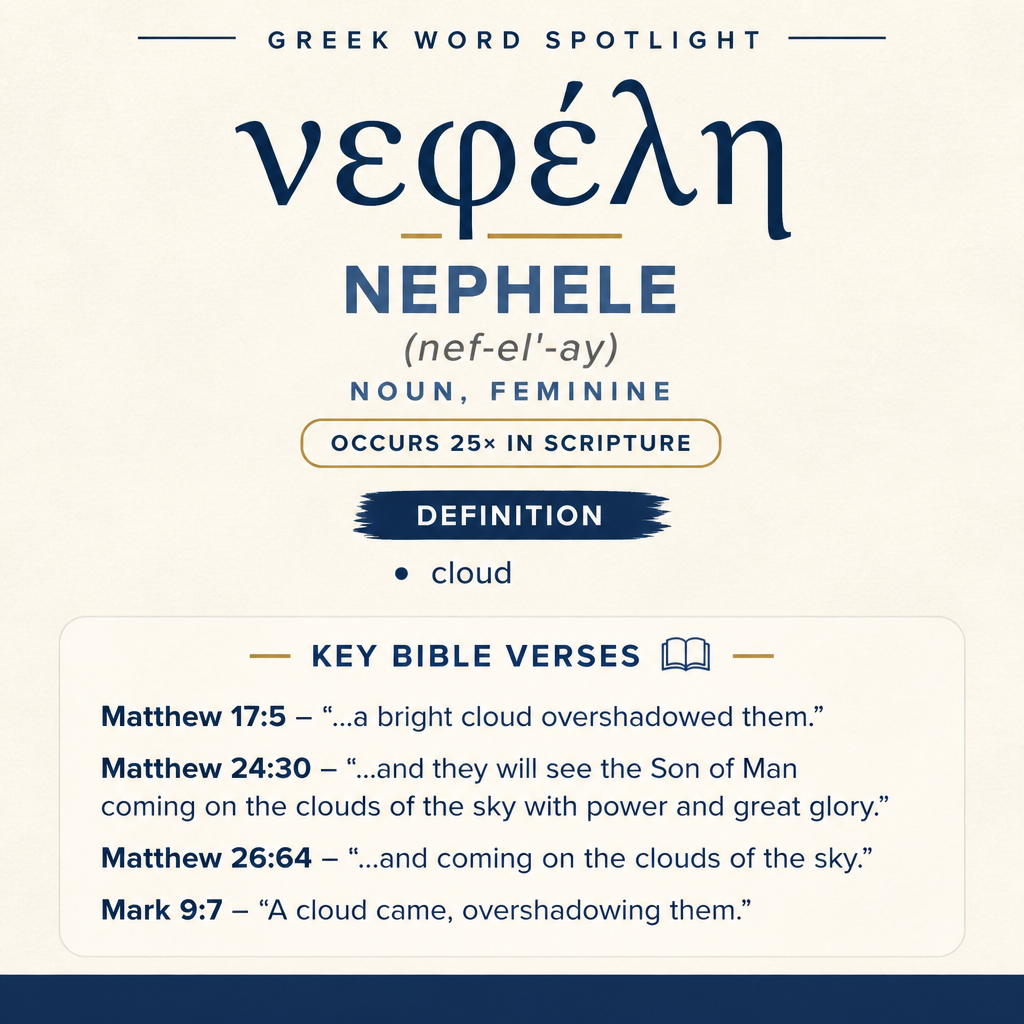
νεφέλη (Nephele) means “cloud” in Greek and occurs 25 times in Scripture, including in Matthew, Mark, and Luke.
Gospel Scenes
In Matthew 17:5, Mark 9:7, and Luke 9:34–35, a cloud overshadows, and a voice comes out of the cloud.
Learn More →Coming in Clouds
Matthew 24:30, Mark 13:26, and Mark 14:62 describe the Son of Man coming with the clouds.
Learn More →νεφέλη refers to a cloud. In the passages quoted here it appears in scenes of divine revelation, coming judgment and glory, ordinary weather observation, the ascension of Jesus, and Israel’s wilderness memory.
Occurrences
Matthew 17:5 — “While he was still speaking, behold, a bright cloud overshadowed them. Behold, a voice came out of the cloud, saying, “This is my beloved Son, in whom I am well pleased. Listen to him.””
Here the cloud is described as “bright” and it “overshadowed them,” marking an enveloping presence rather than a distant feature of the sky. The voice is located spatially—“out of the cloud”—so νεφέλη functions as the immediate setting from which the divine speech issues and by which the moment is framed.
Matthew 24:30 — “and then the sign of the Son of Man will appear in the sky. Then all the tribes of the earth will mourn, and they will see the Son of Man coming on the clouds of the sky with power and great glory.”
In this saying the clouds are part of what is publicly visible “in the sky.” νεφέλη helps picture the Son of Man’s coming as a heavenly event: he is seen “coming on the clouds of the sky,” and the cloud setting matches the scale of “power and great glory” witnessed by “all the tribes of the earth.”
Matthew 26:64 — “Jesus said to him, “You have said it. Nevertheless, I tell you, after this you will see the Son of Man sitting at the right hand of Power, and coming on the clouds of the sky.””
Here νεφέλη again belongs to the portrayal of the Son of Man’s future appearance: “coming on the clouds of the sky.” In this context it is part of what the hearers are told they “will see,” so the cloud language supports the claim’s visibility and grandeur within Jesus’ declaration.
Mark 9:7 — “A cloud came, overshadowing them, and a voice came out of the cloud, “This is my beloved Son. Listen to him.””
The cloud “came” and “overshadowed them,” so νεφέλη is dynamic and near, not merely atmospheric background. As in Matthew’s parallel, the cloud is the medium from which the voice speaks—“out of the cloud”—linking the overshadowing presence with the authoritative proclamation.
Mark 13:26 — “Then they will see the Son of Man coming in clouds with great power and glory.”
Clouds here belong to an eschatological vision that is seen by others: “they will see.” νεφέλη contributes to the depiction of the Son of Man’s arrival “with great power and glory,” where the plural “clouds” suggests a sky-filled setting matching the magnitude of the event.
Mark 14:62 — “Jesus said, “I am. You will see the Son of Man sitting at the right hand of Power, and coming with the clouds of the sky.””
The cloud imagery stands alongside exalted seating—“sitting at the right hand of Power”—and future coming. νεφέλη frames that coming as a heavenly manifestation: “coming with the clouds of the sky,” language meant to be seen and remembered by the audience addressed.
Luke 9:34 — “While he said these things, a cloud came and overshadowed them, and they were afraid as they entered into the cloud.”
Luke emphasizes the cloud’s physical nearness: it “came,” it “overshadowed them,” and they “entered into the cloud.” νεφέλη is therefore not only overhead but enveloping, prompting fear at the moment of entry; it marks a boundary the disciples cross as the scene intensifies.
Luke 9:35 — “A voice came out of the cloud, saying, “This is my beloved Son. Listen to him!””
The cloud is the immediate source-location of the voice—“out of the cloud.” νεφέλη contributes to the portrayal of a concealed-yet-audible presence: the voice is heard, and the cloud is the spatial marker that situates the voice within the transfiguration scene.
Luke 12:54 — “He said to the multitudes also, “When you see a cloud rising from the west, immediately you say, ‘A shower is coming,’ and so it happens.””
In this everyday observation, νεφέλη is a visible weather sign: “When you see a cloud rising from the west.” The cloud’s movement (“rising”) and direction (“from the west”) make it an interpretable feature of ordinary experience, associated with the expectation of rain—“‘A shower is coming,’ and so it happens.”
Luke 21:27 — “Then they will see the Son of Man coming in a cloud with power and great glory.”
Luke presents a concentrated image: not “clouds” but “a cloud.” νεφέλη here is singular and closely attached to the coming itself—“coming in a cloud”—again paired with “power and great glory” and described as something that “they will see.”
Acts 1:9 — “When he had said these things, as they were looking, he was taken up, and a cloud received him out of their sight.”
At the ascension, the cloud is not merely a backdrop but an agent-like feature in the narration: “a cloud received him out of their sight.” νεφέλη marks the transition from visibility to hiddenness; the disciples are “looking,” yet the cloud becomes the means by which Jesus is removed from their view.
1 Corinthians 10:1 — “Now I would not have you ignorant, brothers, that our fathers were all under the cloud, and all passed through the sea;”
Paul invokes Israel’s story with a shared, collective setting: “our fathers were all under the cloud.” Here νεφέλη is a covering presence over the whole community, coordinated with another defining experience—“all passed through the sea”—so the cloud becomes part of a corporate memory that shapes Paul’s admonition.

Sense and Usage
Across these passages νεφέλη retains its concrete reference to a cloud, but the writers use that concreteness in several distinct ways. In the transfiguration accounts (Matthew 17:5; Mark 9:7; Luke 9:34–35), the cloud is close enough to “overshadow” and even to be “entered,” so it functions as an enclosing environment that signals a heightened moment. The repeated detail that “a voice came out of the cloud” anchors the revelation in a tangible phenomenon: the cloud is where the voice is heard from, and it shapes how the scene is experienced—enveloping, authoritative, and, in Luke, fear-inducing.
In the eschatological sayings (Matthew 24:30; 26:64; Mark 13:26; 14:62; Luke 21:27), clouds belong to the sky and to public sight: “they will see.” The cloud imagery places the Son of Man’s coming in the heavenly realm (“of the sky”) and supports the portrayal of manifest “power and great glory.” Matthew and Mark often present “clouds” in the plural, filling the sky as the platform of appearance, while Luke 21:27 compresses the imagery to “a cloud,” keeping the same visible grandeur but with a singular focus.
Luke 12:54 shows νεφέλη in the most ordinary register: a cloud as a recognizable meteorological indicator. The crowd’s immediate inference—“‘A shower is coming,’ and so it happens”—depends on the cloud’s visibility and movement. This use demonstrates that νεφέλη can be simply an observable part of the natural world, without any explicit connection to revelatory speech or eschatological spectacle.
Acts 1:9 uses the cloud as the narrative hinge between presence and absence. The disciples’ gaze is emphasized (“as they were looking”), and the cloud’s action—“received him out of their sight”—makes the cloud the means by which sight is interrupted. The word thereby serves the account’s practical need: to describe how Jesus is taken up and why he is no longer visible.
In 1 Corinthians 10:1, the cloud is a communal canopy—“all under the cloud”—which, alongside “all passed through the sea,” evokes a shared experience encompassing an entire people. The cloud is presented as a defining circumstance under which the community moved, allowing Paul to connect his readers (“brothers”) to “our fathers” through a remembered environment.
Imagery
These texts repeatedly connect the cloud with the limits and possibilities of human sight. In the transfiguration, people are overshadowed and even enter the cloud, yet they hear a voice “out of the cloud” (Matthew 17:5; Mark 9:7; Luke 9:34–35). In the ascension, the cloud ends what the disciples can see: it “received him out of their sight” (Acts 1:9). And in the future-oriented sayings, clouds belong to what the world will see in the sky when the Son of Man comes “with power and great glory” (Matthew 24:30; Mark 13:26; Luke 21:27). Even the everyday cloud “rising from the west” functions by being seen and interpreted (Luke 12:54), keeping the image grounded in visibility, nearness, and the sky’s changing scene.
Sources: Lexical data from Strong’s Exhaustive Concordance and the Translators Brief Lexicon of Extended Strongs for Greek (STEPBible, CC BY). Occurrence data from the Translators Amalgamated Greek New Testament (STEPBible, CC BY). Scripture quotations from the World English Bible (public domain).