
Exploring the Meaning of Akrobustia in Greek
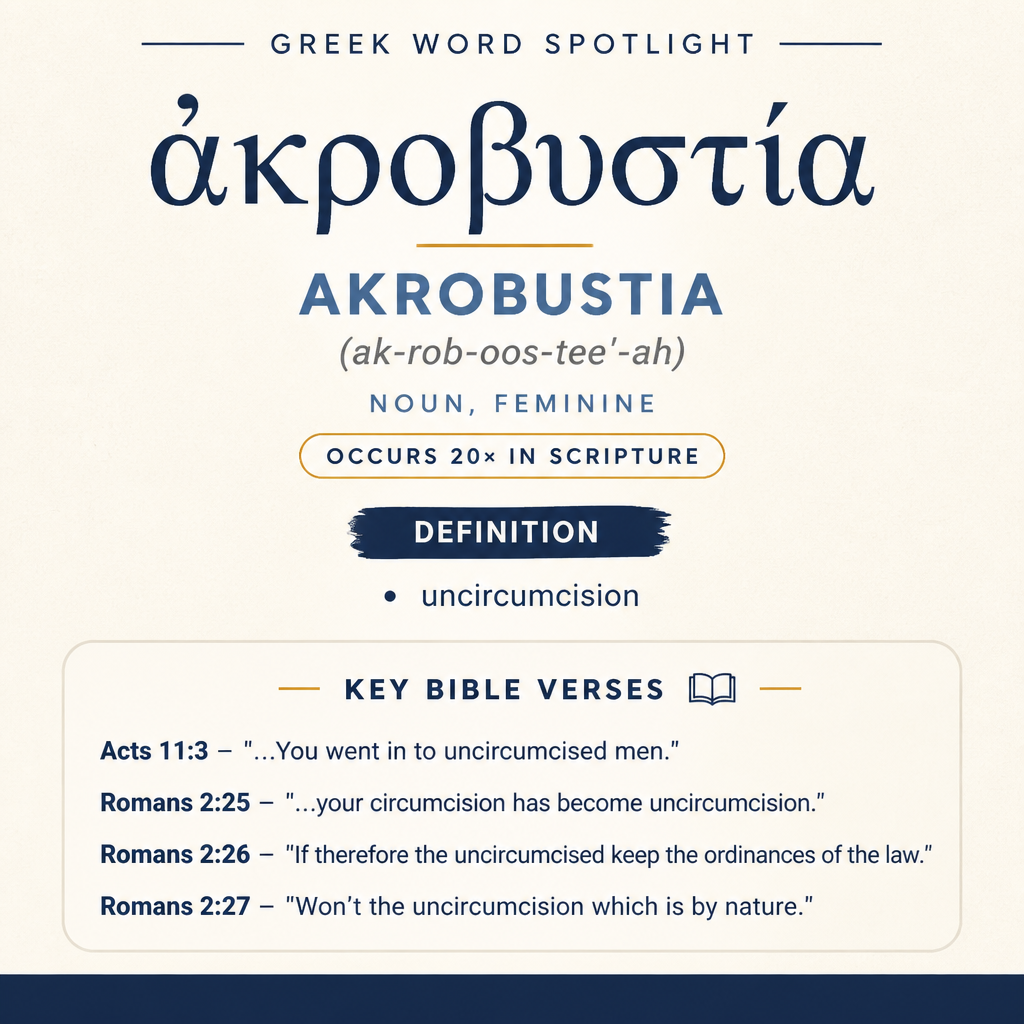
ἀκροβυστία means “uncircumcision” and occurs 20 times in Scripture, including Acts 11:3 and multiple uses in Romans 2–4.
Core Meaning
ἀκροβυστία is the Greek word defined as “uncircumcision.” It appears in contexts contrasting circumcision and uncircumcision.
Learn More →Acts Usage
In Acts 11:3 it is used in the complaint, “You went in to uncircumcised men, and ate with them!” This usage identifies the men as uncircumcised.
Learn More →Romans Usage
Romans 2:25–27 and Romans 3:30–4:11 repeatedly use ἀκροβυστία alongside “circumcision.” These passages speak of God justifying the circumcised by faith and the uncircumcised through faith.
Learn More →ἀκροβυστία means “uncircumcision,” and in the New Testament it appears in narratives about table fellowship as well as extended arguments about law, faith, and covenant identity. The term functions as a concrete bodily designation that also marks social and religious boundaries in the scenes where it is used.
Occurrences
Acts 11:3: saying, “You went in to uncircumcised men, and ate with them!”
Here ἀκροβυστία identifies the status of the men whose company is being criticized. The complaint is not simply that contact occurred, but that intimate association did: “You went in… and ate with them!” The word supplies the boundary being crossed and explains why the shared meal is treated as contentious.

Romans 2:25: For circumcision indeed profits, if you are a doer of the law, but if you are a transgressor of the law, your circumcision has become uncircumcision.
In this sentence ἀκροβυστία is used as the opposite pole against which “circumcision” is measured. The striking contribution is that “your circumcision has become uncircumcision”: the term is used to describe a condition that can be reached by conduct (“if you are a transgressor of the law”), not only by physical status. The word thus serves Paul’s argument that law-breaking undermines what circumcision is supposed to “profit.”
Romans 2:26: If therefore the uncircumcised keep the ordinances of the law, won’t his uncircumcision be accounted as circumcision?
ἀκροβυστία is paired with a legal and evaluative framework: “keep the ordinances of the law” and “be accounted.” The word marks the person’s starting point (“the uncircumcised”), while the question proposes a reversal in reckoning: “his uncircumcision” could be treated “as circumcision.” The term contributes the category that is being re-evaluated in light of obedience.
Romans 2:27: Won’t the uncircumcision which is by nature, if it fulfills the law, judge you, who with the letter and circumcision are a transgressor of the law?
Here ἀκροβυστία is specified as “by nature,” locating the term in one’s given condition rather than a change one might undergo. Yet this “uncircumcision… if it fulfills the law” becomes an agent in the argument: it will “judge you” who possess “the letter and circumcision” but are “a transgressor of the law.” The word therefore helps frame an ironic courtroom-like contrast between status and behavior.
Romans 3:30: since indeed there is one God who will justify the circumcised by faith, and the uncircumcised through faith.
ἀκροβυστία appears in a balanced pair: “the circumcised” and “the uncircumcised.” The term is essential to the universal scope of the claim: “there is one God” who “will justify” both categories, with faith as the stated means (“by faith… through faith”). The word contributes the inclusive second group, making clear that justification is not restricted to one marked community.
Romans 4:9: Is this blessing then pronounced on the circumcised, or on the uncircumcised also? For we say that faith was accounted to Abraham for righteousness.
In this rhetorical question ἀκροβυστία stands as the alternative audience for “this blessing.” The verse links the category to a discussion of how faith is “accounted… for righteousness,” preparing for a timing question about Abraham’s state. The word helps define the debate: whether a blessing tied to righteousness reaches beyond the circumcised.
Romans 4:10: How then was it counted? When he was in circumcision, or in uncircumcision? Not in circumcision, but in uncircumcision.
ἀκροβυστία is used to locate a decisive moment: “When he was in… uncircumcision?” The answer is explicit and emphatic: “Not in circumcision, but in uncircumcision.” The term contributes the temporal setting in which “it was counted,” anchoring the argument in the sequence implied by “when.”
Romans 4:11: He received the sign of circumcision, a seal of the righteousness of the faith which he had while he was in uncircumcision, that he might be the father of all those who believe, though they might be in uncircumcision, that righteousness might also be accounted to them.
Here ἀκροβυστία appears twice and structures the sentence. First, it marks Abraham’s prior condition: he had “faith… while he was in uncircumcision.” Second, it marks the condition of those included among his “all those who believe,” described as believing “though they might be in uncircumcision.” The word thus supports a line of reasoning in which circumcision is described as a “sign” and “seal,” but the credited “righteousness” is connected to faith present in uncircumcision and extendable to others in the same condition.
Romans 4:12: He is the father of circumcision to those who not only are of the circumcision, but who also walk in the steps of that faith of our father Abraham, which he had in uncircumcision.
Although the verse foregrounds “the father of circumcision,” ἀκροβυστία is crucial in the closing clause: Abraham’s faith is the faith “which he had in uncircumcision.” The term contributes the setting that defines what kind of faith is in view—faith that exists prior to circumcision—and therefore becomes the pattern for those who “walk in the steps” of that faith.
1 Corinthians 7:18: Was anyone called having been circumcised? Let him not become uncircumcised. Has anyone been called in uncircumcision? Let him not be circumcised.
In this pastoral instruction ἀκροβυστία is treated as a condition in which one might be “called.” The paired commands (“Let him not become uncircumcised… Let him not be circumcised”) place uncircumcision alongside circumcision as statuses not to be exchanged for the sake of one’s calling. The word contributes to the symmetry of the counsel and to the emphasis on remaining as one was when called.
1 Corinthians 7:19: Circumcision is nothing, and uncircumcision is nothing, but the keeping of the commandments of God.
Here ἀκροβυστία is declared “nothing” in the sense that it does not carry decisive weight alongside what does: “the keeping of the commandments of God.” The term functions as one half of a deliberate leveling statement, reducing the significance of both physical identity-markers in comparison with obedience.
Galatians 2:7: but to the contrary, when they saw that I had been entrusted with the Good News for the uncircumcised, even as Peter with the Good News for the circumcised—
In this account of recognized spheres of ministry, ἀκροβυστία identifies the audience for whom Paul has been “entrusted with the Good News.” The word marks a distinct people-group (“the uncircumcised”) alongside “the circumcised,” and it helps explain the division of labor implied by the comparison with Peter.

Sense and Usage
Across these passages ἀκροβυστία consistently names the state of being uncircumcised, but the word’s force shifts with genre and argument. In Acts 11:3 it operates as a boundary-term in a social setting: it explains the offense taken at entering a home and sharing food. The term is not used as an abstract label there; it points to a concrete identity-marker that regulates association.
In Romans 2–4 the term becomes a central component in tightly reasoned contrasts. Romans 2:25–27 uses ἀκροβυστία to challenge easy equations between outward status and covenant fidelity: uncircumcision can be “accounted as circumcision” (2:26), and “uncircumcision which is by nature” can “judge” one who has “the letter and circumcision” yet breaks the law (2:27). The word therefore supports a moral argument by allowing Paul to speak about counting, accountability, and judgment while still using the concrete category that readers recognize.
Romans 3:30 and 4:9–12 press the term into a larger claim about how righteousness and blessing relate to faith. ἀκροβυστία is the category that must be explicitly included if justification is to match the confession that “there is one God” (3:30). Then Romans 4 ties the term to chronology—what Abraham was “in” when faith was counted—so that uncircumcision becomes the crucial setting for explaining how believing people in uncircumcision can be encompassed as Abraham’s offspring in faith (4:10–11). In that argument, ἀκροβυστία is not merely a demographic label; it is part of the logic that connects “sign,” “seal,” and the accounting of righteousness.
In 1 Corinthians 7:18–19, ἀκροβυστία belongs to practical instruction for a mixed community. The word is treated as a stable social-religious status that some believers already inhabit at their calling. Yet its importance is explicitly relativized: uncircumcision is “nothing” when weighed against “the keeping of the commandments of God.” This does not make the word meaningless; rather, it shows how the category can be acknowledged without being made the decisive measure of fidelity or belonging.
Galatians 2:7 uses ἀκροβυστία in a vocational and missional frame. The term marks the group for whom Paul’s entrusted commission is recognized, set parallel to Peter’s commission among the circumcised. Here the word’s value is classificatory: it names the audience whose identity shapes how ministry is distributed and understood.
Imagery
The imagery attached to ἀκροβυστία in these texts often clusters around boundaries and reckonings. Acts 11:3 presents the boundary as a doorway and a table—going in and eating. Romans adds the imagery of accounting (“be accounted,” “was it counted,” “faith was accounted… for righteousness”) and judging (“judge you”), so that uncircumcision stands in scenes of evaluation rather than mere description. In 1 Corinthians 7:18–19, the word sits in the everyday scene of one’s life situation at the time of being “called,” while Galatians 2:7 places it in the public recognition of entrusted responsibility for announcing “the Good News.”
Sources: Lexical data from Strong’s Exhaustive Concordance and the Translators Brief Lexicon of Extended Strongs for Greek (STEPBible, CC BY). Occurrence data from the Translators Amalgamated Greek New Testament (STEPBible, CC BY). Scripture quotations from the World English Bible (public domain).





