
Understanding the Meaning of Akron in Greek
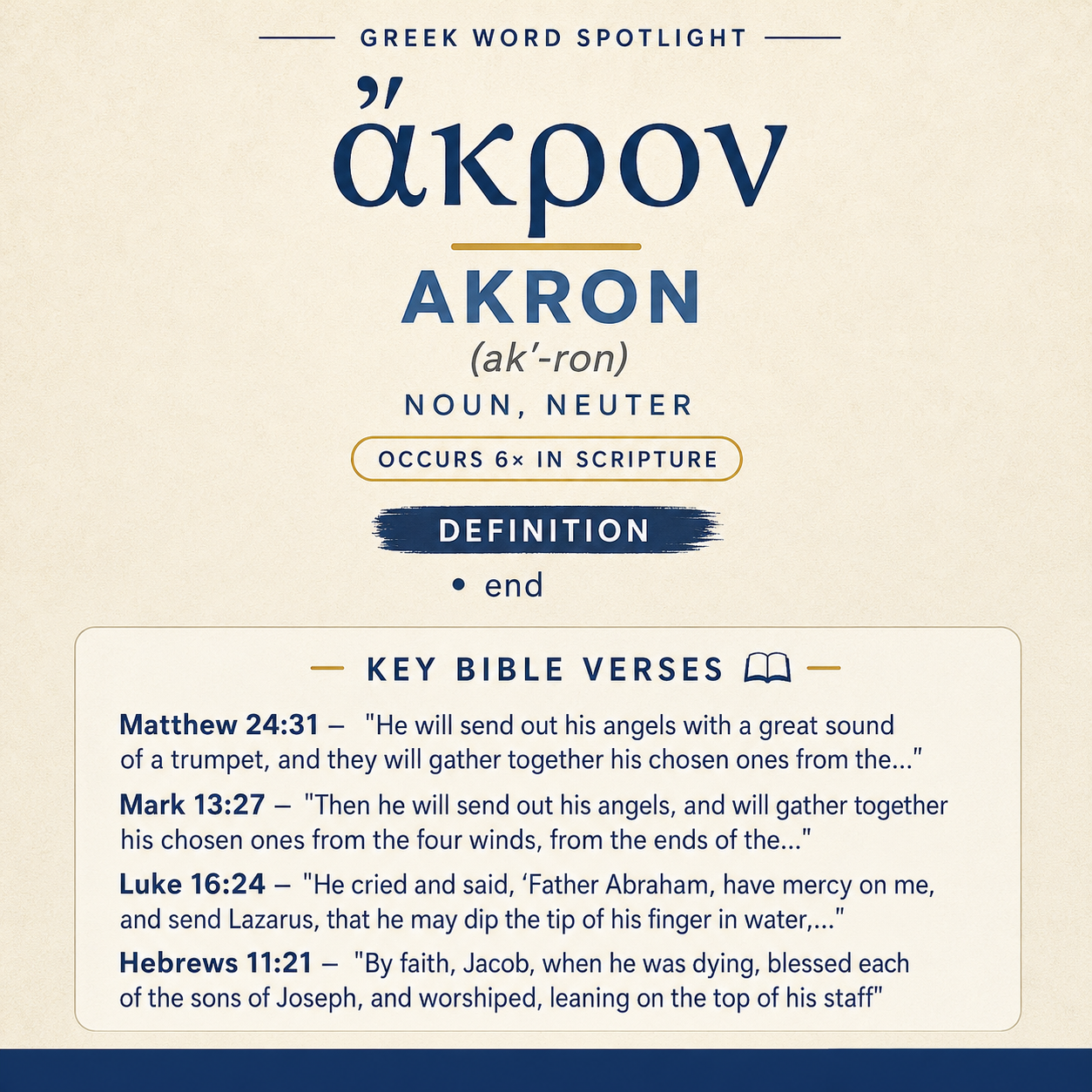
ἄκρον means “end” and occurs 6 times in Scripture, including Matthew 24:31, Mark 13:27, Luke 16:24, and Hebrews 11:21.
Gospel Contexts
In Matthew 24:31 and Mark 13:27, it appears in scenes of angels gathering the chosen from the four winds.
Learn More →Other Uses
In Luke 16:24 it refers to the “tip” of a finger; in Hebrews 11:21 it refers to the “top” of a staff.
Learn More →ἄκρον speaks of an “end,” and in the New Testament it serves to mark extremities—whether of the sky, the earth, or a body part and an object. The passages where it appears use it to express reach, boundary, and the farthest point relevant to the scene.
Root and Related Words
ἄκρον is related to the word akmen (ἀκμήν), glossed “still.”

Occurrences
Matthew 24:31 — “He will send out his angels with a great sound of a trumpet, and they will gather together his chosen ones from the four winds, from one end of the sky to the other.”
Here ἄκρον frames the sky as having a definable extremity: “from one end of the sky to the other.” The line does not focus on a location within the sky but on its outermost span, using “end” language to express total range. Within the sentence, that range supports the idea of a complete gathering: the angels’ action is described as reaching from one extreme boundary to the opposite extreme, leaving no region within the “sky” outside the sweep.

Mark 13:27 — “Then he will send out his angels, and will gather together his chosen ones from the four winds, from the ends of the earth to the ends of the sky.”
Mark pairs two domains—“earth” and “sky”—and places ἄκρον at the outer edges of each: “from the ends of the earth to the ends of the sky.” The plural “ends” multiplies the sense of extremity: there are many boundary points, not a single edge, and the gathering spans them. In the immediate context of “the four winds,” the word reinforces the idea of comprehensive reach in every direction, extending the description from directional breadth (“four winds”) to boundary breadth (“ends”).
Luke 16:24 — “He cried and said, ‘Father Abraham, have mercy on me, and send Lazarus, that he may dip the tip of his finger in water, and cool my tongue! For I am in anguish in this flame.’”
In this plea, ἄκρον shifts from cosmic scope to minute distance: “the tip of his finger.” The “end” here is not an edge of the world but the furthest point of a finger—the smallest extremity capable of holding “water.” The request depends on that extremity: even a tiny amount of water carried at the fingertip would be enough, in the speaker’s words, to “cool my tongue.” The word therefore helps convey both precision and minimality: not a handful, but the smallest end-point touch.
Hebrews 11:21 — “By faith, Jacob, when he was dying, blessed each of the sons of Joseph, and worshiped, leaning on the top of his staff.”
Here ἄκρον marks the staff’s “top,” the end opposite the base. The verse portrays Jacob at the close of life—“when he was dying”—and his posture is described with attention to what he leans on: not merely a staff in general, but its upper extremity. The scene’s physical detail (leaning on the top) gives a concrete point of contact for the act of worship described, tying the bodily stance to a specific end-point of an object.
Sense and Usage
Across these passages, ἄκρον functions as boundary language: it points to where something reaches its limit, whether that “something” is vast (the sky and the earth) or small (a finger, a staff). In Matthew and Mark, “end(s)” expands the scale of the gathering by locating it at the furthest reach of the described realms. The word helps express a movement that is not partial or localized but spans extremes—“from one end … to the other” and “from the ends … to the ends.”
Luke and Hebrews show the same boundary idea applied to tangible objects and body parts. “The tip of his finger” uses “end” to identify the smallest, most distant point of the finger, narrowing attention to what could be dipped and transferred. “The top of his staff” uses “end” to pinpoint a particular extremity as the point of support for leaning. In these two scenes, the word does not primarily amplify scale; instead it increases specificity, highlighting exactly where an action occurs (dipping at the fingertip; leaning at the staff’s top).
Taken together, the uses illustrate how “end” can serve two complementary discourse purposes: (1) delimiting the farthest span of a realm to convey full extent (sky/earth), and (2) identifying an extremity of an item to convey exact point of contact or action (finger/staff). The same basic notion—an end-point—adapts naturally to both, allowing a writer to either widen the horizon or sharpen the detail without shifting away from the central idea of an extremity.
Imagery
The word’s imagery ranges from the widest bounds of creation—“one end of the sky to the other” (Matthew 24:31) and “the ends of the earth … the ends of the sky” (Mark 13:27)—to the most minimal end-point: “the tip of his finger” (Luke 16:24). Hebrews 11:21 places that same idea into a quiet domestic object, “the top of his staff,” showing how “end” language can anchor both grand movement and intimate posture in a single, concrete point.
Sources: Lexical data from Strong’s Exhaustive Concordance and the Translators Brief Lexicon of Extended Strongs for Greek (STEPBible, CC BY). Occurrence data from the Translators Amalgamated Greek New Testament (STEPBible, CC BY). Scripture quotations from the World English Bible (public domain).





