Exploring the Meaning of Akrothinion in Greek
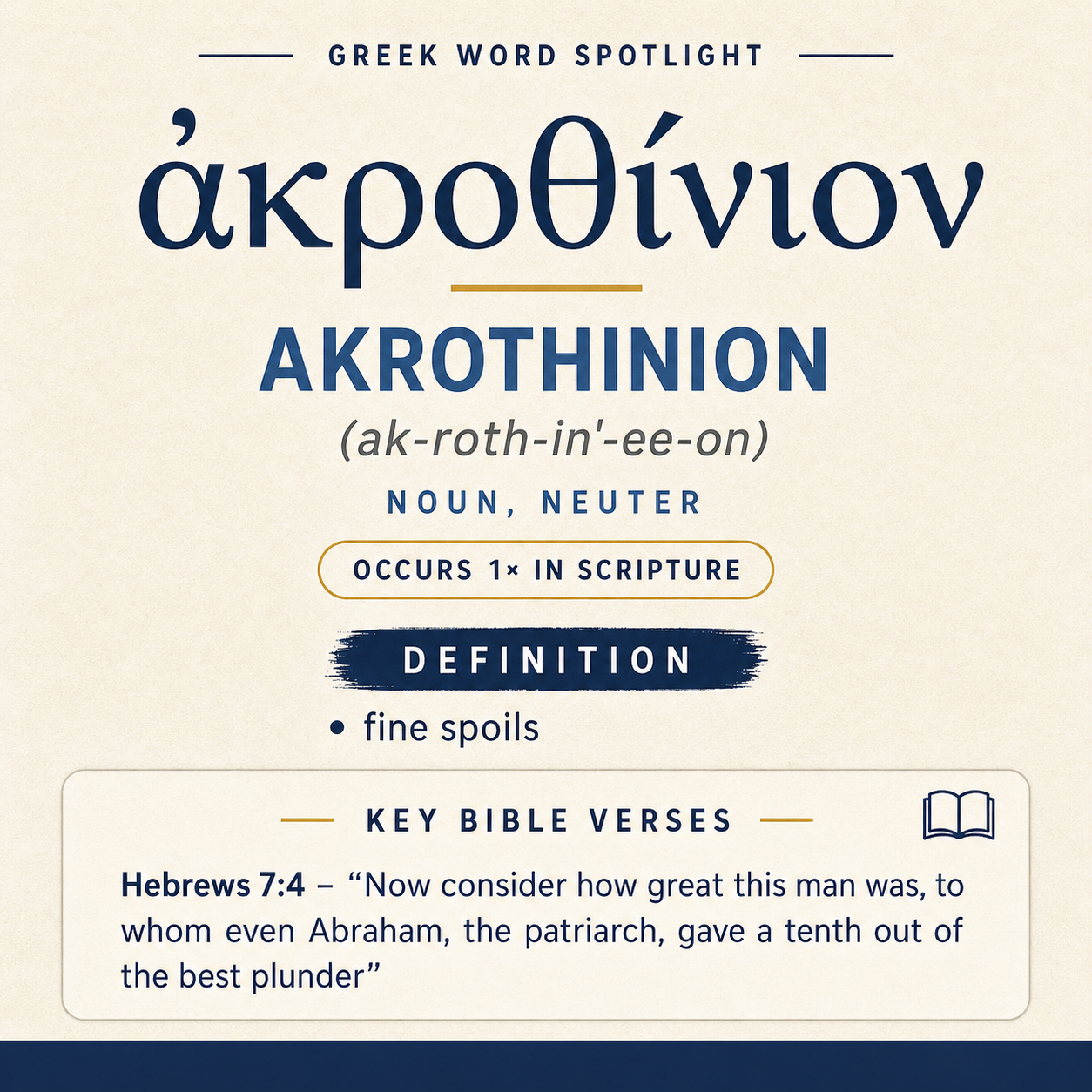
ἀκροθίνιον means “fine spoils” and appears once in Scripture, in Hebrews 7:4.
Core Meaning
ἀκροθίνιον refers to “fine spoils,” the best plunder taken from victory.
Learn More →Biblical Usage
It occurs only in Hebrews 7:4, describing the best plunder from which Abraham gave a tenth.
Learn More →Verse Context
Hebrews 7:4 highlights Abraham’s giving a tenth out of the best plunder to emphasize the greatness of the recipient.
Learn More →ἀκροθίνιον means “fine spoils.” It appears once in the New Testament, in Hebrews 7:4, where it describes what Abraham gave as a tenth in connection with “the best plunder.”
Root and Related Words
Akrothinion derives from the word akron (ἄκρον), meaning “end” (Strong’s G206). In Hebrews 7:4, that relationship is felt in the way the term points to a selected portion taken from plunder rather than plunder in general.

Occurrences
“Now consider how great this man was, to whom even Abraham, the patriarch, gave a tenth out of the best plunder.” (Hebrews 7:4)
Here akrothinion stands behind the idea of “the best plunder,” framing Abraham’s tithe as coming from spoils that are not merely ordinary possessions but the choicest gain from a victory. The sentence is built to highlight the stature of “this man”: the writer calls the reader to “consider how great this man was,” and then supports that claim with a striking measure of Abraham’s action. Abraham is identified by honorific weight—“Abraham, the patriarch”—and yet he is portrayed as giving, and giving specifically “a tenth,” and doing so “out of the best plunder.” The word therefore carries rhetorical force: it helps the verse argue greatness by showing that a revered ancestor offered a significant portion drawn from the most desirable spoils.

The immediate context inside the verse also clarifies the kind of giving in view. Abraham’s gift is not described as coming from his settled wealth or ordinary income, but from “plunder,” a term associated with what is taken in the course of conflict. Akrothinion sharpens that picture: the tenth is reckoned from the “best” portion, emphasizing both the quality of what was given and the honor implied in giving it. The verse does not linger on the mechanics of selection, but the wording makes the gift sound deliberate—Abraham’s tenth comes from a recognized category within the spoils, a portion singled out as superior.
Within this single sentence, the choice of akrothinion also helps distinguish two layers of value: the plunder as a whole, and the “best plunder” as a concentrated subset. By using a term that the English renders with “best,” the verse makes the comparison between Abraham and “this man” more pointed: the patriarch’s act is impressive not only because he gave, but because what he gave was drawn from the finest part of what he had obtained.
Sense and Usage
As “fine spoils,” akrothinion refers to spoils considered choice in quality. In Hebrews 7:4, this sense is not abstract; it is anchored in an evaluative phrase (“the best plunder”) that signals selection and distinction within what has been taken. The word thereby expresses more than the bare fact of spoils: it marks them as superior spoils, goods worth setting apart as a premium portion.
The verse’s logic depends on that nuance. “A tenth” already conveys a defined fraction, but “out of the best plunder” adds a qualitative dimension: the tenth is not computed from leftovers or what is least valuable. Akrothinion thus functions as a value-marker that elevates the act of giving. The term implies that the gift corresponds to honor—because choosing the best part of plunder is a way of recognizing the recipient’s status. In this verse, that recognition serves the writer’s stated purpose: urging the reader to weigh the greatness of “this man” by considering what Abraham did for him.
The connection to akron (“end”) also fits the way this kind of word operates in context: it suggests a portion that stands at an “end” of a scale, an extreme point of quality within a larger set. Hebrews 7:4 does not spell out a ranking system, but it does present “best” as a meaningful category inside “plunder,” and akrothinion provides the compact expression for that idea. The term naturally supports the notion that not all spoils are equal and that some portion can be recognized as especially fine.
Because the occurrence is embedded in an argument about comparative greatness, the word’s connotations are inherently relational. The “fine spoils” are not described for their own sake; they are described because they show something about the giver and, even more, about the one who receives the tenth. In the verse, the “fine spoils” become evidence: Abraham’s willingness to part with them indicates that the recipient stands high enough to receive such an offering from the patriarch.
The phrase “gave a tenth out of the best plunder” also suggests an economy of honor and priority. A tithe from plunder could be conceived as a distribution from what has been gained; specifying “best” pushes the reader to imagine the first-rate portion being set aside before other uses. Without turning the word into more than it is, the verse still uses it to paint an ordered picture of spoils: within the whole, a superior share exists, and Abraham’s tenth is drawn from that superior share.
Imagery
Hebrews 7:4 casts akrothinion in the concrete imagery of gathered spoils after a victory: goods taken as “plunder,” then evaluated for quality, and then a tenth measured out from the “best” portion as a gift. The word therefore carries a scene of selection—fine items distinguished from the rest—and of tribute—those items transferred in recognition of another’s greatness.
Sources: Lexical data from Strong’s Exhaustive Concordance and the Translators Brief Lexicon of Extended Strongs for Greek (STEPBible, CC BY). Occurrence data from the Translators Amalgamated Greek New Testament (STEPBible, CC BY). Scripture quotations from the World English Bible (public domain).