
Exploring the Meaning of Akroaterion in Greek
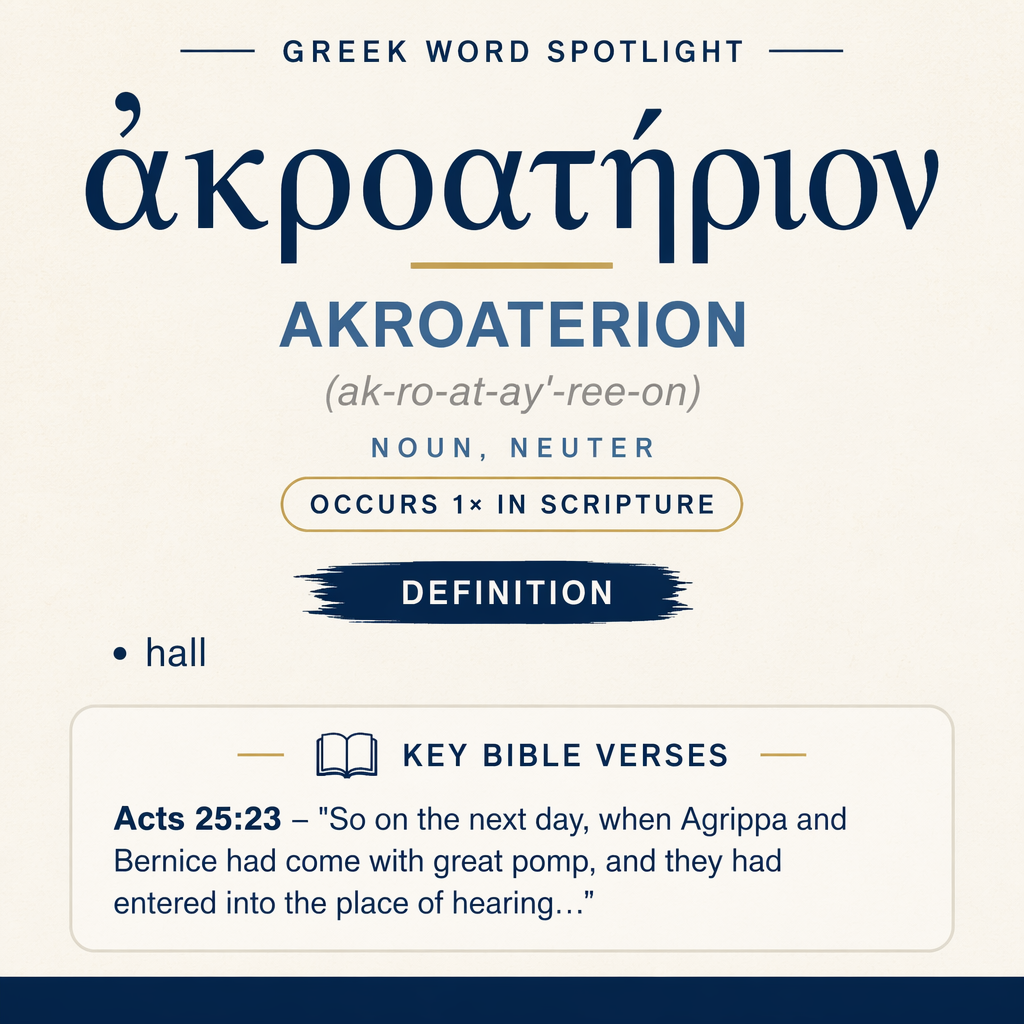
ἀκροατήριον means “hall” and appears once in Scripture, in Acts 25:23.
Context Snapshot
In Acts 25:23, Agrippa and Bernice enter “the place of hearing,” where ἀκροατήριον appears.
Learn More →ἀκροατήριον means “hall” and appears in the setting of Paul’s formal presentation before Roman authorities and local dignitaries. In Acts 25:23 it marks the physical venue arranged for hearing what Festus will bring before Agrippa and Bernice.
Root and Related Words
Akroaterion derives from akroates (ἀκροατής), “hearer” (Strong’s G202). The relationship links the “hall” to the role of hearing: a space defined by an audience gathered to listen.

Occurrences
“So on the next day, when Agrippa and Bernice had come with great pomp, and they had entered into the place of hearing with the commanding officers and the principal men of the city, at the command of Festus, Paul was brought in.” (Acts 25:23)
Here ἀκροατήριον names the setting into which the key figures “had entered”: Agrippa and Bernice arrive “with great pomp,” accompanied by “the commanding officers and the principal men of the city.” The word anchors the scene in a public, structured space intended for listening, a venue suited to the ceremonial entrance and to the presence of ranked attendees. The narrative then turns on official direction—“at the command of Festus”—and the word frames that command as initiating a formal hearing event, not merely an informal conversation. Paul’s being “brought in” completes the picture: the hall is the designated location where he will be presented before the assembled audience.
The immediate context also shows how the hall functions socially. It is large or prominent enough to receive a procession marked by “great pomp,” and it gathers different strata of authority in one place: royalty (Agrippa and Bernice), military leadership (“commanding officers”), and civic leadership (“principal men of the city”). By naming the hall, the verse signals that what follows is meant to be heard by this collected audience under official oversight, with Festus controlling the proceedings.
Sense and Usage
The sense “hall” in Acts 25:23 is not merely architectural; it is a purposeful meeting space defined by its use as a place of hearing. The verse itself reinforces this function by pairing entry into the venue with the convening of listeners and by linking the event to a formal command. The hall is where public attention is organized: the authorities assemble, the key guests arrive with ceremony, and the speaker (Paul) is brought in at the governor’s direction.
Because the narrative stresses order—entrance, assembly, command, and presentation—the hall carries the idea of an official setting suited to a controlled hearing. The wording “place of hearing” ties the location to the act of listening as the reason for gathering. In this context, a “hall” is the appropriate space for a public proceeding in which important people listen to a matter brought before them.
The presence of “great pomp” also colors the way the hall is understood. The venue is not incidental; it is the stage for a display of status and authority. By using ἀκροατήριον at precisely the moment of entry, the verse places the listeners within a defined setting before any speech is reported. The hall, then, prepares the reader to expect a hearing in which the audience, the ranks represented, and the governor’s control shape how Paul’s case will be received.
Imagery
The single use of ἀκροατήριον evokes a scene of controlled public attention: a procession enters, leaders take their places, and an accused man is brought forward. The hall is pictured as the space where authority gathers to listen, giving the moment a formal, weighty atmosphere that matches the “great pomp” and the assembled officers and civic leaders (Acts 25:23).
Sources: Lexical data from Strong’s Exhaustive Concordance and the Translators Brief Lexicon of Extended Strongs for Greek (STEPBible, CC BY). Occurrence data from the Translators Amalgamated Greek New Testament (STEPBible, CC BY). Scripture quotations from the World English Bible (public domain).




