Understanding the Significance of Akroates in Greek
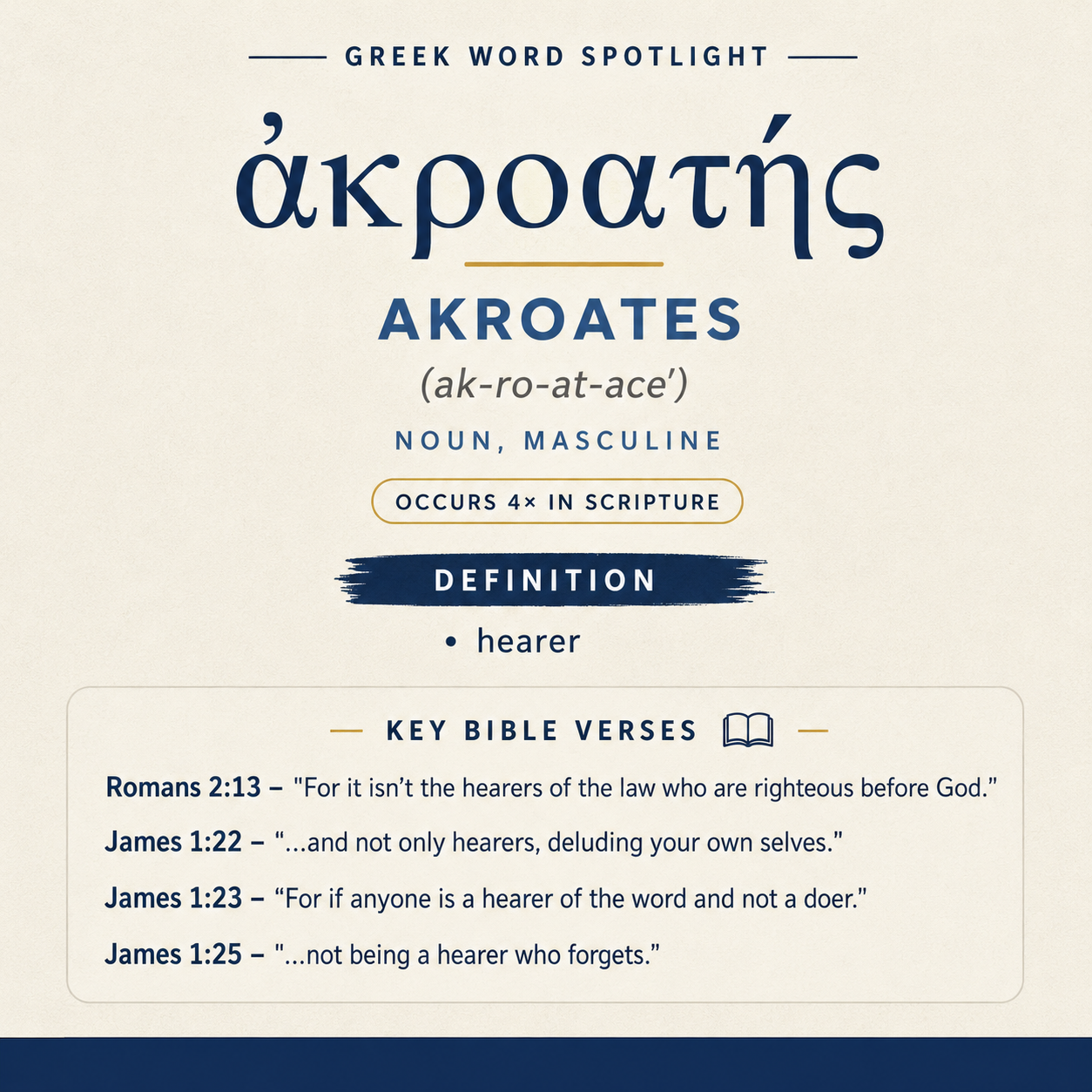
ἀκροατής means “hearer” and occurs four times in Romans 2:13 and James 1:22–25.
Scripture Occurrences
ἀκροατής appears in Romans 2:13 and in James 1:22, 1:23, and 1:25.
Learn More →Usage in Context
In these verses, “hearers” are contrasted with “doers” of the law or the word.
Learn More →ἀκροατής means “hearer,” a person characterized by hearing. It appears where Scripture contrasts mere hearing with doing, especially in Romans 2 and James 1.
Occurrences
“For it isn’t the hearers of the law who are righteous before God, but the doers of the law will be justified” (Romans 2:13)
Here ἀκροατής marks a category of people defined by their relationship to “the law” as something heard. The sentence sets “the hearers of the law” over against “the doers of the law,” and the contrast is sharpened by the stakes named in the verse: being “righteous before God” and being “justified.” In this frame, the word functions to identify an identity built on reception—those who stand in the position of hearing what the law says—while the verse denies that this status, by itself, establishes righteousness. The clause structure makes ἀκροατής part of a decisive distinction: hearing is real, but it is not treated as the determinative factor in the verdict described (“righteous… justified”).

“But be doers of the word, and not only hearers, deluding your own selves.” (James 1:22)
In James, ἀκροατής is paired with “only,” which narrows the profile of the hearer to a person who stops at hearing. The command is framed positively (“be doers of the word”) and then negatively (“and not only hearers”), so the hearer is not condemned for hearing, but for being confined to hearing. The participle-like characterization “deluding your own selves” attaches to the “not only hearers” condition: the word helps James name a spiritual mistake that can accompany hearing when it is severed from action. In this verse, ἀκροατής carries an ethical edge: it describes a posture toward “the word” that can become self-deception when hearing is treated as sufficient.
“For if anyone is a hearer of the word and not a doer, he is like a man looking at his natural face in a mirror;” (James 1:23)
This occurrence develops the earlier contrast by moving from direct exhortation to analogy. ἀκροατής is now embedded in a conditional statement (“if anyone is a hearer of the word and not a doer”), and the hearer is defined by a double description: hearing is present, doing is absent. James then likens such a person to someone “looking at his natural face in a mirror.” Within the verse, the word “hearer” helps set up the logic of the comparison: hearing is like seeing one’s face—there is contact with something true and revealing (“the word” on the one hand, the “natural face” on the other), yet the verse implies that this contact can be momentary and ineffective when it does not lead to the corresponding response. The word thus supports a picture of exposure without follow-through: a hearer may genuinely encounter “the word” but remain unchanged if he is “not a doer.”
“But he who looks into the perfect law of freedom and continues, not being a hearer who forgets, but a doer of the work, this man will be blessed in what he does.” (James 1:25)
In James 1:25, ἀκροατής is qualified by a relative description: “a hearer who forgets.” The verse again turns on contrast (“not… but…”), opposing forgetful hearing to active doing (“a doer of the work”). The hearer is not merely someone who hears once; the verse places hearing in a temporal and moral sequence: one may “look into the perfect law of freedom and continue,” and within that ongoing engagement one may either become a forgetful hearer or a practicing doer. By using “hearer who forgets,” the verse presents hearing as an activity that can fade into forgetfulness—something that passes through awareness without remaining as a guiding force. The outcome stated (“this man will be blessed in what he does”) is explicitly attached to the doer, and ἀκροατής helps define the alternative path: an encounter with the law that does not persist in memory and therefore does not issue in the “work” highlighted in the verse.

Sense and Usage
Across these passages, ἀκροατής consistently denotes a person marked by hearing, but the surrounding language shows how “hearing” can be understood as a settled role rather than a momentary act. Romans 2:13 speaks of “the hearers of the law” as a recognizable group, suggesting that hearing can become a defining relationship to God’s instruction: one stands among those who receive it. James similarly speaks of “hearers” in a way that makes the hearer a type—someone whose engagement with “the word” or “the perfect law of freedom” is primarily receptive.
Yet in every occurrence, the word is set within a contrast that exposes the limitations of hearing when it stands alone. Romans places hearers alongside “doers” in a statement about righteousness and justification, using the term to distinguish between reception and performance. James presses the same contrast into pastoral admonition: hearing without doing can lead to self-delusion (James 1:22), can resemble a glance at a mirror that does not translate into a corresponding response (James 1:23), and can be characterized as forgetful hearing even in the context of sustained looking and continuing (James 1:25). In these lines, ἀκροατής does not merely name someone present at instruction; it highlights a potential disconnect between exposure to “the word” and the embodied life that James calls “the work.”
The nouns surrounding ἀκροατής in James sharpen its practical meaning. The object heard is “the word,” and later the “perfect law of freedom.” Hearing is therefore not treated as passive background noise; it is contact with something authoritative enough to be called “law” and “perfect,” and significant enough to demand a response. The hearer becomes problematic not because hearing is wrong, but because hearing can terminate in itself—“only hearers”—or can be accompanied by “forgets.” In James, then, ἀκροατής helps articulate a spiritual danger that is subtle: one can remain close to the sound of instruction and still be distant from the doing that the instruction calls for.
Another feature of the usage is the way ἀκροατής can be modified to express quality. James 1:25 speaks of “a hearer who forgets,” not simply “a hearer,” showing that hearing can be evaluated. That evaluation is not theoretical; it is tied to perseverance (“continues”) and to concrete action (“does,” “work”). In James’s rhetoric, the hearer’s profile is completed only when set against the doer’s profile: the hearer receives; the doer carries out. The word thus functions as a diagnostic category in moral teaching, a term that can unmask the temptation to equate religious exposure with faithful practice.
Imagery in Context
James attaches ἀκροατής to a vivid image: “a man looking at his natural face in a mirror” (James 1:23). The mirror scene gives sensory weight to the idea of hearing: like looking, hearing brings a person into contact with something that can disclose reality. But the image also fits James’s later phrase “a hearer who forgets” (James 1:25): a mirror glance can be real and yet fleeting, leaving little trace if it does not lead to sustained attention and responsive action. Within these verses, ἀκροατής therefore carries the tension between genuine exposure and ineffective response, and the teaching aims to move the hearer from momentary reception to lasting, embodied doing.
Sources: Lexical data from Strong’s Exhaustive Concordance and the Translators Brief Lexicon of Extended Strongs for Greek (STEPBible, CC BY). Occurrence data from the Translators Amalgamated Greek New Testament (STEPBible, CC BY). Scripture quotations from the World English Bible (public domain).