Uncovering the Meaning of ‘adarkon in Hebrew
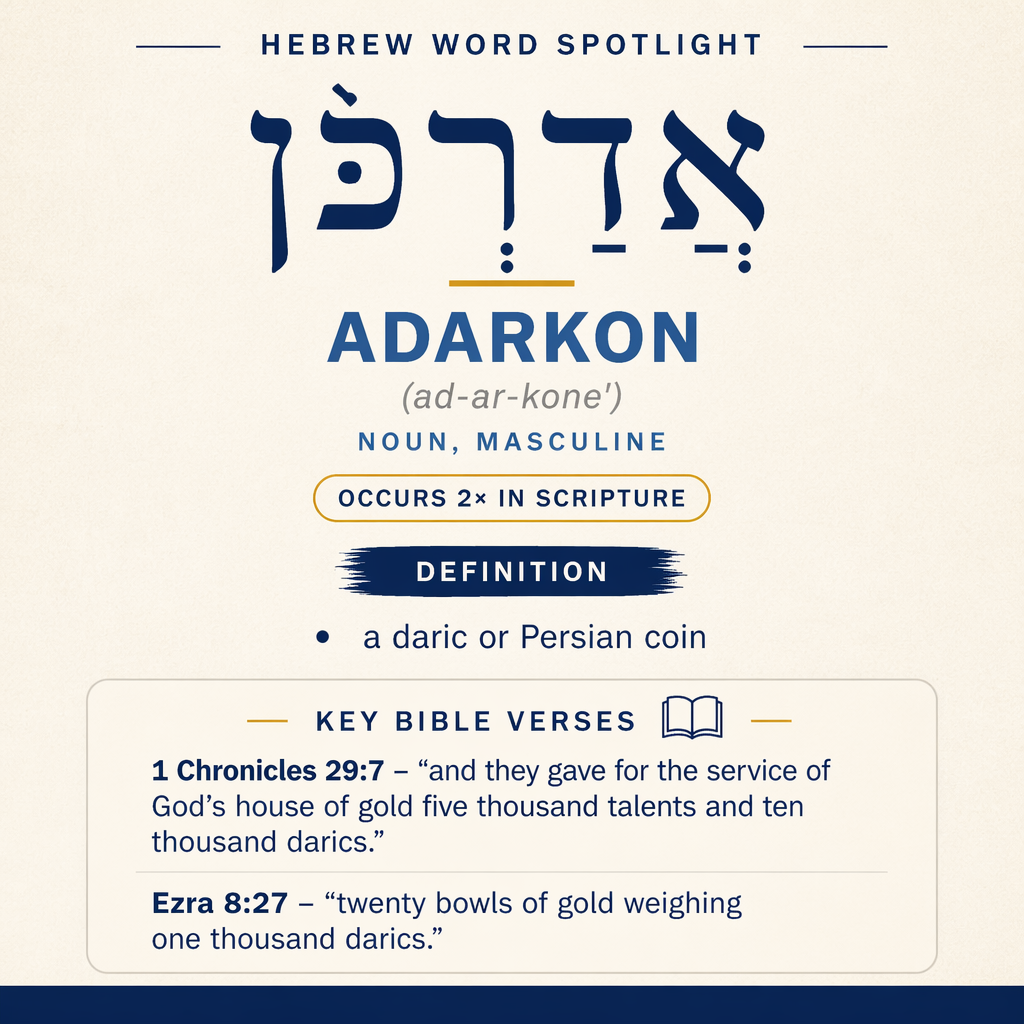
אֲדַרְכֹּן means a daric or Persian coin, appearing in 1 Chronicles 29:7 and Ezra 8:27.
Scripture Occurrences
It occurs 2 times in Scripture: 1 Chronicles 29:7 and Ezra 8:27.
Learn More →Context Examples
In 1 Chronicles 29:7, darics are given for the service of God’s house. In Ezra 8:27, gold is measured in darics for bowls.
Learn More →אֲדַרְכֹּן (adarkon) denotes “a daric or Persian coin.” It appears in lists of valuable materials and vessels given for sacred purposes in 1 Chronicles 29:7 and Ezra 8:27.
Occurrences
“and they gave for the service of God’s house of gold five thousand talents and ten thousand darics, of silver ten thousand talents, of bronze eighteen thousand talents, and of iron one hundred thousand talents.” (1 Chronicles 29:7)
Here אֲדַרְכֹּן occurs within a large-scale inventory of contributions “for the service of God’s house.” The verse moves through multiple categories—gold, silver, bronze, and iron—each paired with a measured quantity, and the darics are the counted unit attached to gold: “gold five thousand talents and ten thousand darics.” In this setting, the daric functions as a discrete coin count alongside (not replacing) the much larger “talents.” The combined phrasing depicts an offering that includes both bulk precious metal measured by weight and coined gold measured by number. Within the same sentence, the darics therefore contribute specificity: the gift of gold is expressed in two complementary ways, underscoring the abundance and the careful accounting of what is devoted to the temple service.
“twenty bowls of gold weighing one thousand darics; and two vessels of fine bright bronze, precious as gold.” (Ezra 8:27)
In Ezra 8:27 the word appears in a description of sacred valuables, but now it is attached to a particular set of objects: “twenty bowls of gold weighing one thousand darics.” The verse presents the bowls and then gives their total gold value/weight in darics, followed by an additional note about “two vessels of fine bright bronze, precious as gold.” In this scene, the daric serves as the stated measure for the gold represented by the bowls. The mention of a coin unit in connection with weighing highlights that what is being handled is not merely ornamental: it is quantified with precision and treated as a responsible charge. The daric thus helps to express the measurable worth of the bowls, set beside other precious items, all presented in a careful list.

Sense and Usage
Across its two attestations, אֲדַרְכֹּן is consistently tied to gold in contexts where offerings or valuables are enumerated for sacred use. Because it denotes “a daric or Persian coin,” the term introduces the idea of coined value into passages that also speak in broader weight-based measures. In 1 Chronicles 29:7, the darics stand next to “talents” as a second mode of expressing the gold contribution: an immense weight (“five thousand talents”) and a large counted amount (“ten thousand darics”). The effect is not to expand the meaning of the word beyond a coin, but to show how coinage can appear within a gift that is otherwise described in the language of metals and weights. The daric in that list functions as part of an accounting register: a countable unit that complements large-weight measures.
In Ezra 8:27, the daric is brought into close association with actual objects, “twenty bowls of gold,” and it is linked with “weighing one thousand darics.” The clause treats the bowls’ gold as something that can be expressed in darics, which in turn supports the passage’s emphasis on exact totals. Here the coin term is not merely a label of currency; it operates as the unit by which the amount of gold is reckoned for the inventory. In both verses, the daric is therefore a way of presenting value with concreteness: a coin unit gives a reader a sense of standardized counting, even while the surrounding items may be described by weight (talents) or by kind (bowls, vessels, bronze, iron).
The two passages also show that אֲדַרְכֹּן belongs to the vocabulary of formal lists. Each occurrence appears inside a single sentence structured around enumeration. 1 Chronicles 29:7 stacks successive clauses (“of gold… of silver… of bronze… and of iron…”) and places the darics within that stacked pattern. Ezra 8:27 similarly uses list-style phrasing (“twenty bowls… weighing…; and two vessels…”) and assigns darics as the unit for the gold component. In such writing, a coin term does narrative work: it helps a catalog sound like an inventory, with quantities that can be recorded, checked, and handed over as a defined contribution.
Imagery
The imagery tied to אֲדַרְכֹּן in these verses is the imagery of counted treasure devoted to holy service. In 1 Chronicles 29:7, the darics sit amid immense stores of metal brought “for the service of God’s house,” evoking the accumulation of resources set apart for worship. In Ezra 8:27, the darics are associated with “twenty bowls of gold” and paired with “two vessels of fine bright bronze, precious as gold,” evoking valuable objects gathered, assessed, and prepared for sacred purposes through careful reckoning.
Sources: Lexical data from Strong’s Exhaustive Concordance and the Open Scriptures Hebrew Lexicon. Occurrence data from the Westminster Leningrad Codex with STEPBible reference data (CC BY). Scripture quotations from the World English Bible (public domain).