Who was Zadok in the bible?
Zadok (Tsadowq) is a priestly name in 1 Chronicles, appearing in genealogies of Aaron’s line and in David-era priestly and administrative lists.
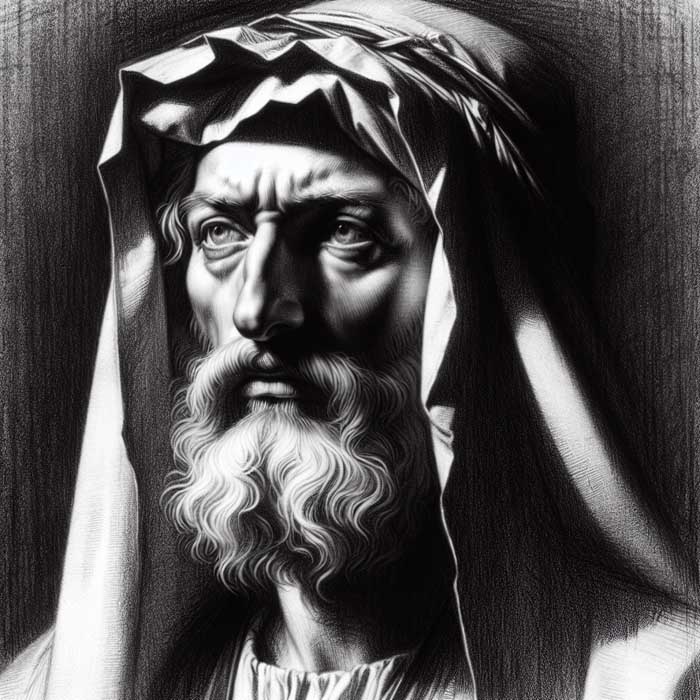
David’s Priest
“David called for Zadok and Abiathar the priests” (1 Chronicles 15:11), and “Zadok the priest, and his brothers the priests” served “before Yahweh’s tabernacle… at Gibeon” (1 Chronicles 16:39).
Learn More →Name and Bearers
Strong’s gloss describes Tsadok as meaning “just” and says it is “the name of eight or nine Israelites.” One is identified as “Zadok, a young man mighty of valor” (1 Chronicles 12:28).
Learn More →Zadok (Tsadok) is a biblical name borne by multiple Israelites; in the passages given, the best-attested Zadok is a priest who appears in genealogies from Levi and Aaron and is named among those serving in David’s administration. The name is explained in the lexicon as deriving from a Hebrew root connected with being or making “right” or “just.”
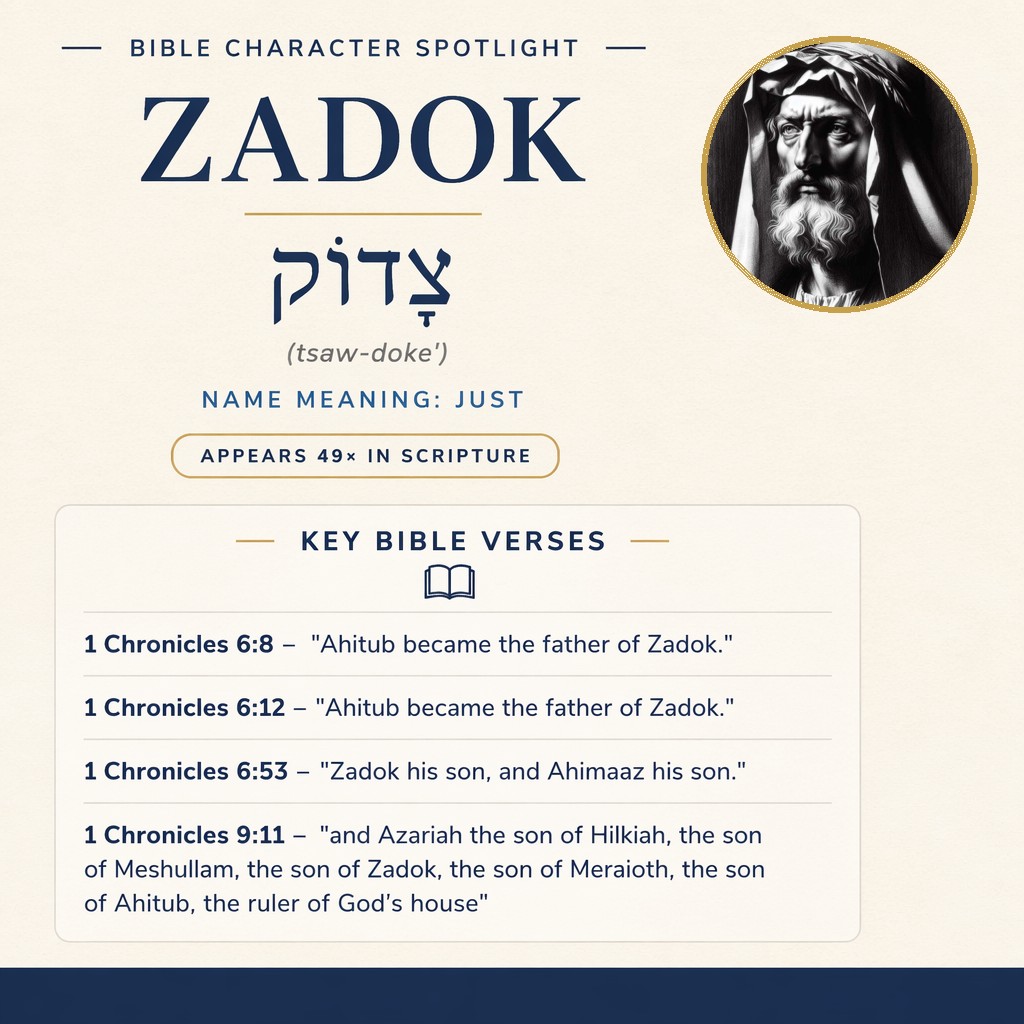
Zadok in Scripture
In the genealogical record of the tribe of Levi, Zadok appears within the priestly line descending from Aaron through Eleazar. The chapter opens, “The sons of Levi: Gershon, Kohath, and Merari” (1 Chronicles 6:1), and then traces Kohath’s line to Aaron: “The children of Amram: Aaron, Moses, and Miriam. The sons of Aaron: Nadab, Abihu, Eleazar, and Ithamar” (1 Chronicles 6:3). Within the line that proceeds from Eleazar, Zadok is introduced as the son of Ahitub and the father of Ahimaaz:
“Ahitub became the father of Zadok. Zadok became the father of Ahimaaz.” (1 Chronicles 6:8)
The same chapter later returns to a focused summary of “the sons of Aaron” and again places Zadok in that descent, emphasizing his priestly placement in that family line:
“These are the sons of Aaron: Eleazar his son, Phinehas his son, Abishua his son, … Amariah his son, Ahitub his son, Zadok his son, and Ahimaaz his son.” (1 Chronicles 6:50–53)
Within the same genealogical section, Zadok’s name also appears in another father-son notice:
“Ahitub became the father of Zadok. Zadok became the father of Shallum.” (1 Chronicles 6:12)
This second notice continues a further line (“Shallum became the father of Hilkiah. Hilkiah became the father of Azariah” in 1 Chronicles 6:13), extending onward in the chapter. The chapter’s broader setting places these priestly genealogies within the larger organization of Levites, including a description of service in the tabernacle and later at the house in Jerusalem (“They ministered with song before the tabernacle of the Tent of Meeting, until Solomon had built Yahweh’s house in Jerusalem,” 1 Chronicles 6:32; and “But Aaron and his sons offered on the altar of burnt offering, and on the altar of incense,” 1 Chronicles 6:49). Zadok’s inclusion in these lines ties his name to the Aaronic priestly family as the Chronicler presents it.
Later in Chronicles, Zadok is mentioned within another genealogy related to priestly leadership. In a list that identifies an individual as a descendant “of Zadok,” Zadok stands several generations back, and the descendant is described as holding authority in God’s house:
“and Azariah the son of Hilkiah, the son of Meshullam, the son of Zadok, the son of Meraioth, the son of Ahitub, the ruler of God’s house;” (1 Chronicles 9:11)
Chronicles also names a Zadok in a military context, portraying him as young and prominent in strength and leadership. In a list of those aligned with David, it says:
“and Zadok, a young man mighty of valor, and of his father’s house twenty-two captains.” (1 Chronicles 12:28)
In accounts connected with David’s organization of worship and priestly personnel, Zadok appears explicitly as a priest. When David gathered priests and Levites, Zadok is among those called:
“David called for Zadok and Abiathar the priests, and for the Levites, for Uriel, Asaiah, Joel, Shemaiah, Eliel, and Amminadab,” (1 Chronicles 15:11)
He is also portrayed serving at a specific sacred location: “before Yahweh’s tabernacle in the high place that was at Gibeon.” This note not only identifies his role but situates him with other priests (“his brothers the priests”) at the tabernacle:
“and Zadok the priest, and his brothers the priests, before Yahweh’s tabernacle in the high place that was at Gibeon,” (1 Chronicles 16:39)
Within David’s administration, Zadok is named together with another priestly figure and other officials. One list reads:
“Zadok the son of Ahitub, and Abimelech the son of Abiathar, were priests; Shavsha was scribe;” (1 Chronicles 18:16)
In the organization of priestly service, Zadok is shown participating in the division of priestly groups, with explicit reference to priestly descent lines. The text records:
“David with Zadok of the sons of Eleazar and Ahimelech of the sons of Ithamar, divided them according to their ordering in their service.” (1 Chronicles 24:3)
The procedure is described with a scribe writing “in the presence of the king” and several leaders, including “Zadok the priest”:
“Shemaiah the son of Nethanel the scribe, who was of the Levites, wrote them in the presence of the king, the princes, Zadok the priest, Ahimelech the son of Abiathar, and the heads of the fathers’ households of the priests and of the Levites;” (1 Chronicles 24:6)
The casting of lots for priestly households is again said to be done “in the presence of David the king” and includes Zadok as one of the witnesses to this ordering:
“These likewise cast lots even as their brothers the sons of Aaron in the presence of David the king, Zadok, Ahimelech, and the heads of the fathers’ households of the priests and of the Levites;” (1 Chronicles 24:31)
Finally, in a list of tribal and administrative leaders, Zadok is named as a representative for Aaron:
“of Levi, Hashabiah the son of Kemuel; of Aaron, Zadok;” (1 Chronicles 27:17)
Across these references, Zadok is consistently presented either within Aaron’s priestly line or functioning as “Zadok the priest” in settings related to tabernacle service and the ordering of priestly work under David.
Multiple Bearers
The lexicon gloss identifies Tsadok as “the name of eight or nine Israelites,” and the passages supplied show at least two distinct portrayals associated with the name. One Zadok is strongly identified as a priest connected with Aaron and Eleazar and specifically called “Zadok the priest” (1 Chronicles 16:39); he is also called “Zadok the son of Ahitub” in an administrative list (1 Chronicles 18:16). Another reference describes “Zadok, a young man mighty of valor, and of his father’s house twenty-two captains” (1 Chronicles 12:28), a description that highlights military strength and leadership rather than priestly duty. The text given does not explicitly state whether this “young man” is the same as “Zadok the priest,” so the references should be read as showing that the name Zadok is borne by more than one person in Chronicles’ narratives and lists.
Name and Meaning
The name is written in Hebrew as צָדוֹק, transliterated Tsadowq and pronounced tsaw-doke’. The lexicon derives it from a Hebrew root (H6663) with the sense “just,” connected with the component verb tsadaq (צָדַק), “to be (causatively, make) right.”
Observation
In the passages provided, Zadok’s name is repeatedly tied to ordered priestly service—he appears both within the Aaronic genealogy (1 Chronicles 6:50–53) and among those who “divided them according to their ordering in their service” (1 Chronicles 24:3), linking his identity to the structured worship life described in Chronicles.
Frequently Asked Questions
What does the name Zadok mean?
The name Zadok means “just.”
How many times does Zadok appear in the Bible?
Zadok occurs 49 times.
Who was Zadok?
Zadok is the name of eight or nine Israelites, and one Zadok is identified as a priest (1 Chronicles 15:11; 1 Chronicles 16:39). He is also described in a genealogy as the son of Ahitub and the father of Ahimaaz (1 Chronicles 6:8).
Was Zadok described as a young man and warrior?
Yes. One Zadok is called “a young man mighty of valor,” with “twenty-two captains” from his father’s house (1 Chronicles 12:28).
Explore Further
If you found this page about Zadok interesting and would like to discover more about other biblical characters, explore our comprehensive Encyclopedia of Biblical Characters. For those looking to delve deeper into the Greek origins of these names and terms, our Greek Lexicon is an invaluable resource.
Sources: Name and occurrence data from Strong’s Exhaustive Concordance and STEPBible reference data (CC BY). Scripture quotations from the World English Bible (public domain).