
Who was Miriam in the bible?
Miriam is an Israelite woman named alongside Moses and Aaron, appearing in Exodus 15, Numbers 12, Deuteronomy 24, Micah 6, 1 Chronicles 6, Numbers 26, and 1 Chronicles 4.
Key Episodes
Miriam and Aaron “spoke against Moses” and Yahweh summoned them to the Tent of Meeting (Numbers 12:1,4). “Behold, Miriam was leprous, as white as snow,” and she was shut outside the camp seven days (Numbers 12:10,15).
Learn More →Name and Meaning
Miriam (Miryam) is described in a lexicon gloss as “the name of two Israelitesses,” and the name is linked to a sense of bitterness or rebellion. In Scripture, one Miriam is borne by an unnamed woman in Ezrah’s line (1 Chronicles 4:17).
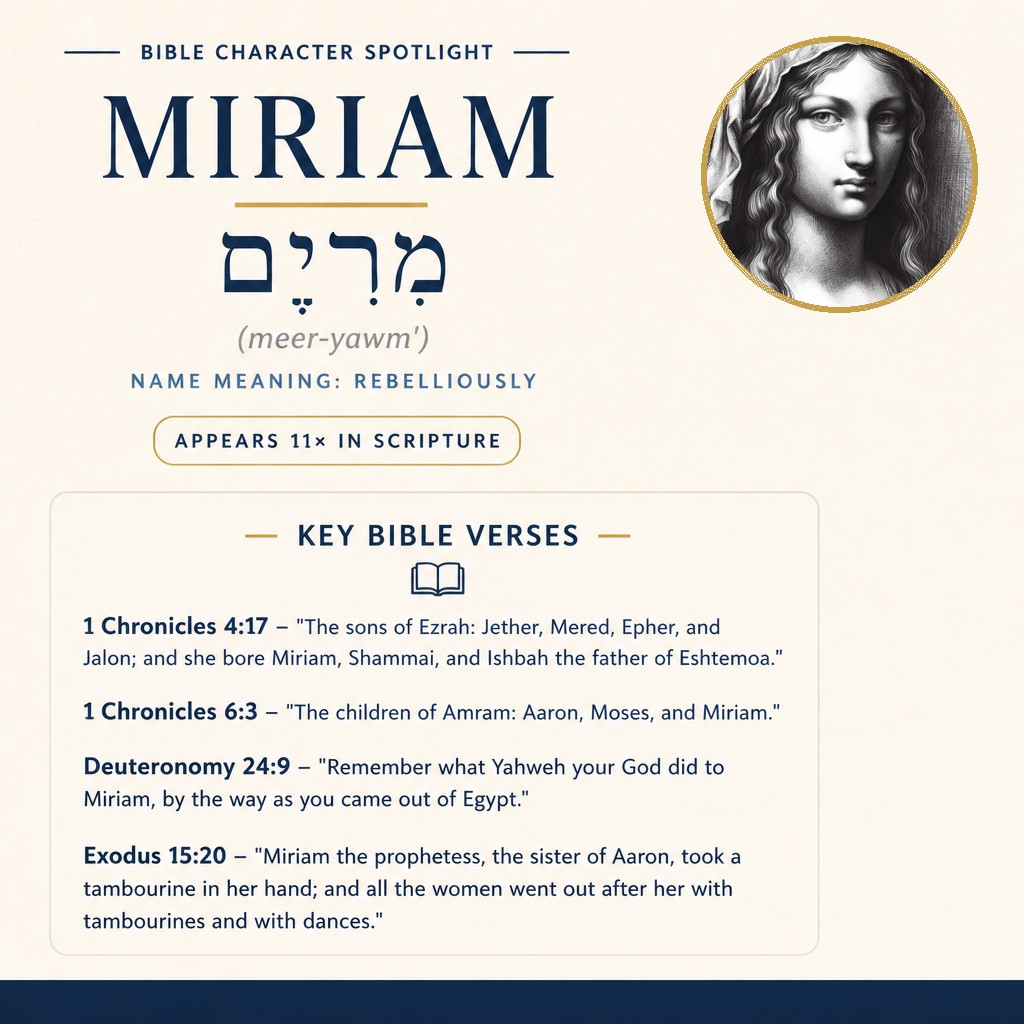
Learn More →Miriam (מִרְיָם, Miryam; pronounced meer-yawm’) is a biblical woman whose name is explained in a lexicon as being derived from a word connected with “bitterness” and, figuratively, “rebellio[usly].” The name “Miriam” is borne by two Israelite women in Scripture, one appearing in genealogical records and another appearing in Israel’s wilderness narratives as the sister of Aaron and associated with Moses.
Miriam in Scripture
One Miriam appears in a genealogical note in Chronicles. In a list of descendants, the text states:
“The sons of Ezrah: Jether, Mered, Epher, and Jalon; and she bore Miriam, Shammai, and Ishbah the father of Eshtemoa.” (1 Chronicles 4:17)
This verse identifies a Miriam as one of the children borne in that line, alongside Shammai and Ishbah.
A second Miriam is presented as part of Amram’s household and as the sister of Aaron (and linked with Moses). Chronicles summarizes the children of Amram:
“The children of Amram: Aaron, Moses, and Miriam.” (1 Chronicles 6:3)
Numbers likewise names her within Amram’s family, explicitly describing her as their sister:
“She bore to Amram Aaron and Moses, and Miriam their sister.” (Numbers 26:59)
In the wilderness narrative, Miriam is portrayed with a public religious role and as a leader among the women after a decisive deliverance. Exodus describes her with a title and a family identification:
“Miriam the prophetess, the sister of Aaron, took a tambourine in her hand; and all the women went out after her with tambourines and with dances.” (Exodus 15:20)
Immediately after, she leads a spoken response, directing praise:
“Miriam answered them, ‘Sing to Yahweh, for he has triumphed gloriously. The horse and his rider he has thrown into the sea.’” (Exodus 15:21)
Later biblical references recall Miriam in connection with Israel’s deliverance and leadership. Through Micah, Yahweh declares:
“For I brought you up out of the land of Egypt, and redeemed you out of the house of bondage. I sent before you Moses, Aaron, and Miriam.” (Micah 6:4)
Deuteronomy refers to a remembered act of Yahweh involving her during the journey from Egypt:
“Remember what Yahweh your God did to Miriam, by the way as you came out of Egypt.” (Deuteronomy 24:9)
The fullest narrative focused on Miriam is found in Numbers 12. The chapter begins with Miriam acting together with Aaron in opposition to Moses, and it records both their words and Yahweh’s response. The opening accusation is stated plainly:
“Miriam and Aaron spoke against Moses because of the Cushite woman whom he had married; for he had married a Cushite woman.” (Numbers 12:1)
Their complaint includes a claim about prophetic speech and authority:
“They said, ‘Has Yahweh indeed spoken only with Moses? Hasn’t he spoken also with us?’ And Yahweh heard it.” (Numbers 12:2)
The scene then shifts abruptly to Yahweh’s summons, drawing Moses, Aaron, and Miriam to a defined meeting place:
“Yahweh spoke suddenly to Moses, to Aaron, and to Miriam, ‘You three come out to the Tent of Meeting!’ The three of them came out.” (Numbers 12:4)
Yahweh appears and calls forward Aaron and Miriam in particular:
“Yahweh came down in a pillar of cloud, and stood at the door of the Tent, and called Aaron and Miriam; and they both came forward.” (Numbers 12:5)
Yahweh then delivers an oracle distinguishing ordinary prophetic revelation from the manner in which Yahweh speaks with Moses. He says:
“If there is a prophet among you, I, Yahweh, will make myself known to him in a vision. I will speak with him in a dream.” (Numbers 12:6)
In contrast, Yahweh affirms Moses’ place and the directness of Yahweh’s communication with him:
“With him, I will speak mouth to mouth, even plainly, and not in riddles; and he shall see Yahweh’s form.” (Numbers 12:8)
The rebuke is pointed at their fearlessness in opposing Moses:
“Why then were you not afraid to speak against my servant, against Moses?” (Numbers 12:8)
After the oracle, the narrative records Yahweh’s anger and departure, followed by an immediate consequence that falls on Miriam:
“The cloud departed from over the Tent; and behold, Miriam was leprous, as white as snow.” (Numbers 12:10)
Aaron appeals to Moses, acknowledging guilt and asking that the offense not be held against them and that Miriam not remain in that condition. He pleads:
“Oh, my lord, please don’t count this sin against us, in which we have done foolishly, and in which we have sinned.” (Numbers 12:11)
Moses then intercedes directly to Yahweh on Miriam’s behalf:
“Moses cried to Yahweh, saying, ‘Heal her, God, I beg you!’” (Numbers 12:13)
Yahweh’s response sets a term of exclusion outside the camp, using a vivid comparison and specifying the duration:
“Let her be shut up outside of the camp seven days, and after that she shall be brought in again.” (Numbers 12:14)
The chapter concludes by recording both the fulfillment of that instruction and its effect on the community’s movement:
“Miriam was shut up outside of the camp seven days, and the people didn’t travel until Miriam was brought in again.” (Numbers 12:15)
Multiple bearers
Scripture uses the name Miriam for more than one person. One Miriam appears only in a genealogical record: “and she bore Miriam, Shammai, and Ishbah” (1 Chronicles 4:17). Another Miriam is identified within Amram’s family—“Aaron, Moses, and Miriam” (1 Chronicles 6:3)—and is described as “Miriam the prophetess, the sister of Aaron” (Exodus 15:20), who later appears prominently in the dispute and judgment recorded in Numbers 12.
Name and Meaning
The name is written in Hebrew as מִרְיָם and transliterated Miryam (pronounced meer-yawm’). A lexicon explains it as derived from a root associated with “rebelliously,” with a component word meriy (מְרִי) meaning “bitterness” and, figuratively, “rebellio[n].”
Observation
The texts present Miriam both as one who leads public praise—“Miriam the prophetess… took a tambourine in her hand” (Exodus 15:20)—and as one who, with Aaron, is rebuked for speaking against Moses, after which “Miriam was shut up outside of the camp seven days” (Numbers 12:15), an event later recalled: “Remember what Yahweh your God did to Miriam” (Deuteronomy 24:9).
Frequently Asked Questions
What does the name Miriam mean?
The name Miriam is linked with the idea of being rebellious.
How many times does Miriam appear in the Bible?
Miriam appears 11 times.
Who was Miriam in the Bible?
Miriam is the name of two Israelitesses. One Miriam is described as a prophetess and as the sister of Aaron (Exodus 15:20).
What did Miriam do after the crossing of the sea?
Miriam took a tambourine, and all the women went out after her with tambourines and dances (Exodus 15:20). She led a song praising Yahweh for triumphing gloriously (Exodus 15:21).
Explore Further
If you found this page about Miriam interesting and would like to discover more about other biblical characters, explore our comprehensive Encyclopedia of Biblical Characters. For those looking to delve deeper into the Greek origins of these names and terms, our Greek Lexicon is an invaluable resource.
Sources: Name and occurrence data from Strong’s Exhaustive Concordance and STEPBible reference data (CC BY). Scripture quotations from the World English Bible (public domain).




