Who was Seir in the bible?
Seir appears as both a person with named sons and as “Mount Seir” and its inhabitants in Chronicles and Deuteronomy.

Mount Seir
Israel was commanded, “You are to pass through the border of your brothers, the children of Esau, who dwell in Seir.” (Deuteronomy 2:4) “I have given Mount Seir to Esau for a possession.” (Deuteronomy 2:5)
Learn More →Conflict References
“The children of Ammon and Moab and Mount Seir… had come against Judah; and they were struck.” (2 Chronicles 20:22) Amaziah “struck ten thousand of the children of Seir.” (2 Chronicles 25:11)
Learn More →Seir is a biblical name applied both to a person and to a place: Seir appears as an ancestor with “sons,” and also as “Mount Seir,” a territorial region associated with its inhabitants. The lexicon gloss associated with this name identifies Seir as “a mountain of Idumaea and its aboriginal occupants,” and also mentions “one in Palestine.”
Seir in Scripture
Seir as a person with sons. In a genealogical list, Seir is presented as a father figure whose sons are named.
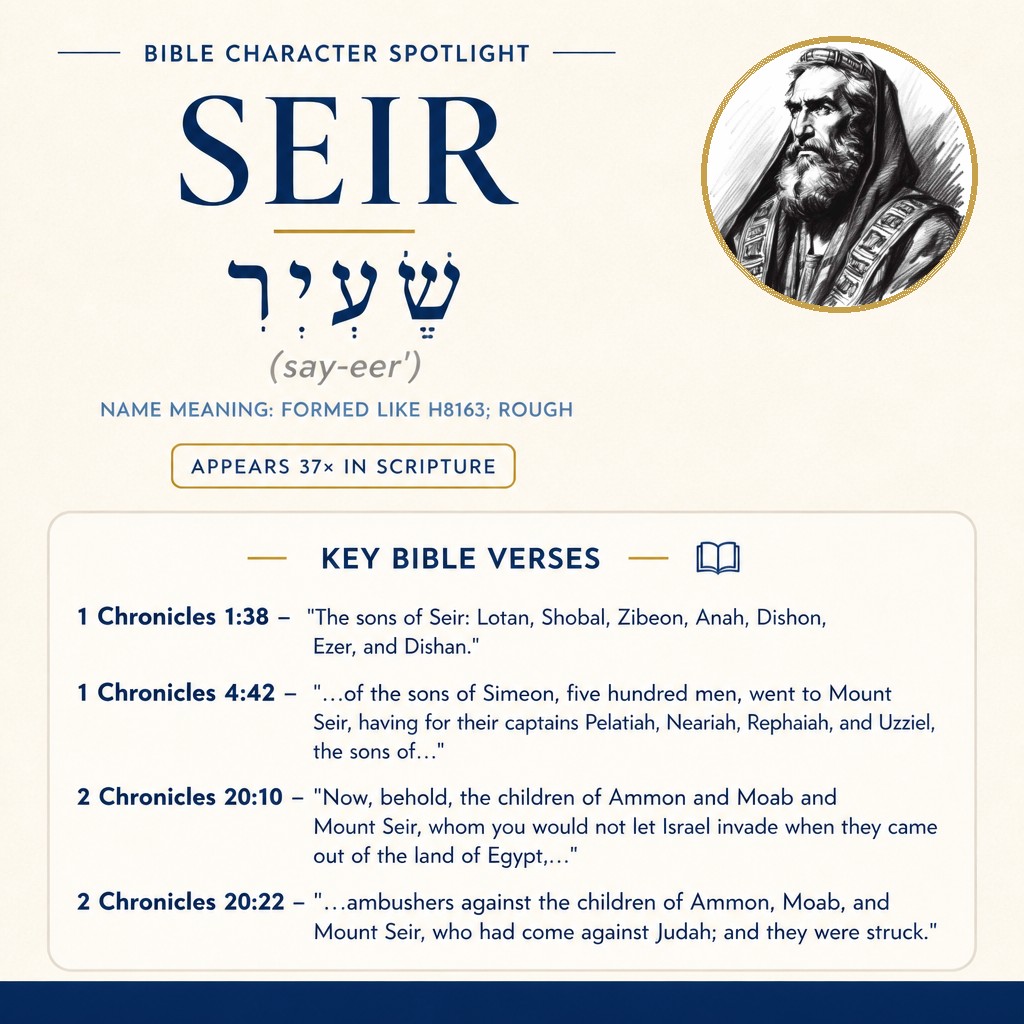
“The sons of Seir: Lotan, Shobal, Zibeon, Anah, Dishon, Ezer, and Dishan.” (1 Chronicles 1:38)
Mount Seir as a route marker and border region. Deuteronomy refers to Mount Seir in geographic terms, first as part of a route description, and then as a region where Israel’s movement is framed by divine instruction concerning boundaries and conflict.
“It is eleven days’ journey from Horeb by the way of Mount Seir to Kadesh Barnea.” (Deuteronomy 1:2)
“The Amorites, who lived in that hill country, came out against you and chased you as bees do, and beat you down in Seir, even to Hormah.” (Deuteronomy 1:44)
“Command the people, saying, ‘You are to pass through the border of your brothers, the children of Esau, who dwell in Seir; and they will be afraid of you. Therefore be careful.” (Deuteronomy 2:4)
“Don’t contend with them; for I will not give you any of their land, no, not so much as for the sole of the foot to tread on, because I have given Mount Seir to Esau for a possession.” (Deuteronomy 2:5)
“So we passed by from our brothers, the children of Esau, who dwell in Seir, from the way of the Arabah from Elath and from Ezion Geber. We turned and passed by the way of the wilderness of Moab.” (Deuteronomy 2:8)
Mount Seir and a Simeonite expedition. Chronicles records an episode in which some from Simeon go to Mount Seir under named captains.
“Some of them, even of the sons of Simeon, five hundred men, went to Mount Seir, having for their captains Pelatiah, Neariah, Rephaiah, and Uzziel, the sons of Ishi.” (1 Chronicles 4:42)
Mount Seir in Jehoshaphat’s crisis (full narrative setting from 2 Chronicles 20). In the reign context of Jehoshaphat, a coalition comes to battle, and Mount Seir is named among the hostile parties. The account portrays Judah’s response as seeking Yahweh through assembly, prayer, and worship; it then describes Yahweh’s intervention that turns the enemies against one another.
The chapter begins with the threat: “After this, the children of Moab, the children of Ammon, and with them some of the Ammonites, came against Jehoshaphat to battle” (2 Chronicles 20:1). When the danger is reported, “Jehoshaphat was alarmed, and set himself to seek to Yahweh. He proclaimed a fast throughout all Judah” (2 Chronicles 20:3), and “Judah gathered themselves together to seek help from Yahweh” (2 Chronicles 20:4).
In Jehoshaphat’s prayer at Yahweh’s house, Mount Seir is explicitly included among the aggressors, described in light of prior restraint shown to them during Israel’s earlier movements:
“Now, behold, the children of Ammon and Moab and Mount Seir, whom you would not let Israel invade when they came out of the land of Egypt, but they turned away from them, and didn’t destroy them; behold, how they reward us, to come to cast us out of your possession, which you have given us to inherit.” (2 Chronicles 20:10–11)
Jehoshaphat confesses Judah’s helplessness and dependence: “For we have no might against this great company that comes against us. We don’t know what to do, but our eyes are on you” (2 Chronicles 20:12). The narrative then focuses on a prophetic word that reframes the conflict: “Yahweh says to you, ‘Don’t be afraid, and don’t be dismayed because of this great multitude; for the battle is not yours, but God’s’” (2 Chronicles 20:15). The people are told, “You will not need to fight this battle. Set yourselves, stand still, and see the salvation of Yahweh with you” (2 Chronicles 20:17).
Jehoshaphat appoints singers to go before the army, saying, “Give thanks to Yahweh; for his loving kindness endures forever” (2 Chronicles 20:21). At the moment of praise, Mount Seir again appears as part of the enemy host that is struck:
“When they began to sing and to praise, Yahweh set ambushers against the children of Ammon, Moab, and Mount Seir, who had come against Judah; and they were struck.” (2 Chronicles 20:22)
The account then describes internal destruction among the enemy coalition, with Mount Seir’s inhabitants targeted:
“For the children of Ammon and Moab stood up against the inhabitants of Mount Seir to utterly kill and destroy them. When they had finished the inhabitants of Seir, everyone helped to destroy each other.” (2 Chronicles 20:23)
When Judah arrives at the overlook, “they looked at the multitude; and behold, they were dead bodies fallen to the earth, and there were none who escaped” (2 Chronicles 20:24). The victory results in abundant plunder gathered over three days (2 Chronicles 20:25) and a communal blessing of Yahweh in “Beracah Valley” (2 Chronicles 20:26). The episode ends with quiet for Jehoshaphat’s realm: “So the realm of Jehoshaphat was quiet, for his God gave him rest all around” (2 Chronicles 20:30). Within this narrative, Mount Seir functions as part of the threatening alliance, and its inhabitants are depicted as destroyed amid the coalition’s collapse.
Children of Seir in Amaziah’s campaign. In another account, “the children of Seir” appear as an opposing people whom Amaziah strikes, and whose gods he takes.
“Amaziah took courage, and led his people out, and went to the Valley of Salt, and struck ten thousand of the children of Seir.” (2 Chronicles 25:11)
“Now after Amaziah had come from the slaughter of the Edomites, he brought the gods of the children of Seir, and set them up to be his gods, and bowed down himself before them, and burned incense to them.” (2 Chronicles 25:14)
Multiple Bearers
The name Seir is used in more than one way in the provided passages. First, Seir is an individual with sons named in a genealogy: “The sons of Seir: Lotan, Shobal, Zibeon, Anah, Dishon, Ezer, and Dishan” (1 Chronicles 1:38). Second, Seir is a place, “Mount Seir,” with “inhabitants” and “children” described as a people group: “the inhabitants of Mount Seir” (2 Chronicles 20:23) and “the children of Seir” (2 Chronicles 25:11). Deuteronomy further speaks of “Mount Seir” as territory connected with “the children of Esau, who dwell in Seir” (Deuteronomy 2:4) and as a possession: “I have given Mount Seir to Esau for a possession” (Deuteronomy 2:5).
Name and Meaning
In Hebrew, Seir is written שֵׂעִיר, transliterated Se’iyr and pronounced say-eer’. The name derivation given in Strong’s links it to a form meaning “rough,” related to a component word sa’iyr (שָׂעִיר), glossed as “shaggy,” which can refer to “a he-goat” and, by analogy, is associated with that idea.
Observation
Across these passages, “Seir” consistently marks a defined identity—either a named ancestor (1 Chronicles 1:38) or a territorial people (“Mount Seir”) whose borders are to be respected in one setting (Deuteronomy 2:4–5) and who appear as opponents in later conflicts (2 Chronicles 20:10–23; 2 Chronicles 25:11–14).
Frequently Asked Questions
What does the name Seir mean?
Seir means “rough.”
How many times does Seir appear in the Bible?
Seir appears 37 times.
Who was Seir?
Seir is the name of a mountain of Idumaea and its aboriginal occupants, and also one in Palestine.
Who are listed as the sons of Seir?
1 Chronicles 1:38 lists the sons of Seir as Lotan, Shobal, Zibeon, Anah, Dishon, Ezer, and Dishan.
Explore Further
If you found this page about Seir interesting and would like to discover more about other biblical characters, explore our comprehensive Encyclopedia of Biblical Characters. For those looking to delve deeper into the Greek origins of these names and terms, our Greek Lexicon is an invaluable resource.
Sources: Name and occurrence data from Strong’s Exhaustive Concordance and STEPBible reference data (CC BY). Scripture quotations from the World English Bible (public domain).