
Who was Simeon in the bible?
Simeon (also Simon/Shimon) is a name borne by several figures and a tribe, appearing in both Old Testament genealogies/tribal lists and New Testament Gospel narratives.
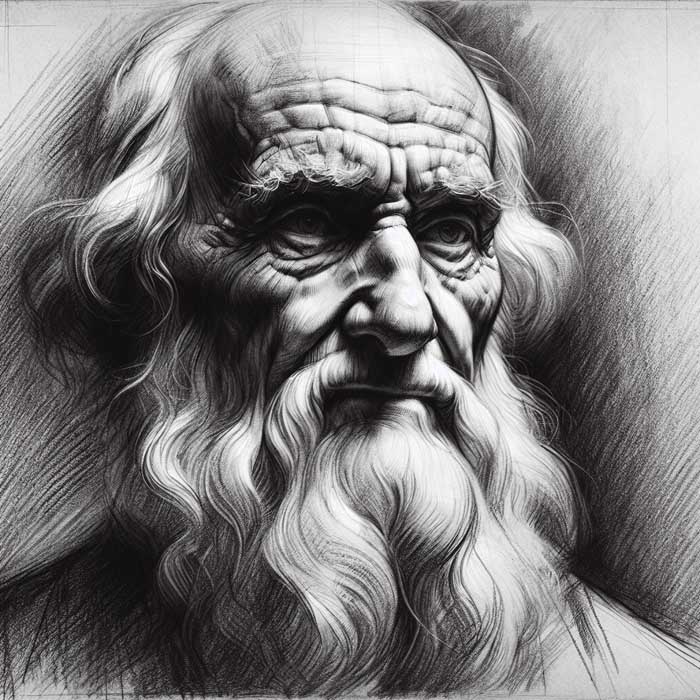
Tribe of Simeon
Simeon is listed among Israel’s tribes, including in blessings and allotments: “Simeon, Levi, Judah…” (Deuteronomy 27:12) and “Simeon, one portion” (Ezekiel 48:24).
Learn More →Genealogies Listed
Simeon’s descendants are enumerated: “The sons of Simeon: Jemuel… Shaul” (Exodus 6:15) and “The sons of Simeon: Nemuel… Shaul” (1 Chronicles 4:24).
Learn More →Simeon is a biblical name borne by multiple individuals and also used for a tribal designation. In the Hebrew form Shim’own, it is associated (by lexicon derivation) with “hearing,” while the Greek form Simon is presented as a name of Hebrew origin.
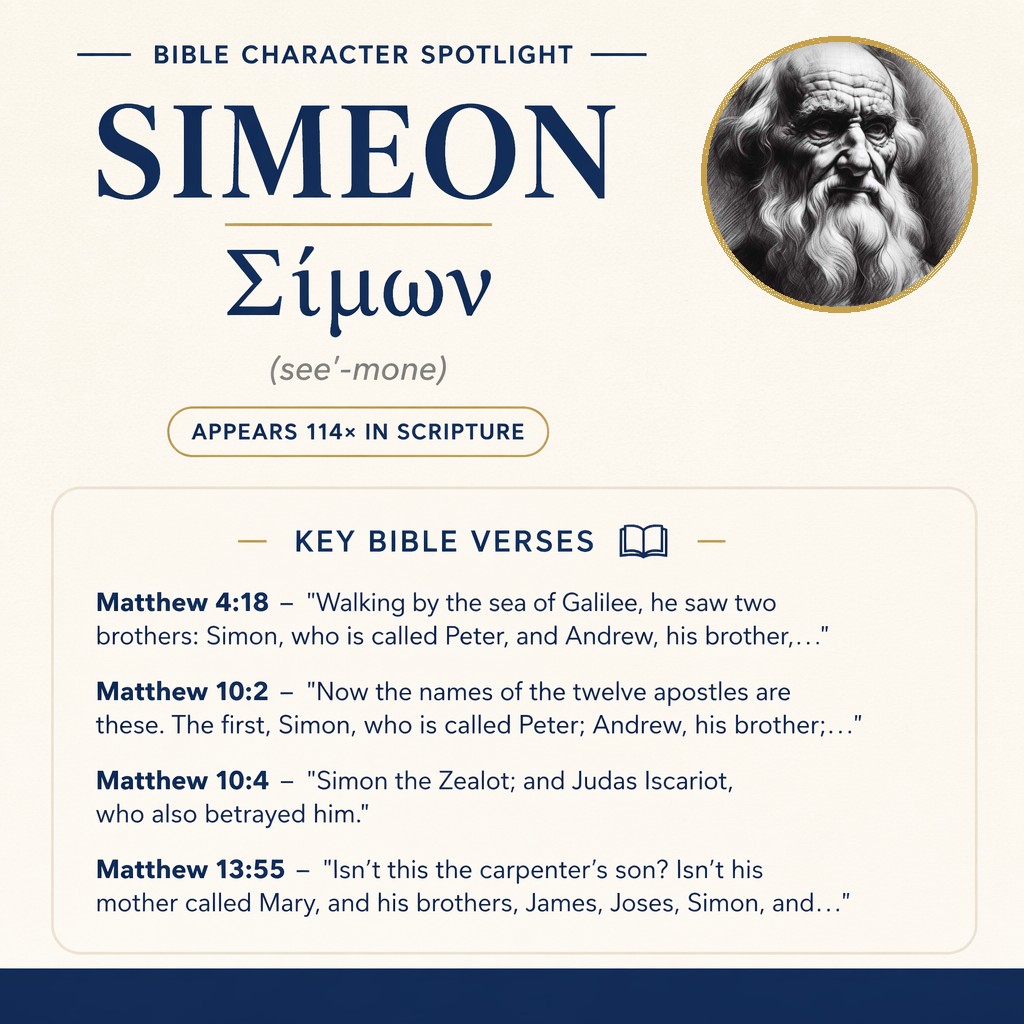
Simeon in Scripture
The name appears in the New Testament in Greek as “Simon,” applied to several distinct people.
“Walking by the sea of Galilee, he saw two brothers: Simon, who is called Peter, and Andrew, his brother, casting a net into the sea; for they were fishermen.” (Matthew 4:18, WEB)
“Now the names of the twelve apostles are these. The first, Simon, who is called Peter; Andrew, his brother; James the son of Zebedee; John, his brother;” (Matthew 10:2, WEB)
“Simon the Zealot; and Judas Iscariot, who also betrayed him.” (Matthew 10:4, WEB)
“Isn’t this the carpenter’s son? Isn’t his mother called Mary, and his brothers, James, Joses, Simon, and Judas?” (Matthew 13:55, WEB)
“Simon Peter answered, ‘You are the Christ, the Son of the living God.’ ” (Matthew 16:16, WEB)
“Jesus answered him, ‘Blessed are you, Simon Bar Jonah, for flesh and blood has not revealed this to you, but my Father who is in heaven.’ ” (Matthew 16:17, WEB)
“He said, ‘Yes.’ When he came into the house, Jesus anticipated him, saying, ‘What do you think, Simon? From whom do the kings of the earth receive toll or tribute? From their children, or from strangers?’ ” (Matthew 17:25, WEB)
“Now when Jesus was in Bethany, in the house of Simon the leper,” (Matthew 26:6, WEB)
“As they came out, they found a man of Cyrene, Simon by name, and they compelled him to go with them, that he might carry his cross.” (Matthew 27:32, WEB)
Mark’s Gospel provides a concentrated narrative setting for Simon (called Peter) early in Jesus’ Galilean ministry. Mark opens with an announcement of the message being proclaimed:
“The beginning of the Good News of Jesus Christ, the Son of God.” (Mark 1:1, WEB)
Within that framework, Simon first appears as a fisherman alongside his brother Andrew. Jesus’ call, and Simon’s immediate response, are described succinctly:
“Passing along by the sea of Galilee, he saw Simon and Andrew, the brother of Simon, casting a net into the sea, for they were fishermen.” (Mark 1:16, WEB)
“Jesus said to them, ‘Come after me, and I will make you into fishers for men.’ ” (Mark 1:17, WEB)
“Immediately they left their nets, and followed him.” (Mark 1:18, WEB)
Soon afterward, Simon is associated with a specific household setting in Capernaum, where Jesus’ activity continues after synagogue teaching:
“Immediately, when they had come out of the synagogue, they came into the house of Simon and Andrew, with James and John.” (Mark 1:29, WEB)
There Simon’s family connections are mentioned by reference to his wife’s mother:
“Now Simon’s wife’s mother lay sick with a fever, and immediately they told him about her.” (Mark 1:30, WEB)
Jesus’ action and the result are narrated in a way that highlights immediacy and restoration:
“He came and took her by the hand, and raised her up. The fever left her immediately, and she served them.” (Mark 1:31, WEB)
Mark then depicts a wider scene of healings and exorcisms, with many people gathering near the house, before Jesus withdraws to pray. Simon is again present, now as part of a group actively seeking Jesus:
“Early in the morning, while it was still dark, he rose up and went out, and departed into a deserted place, and prayed there.” (Mark 1:35, WEB)
“Simon and those who were with him searched for him.” (Mark 1:36, WEB)
“They found him and told him, ‘Everyone is looking for you.’ ” (Mark 1:37, WEB)
Jesus answers by redirecting the group toward broader proclamation:
“He said to them, ‘Let’s go elsewhere into the next towns, that I may preach there also, because I came out for this reason.’ ” (Mark 1:38, WEB)
In the Hebrew Scriptures, “Simeon” (Shim’own) appears as the name of a son of Jacob and as the tribe descended from him. The tribal name occurs in lists and territorial descriptions, and it is included among the tribes in various settings.
“Reuben, Simeon, Levi, and Judah,” (Exodus 1:2, WEB)
“The sons of Simeon: Jemuel, and Jamin, and Ohad, and Jachin, and Zohar, and Shaul the son of a Canaanite woman; these are the families of Simeon.” (Exodus 6:15, WEB)
In Deuteronomy, Simeon is named among those designated to stand for blessing:
“These shall stand on Mount Gerizim to bless the people, when you have crossed over the Jordan: Simeon, Levi, Judah, Issachar, Joseph, and Benjamin.” (Deuteronomy 27:12, WEB)
Chronicles contains genealogical and military notes relating to the tribe:
“The sons of Simeon: Nemuel, Jamin, Jarib, Zerah, Shaul;” (1 Chronicles 4:24, WEB)
“Of the children of Simeon, mighty men of valor for the war: seven thousand one hundred.” (1 Chronicles 12:25, WEB)
It also notes a movement involving some Simeonites:
“Some of them, even of the sons of Simeon, five hundred men, went to Mount Seir, having for their captains Pelatiah, Neariah, Rephaiah, and Uzziel, the sons of Ishi.” (1 Chronicles 4:42, WEB)
In the context of cities given by lot, Simeon is named among tribes associated with those allocations:
“They gave by lot out of the tribe of the children of Judah, and out of the tribe of the children of Simeon, and out of the tribe of the children of Benjamin, these cities which are mentioned by name.” (1 Chronicles 6:65, WEB)
Later historical notices include Simeon among those gathered, and among cities addressed:
“He gathered all Judah and Benjamin, and those who lived with them out of Ephraim, Manasseh, and Simeon; for they came to him out of Israel in abundance when they saw that Yahweh his God was with him.” (2 Chronicles 15:9, WEB)
“He did this in the cities of Manasseh, Ephraim, and Simeon, even to Naphtali, around in their ruins.” (2 Chronicles 34:6, WEB)
Ezekiel 48 presents Simeon as part of an ordered description of tribal portions and city gates. Simeon’s portion is placed between Benjamin and Issachar, and one gate bears Simeon’s name:
“By the border of Benjamin, from the east side to the west side, Simeon, one portion.” (Ezekiel 48:24, WEB)
“By the border of Simeon, from the east side to the west side, Issachar, one portion.” (Ezekiel 48:25, WEB)
“At the south side four thousand and five hundred reeds by measure, and three gates: the gate of Simeon, one; the gate of Issachar, one; the gate of Zebulun, one.” (Ezekiel 48:33, WEB)
Multiple Bearers
The Greek name “Simon” (often rendered “Simeon” in English discussion) refers to several different people in the passages provided: (1) “Simon, who is called Peter” (Matthew 4:18; Matthew 10:2), also addressed as “Simon Bar Jonah” (Matthew 16:17) and shown in Mark 1 as a fisherman with Andrew and the one whose household hosted Jesus’ healing of “Simon’s wife’s mother” (Mark 1:30). (2) “Simon the Zealot” is listed among “the twelve apostles” (Matthew 10:4). (3) A “Simon” is named as one of Jesus’ brothers in a hometown saying (Matthew 13:55). (4) “Simon the leper” is named as the owner of the house in Bethany where Jesus was (Matthew 26:6). (5) “a man of Cyrene, Simon by name” is compelled to carry Jesus’ cross (Matthew 27:32).
In Hebrew, “Simeon” (Shim’own) is both an individual—identified in the lexicon gloss as one of Jacob’s sons—and “the tribe descended from him,” appearing in lists (Exodus 1:2), family lines (Exodus 6:15; 1 Chronicles 4:24), military enumeration (1 Chronicles 12:25), and territorial description (Ezekiel 48:24, 48:33).
Additionally, a distinct Hebrew name form “Shimon” (Shiymown) appears once as an Israelite in a genealogical context, with his sons named:
“The sons of Shimon: Amnon, Rinnah, Ben Hanan, and Tilon. The sons of Ishi: Zoheth, and Ben Zoheth.” (1 Chronicles 4:20, WEB)
The surrounding genealogical context situates this notice among other family records:
“His wife the Jewess bore Jered the father of Gedor, Heber the father of Soco, and Jekuthiel the father of Zanoah. These are the sons of Bithiah the daughter of Pharaoh, whom Mered took.” (1 Chronicles 4:18, WEB)
“The sons of the wife of Hodiah, the sister of Naham, were the father of Keilah the Garmite, and Eshtemoa the Maacathite.” (1 Chronicles 4:19, WEB)
“The sons of Shelah the son of Judah: Er the father of Lecah, Laadah the father of Mareshah, and the families of the house of those who worked fine linen, of the house of Ashbea;” (1 Chronicles 4:21, WEB)
“These were the potters, and the inhabitants of Netaim and Gederah: they lived there with the king for his work.” (1 Chronicles 4:23, WEB)
Name and Meaning
In Greek the name is written Σίμων (Simon, pronounced “see’-mone”), and it is described in the lexicon derivation as being of Hebrew origin. In Hebrew one form is written שִׁמְעוֹן (Shim’own, pronounced “shim-one’”), derived (per the lexicon) from a root meaning “hearing,” connected with the component shama’ (שָׁמַע), “to hear intelligently.” Another Hebrew form is written שִׁימוֹן (Shiymown, pronounced “shee-mone’”), described in the lexicon as apparently connected with a term for “desert” or “a desolation,” linked with the component yeshiymown (יְשִׁימוֹן), “a desolation.”
Brief Observation
Across the passages, the name ranges from genealogies and tribal portions (for Simeon) to multiple distinct figures in the Gospel narratives (for Simon), including one who responds to Jesus’ call—“Immediately they left their nets, and followed him” (Mark 1:18, WEB)—and others identified only by a title, a family listing, a location, or a single compelled act (Matthew 10:4; Matthew 13:55; Matthew 26:6; Matthew 27:32).
Frequently Asked Questions
What does the name Simeon mean?
Simeon (Hebrew Shim’own) means “hearing.” A Hebrew form Shiymown is also listed with the meaning “desert.”
How many times does Simeon appear in the Bible?
Across the entries given, Simeon/Simon appears a total of 114 times.
Who was Simeon?
Simeon (Shim’own) is identified as one of Jacob’s sons, and also the tribe descended from him. In the New Testament form Simon, he is the person called Peter (Matthew 4:18; Matthew 10:2).
Was there more than one person named Simeon?
Yes. The name includes Simon who is called Peter (Matthew 4:18), Simon the Zealot (Matthew 10:4), Simon the leper (Matthew 26:6), and Simon of Cyrene (Matthew 27:32), and it is also used for Simeon one of Jacob’s sons and the tribe descended from him.
Explore Further
If you found this page about Simeon interesting and would like to discover more about other biblical characters, explore our comprehensive Encyclopedia of Biblical Characters. For those looking to delve deeper into the Greek origins of these names and terms, our Greek Lexicon is an invaluable resource.
Sources: Name and occurrence data from Strong’s Exhaustive Concordance and STEPBible reference data (CC BY). Scripture quotations from the World English Bible (public domain).




