
Who was Ammon in the bible?
Ammon refers to multiple biblical names: the children of Ammon in David’s wars (1 Chronicles 19), King Amon of Judah (2 Kings 21; 2 Chronicles 33), and “Amon of No” in prophecy (Jeremiah 46:25; Nahum 3:8).
Key Narratives
In David’s time, “the children of Ammon” confronted Israel after Hanun humiliated David’s servants (1 Chronicles 19:4, 19:9). King Amon “did that which was evil in Yahweh’s sight… and Amon sacrificed to all the engraved images… and served them” (2 Chronicles 33:22).
Learn More →Prophetic Mention
Jeremiah records Yahweh’s words: “I will punish Amon of No, and Pharaoh, and Egypt” (Jeremiah 46:25). Nahum mentions “No-Amon” as a fortified riverside city: “whose rampart was the sea” (Nahum 3:8).
Learn More →Ammon is a biblical name applied to more than one figure or referent. In the provided material it refers (1) to Ammon, identified in a lexicon gloss as “a son of Lot; also his posterity and their country,” and seen in Scripture especially in the recurring phrase “the children of Ammon”; (2) to Amon, a personal name borne by multiple Israelites, including a king who reigned in Jerusalem; and (3) to Amon as an Egyptian deity and as part of the place-name “No-Amon.”
Ammon in Scripture
1) “The children of Ammon” (a people and their land). In the narratives provided, Ammon most often appears as the designation of a people (“the children of Ammon”) and their territory, in contexts of diplomatic contact and war in the days of David.
After the death of a king of the children of Ammon, David initiates a gesture of goodwill toward the new ruler:
“After this, Nahash the king of the children of Ammon died, and his son reigned in his place.” (1 Chronicles 19:1, WEB)
“David said, ‘I will show kindness to Hanun the son of Nahash, because his father showed kindness to me.’ So David sent messengers to comfort him concerning his father. David’s servants came into the land of the children of Ammon to Hanun, to comfort him.” (1 Chronicles 19:2, WEB)
The Ammonite princes interpret David’s emissaries as a threat:
“But the princes of the children of Ammon said to Hanun, ‘Do you think that David honors your father, in that he has sent comforters to you? Haven’t his servants come to you to search, to overthrow, and to spy out the land?’” (1 Chronicles 19:3, WEB)
Hanun humiliates the messengers, and David responds by protecting their dignity until they can return:
“So Hanun took David’s servants, shaved them, and cut off their garments in the middle at their buttocks, and sent them away.” (1 Chronicles 19:4, WEB)
“Then some people went and told David how the men were treated. He sent to meet them; for the men were greatly humiliated. The king said, ‘Stay at Jericho until your beards have grown, and then return.’” (1 Chronicles 19:5, WEB)
Recognizing that they have provoked David, the children of Ammon hire allied forces for war:
“When the children of Ammon saw that they had made themselves odious to David, Hanun and the children of Ammon sent one thousand talents of silver to hire chariots and horsemen out of Mesopotamia, out of Aram-maacah, and out of Zobah.” (1 Chronicles 19:6, WEB)
“So they hired for themselves thirty-two thousand chariots, and the king of Maacah with his people, who came and encamped near Medeba. The children of Ammon gathered themselves together from their cities, and came to battle.” (1 Chronicles 19:7, WEB)
David dispatches Joab. The battle positioning highlights the Ammonites at the city gate and their hired partners in the field:
“When David heard of it, he sent Joab with all the army of the mighty men.” (1 Chronicles 19:8, WEB)
“The children of Ammon came out, and put the battle in array at the gate of the city; and the kings who had come were by themselves in the field.” (1 Chronicles 19:9, WEB)
Joab divides forces between the Syrians and the children of Ammon, coordinating mutual support:
“The rest of the people he committed into the hand of Abishai his brother; and they put themselves in array against the children of Ammon.” (1 Chronicles 19:11, WEB)
“He said, ‘If the Syrians are too strong for me, then you are to help me; but if the children of Ammon are too strong for you, then I will help you.’” (1 Chronicles 19:12, WEB)
When Joab advances, the Syrians flee, and the children of Ammon retreat into their city:
“So Joab and the people who were with him came near to the front of the Syrians to the battle; and they fled before him.” (1 Chronicles 19:14, WEB)
“When the children of Ammon saw that the Syrians had fled, they likewise fled before Abishai his brother, and entered into the city. Then Joab came to Jerusalem.” (1 Chronicles 19:15, WEB)
The narrative continues with further Syrian mobilization and defeat, and it ends with a political result that isolates the children of Ammon:
“When the servants of Hadadezer saw that they were defeated by Israel, they made peace with David, and served him. The Syrians would not help the children of Ammon any more.” (1 Chronicles 19:19, WEB)
Elsewhere, Ammon appears in a list of nations from which David took spoil that he dedicated to Yahweh:
“King David also dedicated these to Yahweh, with the silver and the gold that he carried away from all the nations; from Edom, from Moab, from the children of Ammon, from the Philistines, and from Amalek.” (1 Chronicles 18:11, WEB)
And a later summary describes severe treatment of the population of Ammonite cities:
“He brought out the people who were in it, and had them cut with saws, with iron picks, and with axes. David did so to all the cities of the children of Ammon. Then David and all the people returned to Jerusalem.” (1 Chronicles 20:3, WEB)
Ammon is also linked to idolatrous worship in Solomon’s building of high places:
“Then Solomon built a high place for Chemosh the abomination of Moab, on the mountain that is before Jerusalem, and for Molech the abomination of the children of Ammon.” (1 Kings 11:7, WEB)
2) Amon (an Israelite governor). A man named Amon appears as “the governor of the city” in the context of Micaiah’s detention:
“The king of Israel said, ‘Take Micaiah, and carry him back to Amon the governor of the city, and to Joash the king’s son.” (1 Kings 22:26, WEB)
“The king of Israel said, ‘Take Micaiah, and carry him back to Amon the governor of the city, and to Joash the king’s son;’” (2 Chronicles 18:25, WEB)
3) Amon (king in Jerusalem). Another bearer of the name is a king who succeeded Manasseh. The account gives his age at accession, length of reign, and a moral-religious evaluation:
“So Manasseh slept with his fathers, and they buried him in his own house; and Amon his son reigned in his place.” (2 Chronicles 33:20, WEB)
“Amon was twenty-two years old when he began to reign; and he reigned two years in Jerusalem.” (2 Chronicles 33:21, WEB)
His conduct is described in terms of evil and idolatry, contrasted with Manasseh’s later humility:
“He did that which was evil in Yahweh’s sight, as did Manasseh his father; and Amon sacrificed to all the engraved images which Manasseh his father had made, and served them.” (2 Chronicles 33:22, WEB)
“He didn’t humble himself before Yahweh, as Manasseh his father had humbled himself; but this same Amon trespassed more and more.” (2 Chronicles 33:23, WEB)
His reign ends with an internal conspiracy and the reaction of “the people of the land,” who kill the conspirators and enthrone his son:
“His servants conspired against him, and put him to death in his own house.” (2 Chronicles 33:24, WEB)
“But the people of the land killed all those who had conspired against king Amon; and the people of the land made Josiah his son king in his place.” (2 Chronicles 33:25, WEB)
Parallel statements appear in Kings, including the burial note and an additional detail about his mother:
“Manasseh slept with his fathers, and was buried in the garden of his own house, in the garden of Uzza; and Amon his son reigned in his place.” (2 Kings 21:18, WEB)
“Amon was twenty-two years old when he began to reign; and he reigned two years in Jerusalem. His mother’s name was Meshullemeth the daughter of Haruz of Jotbah.” (2 Kings 21:19, WEB)
“The servants of Amon conspired against him, and put the king to death in his own house.” (2 Kings 21:23, WEB)
“But the people of the land killed all those who had conspired against king Amon; and the people of the land made Josiah his son king in his place.” (2 Kings 21:24, WEB)
A genealogy also places an Amon as father of Josiah:
“Amon his son, and Josiah his son.” (1 Chronicles 3:14, WEB)
4) Amon (an Egyptian deity / “No-Amon”). The name also denotes an Egyptian deity associated with “No” in prophetic judgment:
“Yahweh of Armies, the God of Israel, says: ‘Behold, I will punish Amon of No, and Pharaoh, and Egypt, with her gods, and her kings; even Pharaoh, and those who trust in him.’” (Jeremiah 46:25, WEB)
In Nahum, “No-Amon” is described as a city “situated among the rivers,” used as a comparison point:
“Are you better than No-Amon, who was situated among the rivers, who had the waters around her; whose rampart was the sea, and her wall was of the sea?” (Nahum 3:8, WEB)
Name and Meaning
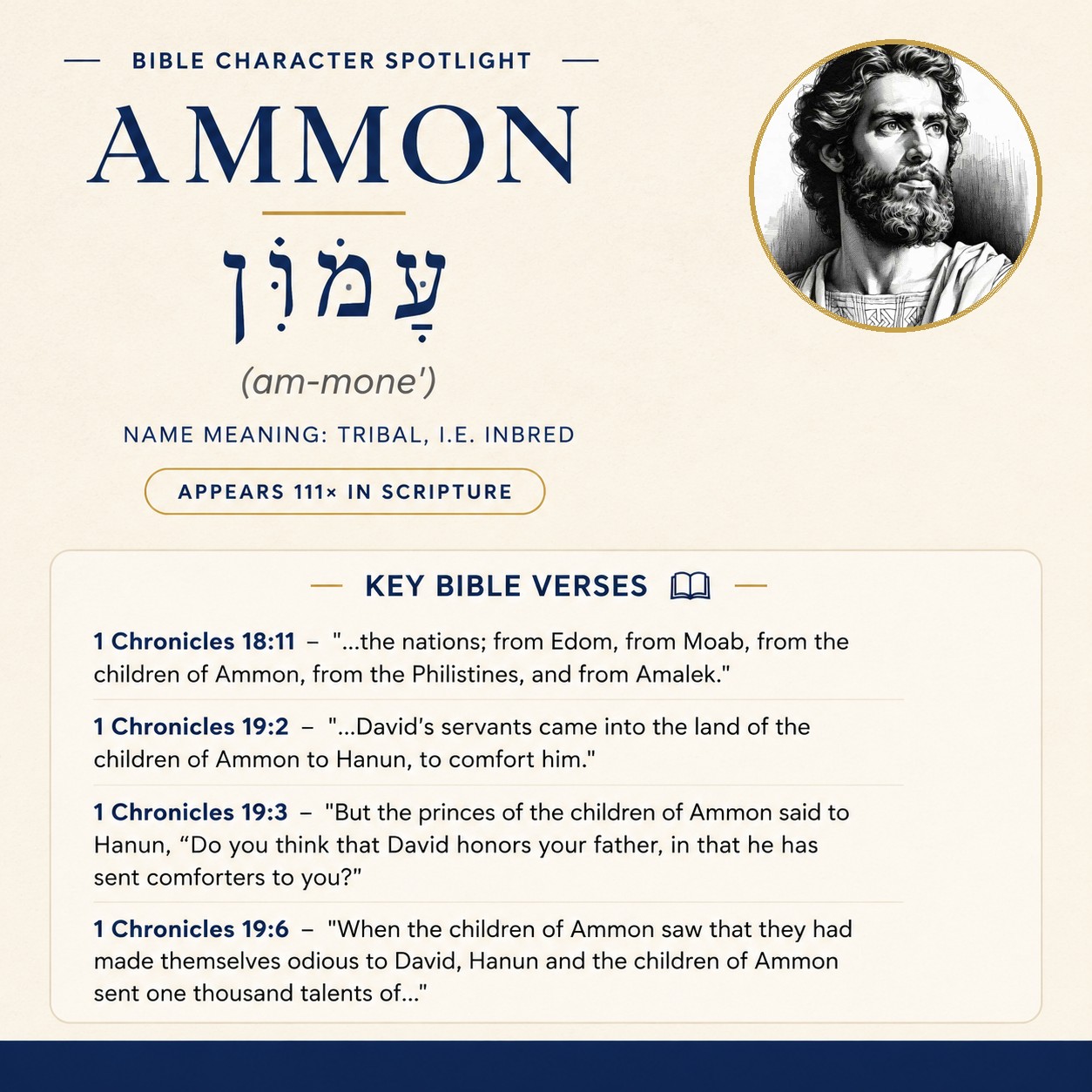
The form Ammon appears in Hebrew as עַמּוֹן (transliterated ‘Ammown, pronounced am-mone’). A lexicon derivation connects it to a root meaning “a people (as a congregated unit),” and characterizes it as “tribal.” The lexicon gloss identifies this Ammon as “a son of Lot,” and also uses the name for “his posterity and their country,” which aligns with the biblical phrasing “the children of Ammon” and “the land of the children of Ammon” (1 Chronicles 19:2).
The personal name Amon appears in Hebrew as אָמוֹן (transliterated ‘Amown, pronounced aw-mone’). A lexicon note connects it with a sense of being “skilled,” described as “an architect,” and states that the name is borne by multiple Israelites, matching the appearances of Amon as “the governor of the city” (1 Kings 22:26) and as a king in Jerusalem (2 Chronicles 33:21).
Another Hebrew form, also written אָמוֹן (transliterated ‘Amown, pronounced aw-mone’), is treated in the lexicon as of Egyptian derivation and is used for “Amon of No” (Jeremiah 46:25), while Nahum’s “No-Amon” frames the name as part of a place designation (Nahum 3:8).
Observation
Across these uses, the same name marks very different referents: a people who “gathered themselves together from their cities, and came to battle” (1 Chronicles 19:7), a king who “did that which was evil in Yahweh’s sight” (2 Chronicles 33:22), and a foreign power judged alongside its rulers and gods: “I will punish Amon of No, and Pharaoh, and Egypt” (Jeremiah 46:25).
Frequently Asked Questions
What does the name Ammon mean?
Ammon is given the meaning “tribal, i.e. inbred.”
How many times does Ammon appear in the Bible?
Across the entries listed, “Ammon/Amon” appears a total of 111 times.
Who was Ammon?
Ammon is identified as a son of Lot, and also as the name of his posterity and their country.
Was there more than one person or thing named Ammon/Amon?
Yes. The name refers to Ammon the son of Lot (and his descendants and their country), Amon as the name of three Israelites, and Amon as a deity of Egypt.
Explore Further
If you found this page about Ammon interesting and would like to discover more about other biblical characters, explore our comprehensive Encyclopedia of Biblical Characters. For those looking to delve deeper into the Greek origins of these names and terms, our Greek Lexicon is an invaluable resource.
Sources: Name and occurrence data from Strong’s Exhaustive Concordance and STEPBible reference data (CC BY). Scripture quotations from the World English Bible (public domain).




