
Who was Isaac in the bible?
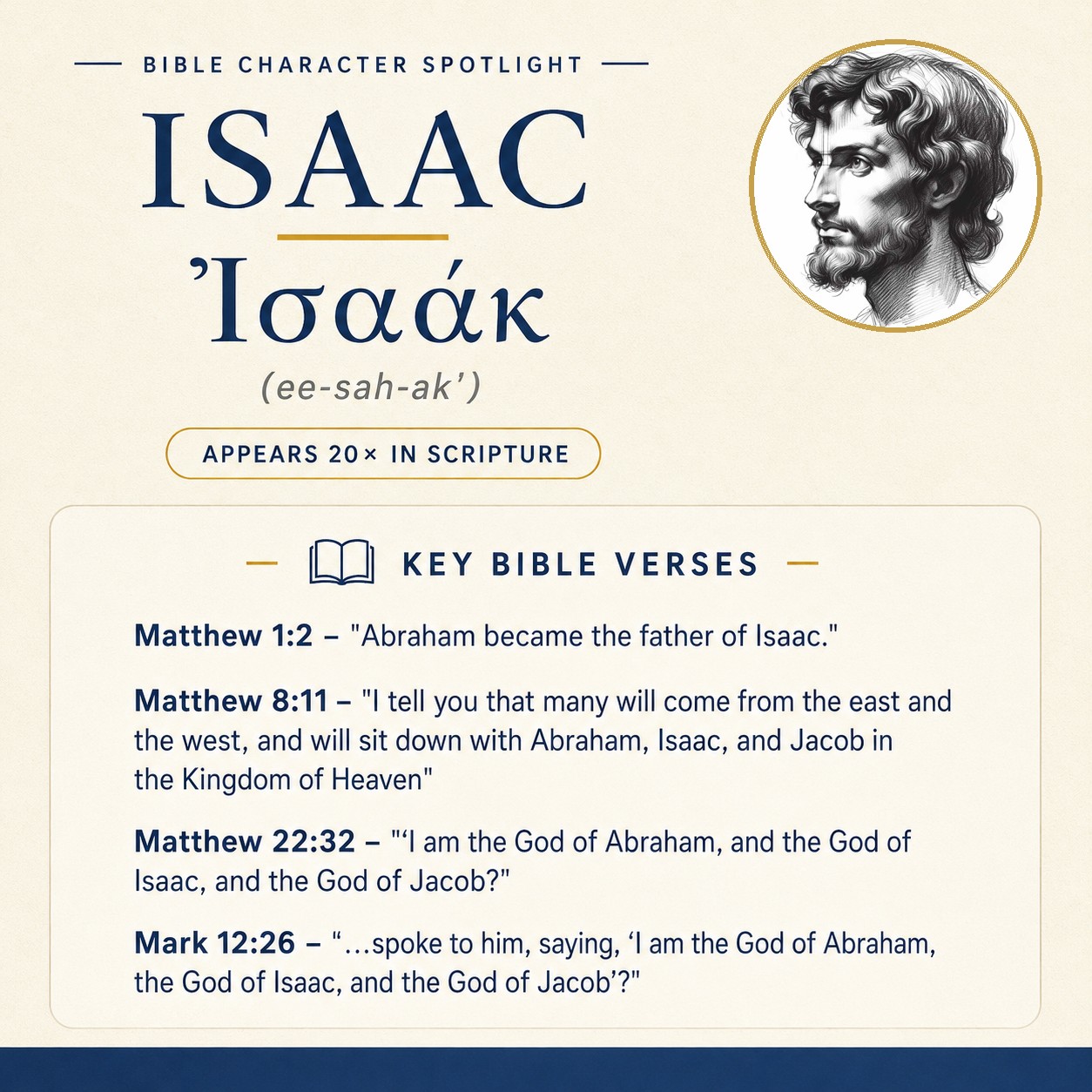
Isaac (Ἰσαάκ) appears in the New Testament as Abraham’s son and Jacob’s father, named in genealogies and in repeated references to “the God of Abraham, Isaac, and Jacob.”
In God’s Promise
Paul quotes the promise line: “your offspring will be accounted as from Isaac.” (Romans 9:7).
Learn More →Named With Patriarchs
Isaac is repeatedly named with Abraham and Jacob, as in: “I am the God of Abraham, and the God of Isaac, and the God of Jacob.” (Matthew 22:32).
Learn More →Isaac (Greek Ἰσαάκ, Isaak) is a biblical figure named in the New Testament as the son of Abraham and the father of Jacob, appearing in genealogies and in repeated formulas that speak of “the God of Abraham…Isaac…and Jacob.” The name is presented as being of Hebrew origin.
Isaac in Scripture
Isaac is first shown in the New Testament within Jesus’ genealogy as a link in a paternal line leading from Abraham onward:
“Abraham became the father of Isaac. Isaac became the father of Jacob. Jacob became the father of Judah and his brothers.” (Matthew 1:2)
Luke likewise includes Isaac in a genealogical sequence, placing him between Jacob and Abraham:
“the son of Jacob, the son of Isaac, the son of Abraham, the son of Terah, the son of Nahor,” (Luke 3:34)
In Jesus’ teaching about the kingdom, Isaac is named alongside Abraham and Jacob as one with whom many will “sit down”:
“I tell you that many will come from the east and the west, and will sit down with Abraham, Isaac, and Jacob in the Kingdom of Heaven,” (Matthew 8:11)
Elsewhere Jesus describes a future reversal in which some see these patriarchal figures inside God’s kingdom while they themselves are “thrown outside”:
“There will be weeping and gnashing of teeth when you see Abraham, Isaac, Jacob, and all the prophets in God’s Kingdom, and yourselves being thrown outside.” (Luke 13:28)
In debates about resurrection, Isaac appears in a quotation that identifies God as the God of living persons. Jesus frames the point by citing God’s self-identification:
“‘I am the God of Abraham, and the God of Isaac, and the God of Jacob?’ God is not the God of the dead, but of the living.” (Matthew 22:32)
Mark preserves the same argument with explicit reference to Moses and “the Bush” scene, again using the triad of names as the scriptural wording:
“But about the dead, that they are raised; haven’t you read in the book of Moses, about the Bush, how God spoke to him, saying, ‘I am the God of Abraham, the God of Isaac, and the God of Jacob’?” (Mark 12:26)
Luke records the same appeal to Moses at the bush:
“But that the dead are raised, even Moses showed at the bush, when he called the Lord ‘The God of Abraham, the God of Isaac, and the God of Jacob.’” (Luke 20:37)
Stephen’s speech in Acts (given in full in Acts 7) treats Isaac as part of a chain of promise and descent that begins with Abraham. Stephen recounts God’s call to Abraham—“‘Get out of your land and away from your relatives, and come into a land which I will show you.’” (Acts 7:3)—and notes that God “promised that he would give it to him for a possession, and to his offspring after him, when he still had no child.” (Acts 7:5). In that setting, Isaac is introduced as Abraham’s son in connection with “the covenant of circumcision”:
“He gave him the covenant of circumcision. So Abraham became the father of Isaac, and circumcised him the eighth day. Isaac became the father of Jacob, and Jacob became the father of the twelve patriarchs.” (Acts 7:8)
Stephen then moves from the patriarchs to Joseph, and later to Moses. When he arrives at Moses’ encounter with God, Stephen quotes the divine words that name Isaac as part of God’s self-identification:
“‘I am the God of your fathers, the God of Abraham, the God of Isaac, and the God of Jacob.’ Moses trembled, and dared not look.” (Acts 7:32)
Thus, within Stephen’s retelling, Isaac is both (1) a key figure in the generational line—Abraham, Isaac, Jacob—and (2) part of the language by which God identifies himself to Moses.
In Acts outside Stephen’s speech, Isaac is again named within a traditional formula used in proclamation about Jesus:
“The God of Abraham, Isaac, and Jacob, the God of our fathers, has glorified his Servant Jesus, whom you delivered up, and denied in the presence of Pilate, when he had determined to release him.” (Acts 3:13)
Paul’s letter to the Romans uses Isaac to define a particular line of “offspring,” quoting a statement about how offspring are “accounted”:
“Neither, because they are Abraham’s offspring, are they all children. But, ‘your offspring will be accounted as from Isaac.’” (Romans 9:7)
Romans also mentions Isaac as the man by whom Rebekah conceived, using the expression “our father” to describe him:
“Not only so, but Rebekah also conceived by one, by our father Isaac.” (Romans 9:10)
Name and Meaning
The New Testament form of the name is written Ἰσαάκ (transliterated Isaak, pronounced ee-sah-ak’). According to the lexicon note, the name is of Hebrew origin (from H03327), and the identity gloss identifies the bearer as Isaac.
Observation
Across these passages, Isaac is consistently presented in tandem with Abraham and Jacob—whether in genealogies (“Abraham became the father of Isaac…”) (Matthew 1:2), in the promise-line recalled by Stephen (Acts 7:8), or in the recurring divine title, “the God of Abraham…the God of Isaac…and the God of Jacob” (Matthew 22:32; Acts 7:32).
Frequently Asked Questions
What does the name Isaac mean?
Isaac is a name of Hebrew origin meaning “Isaac.”
How many times does Isaac appear in the Bible?
Isaac appears 20 times.
Who was Isaac?
Isaac is Abraham’s son and the father of Jacob (Matthew 1:2). Luke’s genealogy also lists him as “the son of Abraham” (Luke 3:34).
Where is Isaac mentioned in connection with the kingdom of heaven?
Jesus said that many will “sit down with Abraham, Isaac, and Jacob in the Kingdom of Heaven” (Matthew 8:11).
Explore Further
If you found this page about Isaac interesting and would like to discover more about other biblical characters, explore our comprehensive Encyclopedia of Biblical Characters. For those looking to delve deeper into the Greek origins of these names and terms, our Greek Lexicon is an invaluable resource.
Sources: Name and occurrence data from Strong’s Exhaustive Concordance and STEPBible reference data (CC BY). Scripture quotations from the World English Bible (public domain).




