Who was Edom in the bible?
Edom is a biblical name linked to Esau and to the land of Edom, appearing in genealogical and historical notices in 1 Chronicles, 1 Samuel, and 1 Kings.

Land of Edom
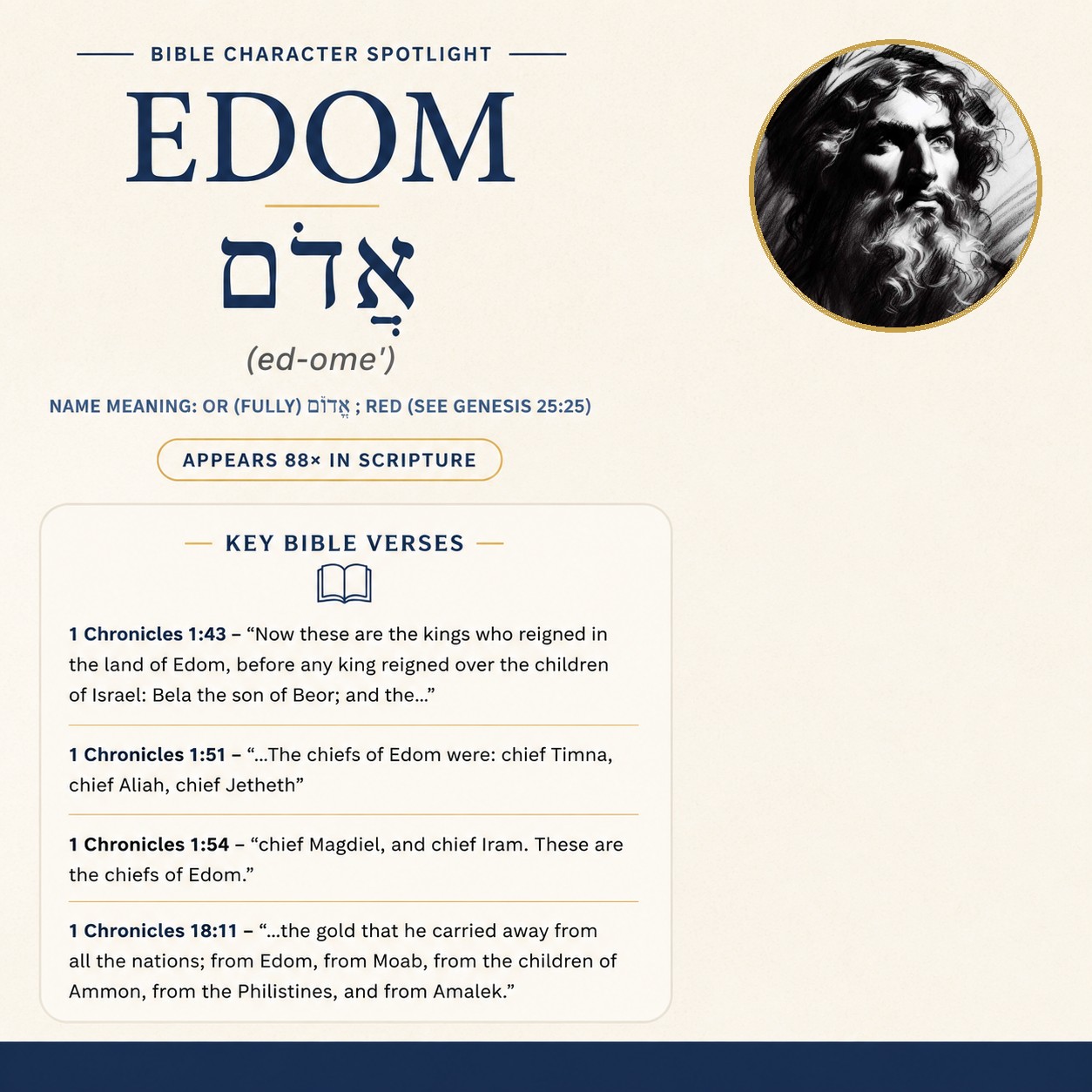
“Now these are the kings who reigned in the land of Edom, before any king reigned over the children of Israel” (1 Chronicles 1:43). “There was no king in Edom. A deputy ruled” (1 Kings 22:47).
Learn More →Israel and Edom
Saul “fought… against Edom” (1 Samuel 14:47). David’s era includes, “He put garrisons in Edom; and all the Edomites became servants to David” (1 Chronicles 18:13).
Learn More →Edom is presented as the name associated with Esau—identified in a lexicon gloss as the elder twin-brother of Jacob—and, by extension, with the region occupied by him. In the passages provided, “Edom” most often refers to a land and people group in relation to Israel’s kings and wars.
Edom in Scripture
In the genealogical setting of 1 Chronicles 1, Edom appears in connection with Esau (also called by a different name in the same chapter) and with the later political leadership of a land called Edom. The chapter frames this within a long list of generations that reaches Abraham and then narrows to Isaac’s line:
“Abraham became the father of Isaac. The sons of Isaac: Esau and Israel.” (1 Chronicles 1:34, WEB)
From there, the narrative continues through Esau’s descendants (listed by name), and then transitions to describe a territory specifically called “the land of Edom” with its rulers. The chapter highlights an ordered succession of kings in that land and explicitly compares this to Israel’s later monarchy:
“Now these are the kings who reigned in the land of Edom, before any king reigned over the children of Israel: Bela the son of Beor; and the name of his city was Dinhabah.” (1 Chronicles 1:43, WEB)
After introducing Bela, 1 Chronicles 1 continues by recording a sequence of reigns—each king dying and another reigning “in his place”—and includes brief identifying notes such as origin (“of Bozrah,” “of the land of the Temanites”), a deed (“who struck Midian in the field of Moab”), and city associations. The chapter closes the royal list and then shifts from kings to a roster of “chiefs of Edom,” presenting Edom as having an organized leadership beyond the kingship line:
“Then Hadad died. The chiefs of Edom were: chief Timna, chief Aliah, chief Jetheth,” (1 Chronicles 1:51, WEB)
“chief Magdiel, and chief Iram. These are the chiefs of Edom.” (1 Chronicles 1:54, WEB)
Beyond genealogical and administrative lists, Edom is also mentioned in Israel’s royal narratives as a place and people involved in warfare and tribute. During Saul’s reign, Edom appears among the neighboring opponents he fought:
“Now when Saul had taken the kingdom over Israel, he fought against all his enemies on every side, against Moab, and against the children of Ammon, and against Edom, and against the kings of Zobah, and against the Philistines.” (1 Samuel 14:47, WEB)
In David’s era, Edom is included among the nations whose valuables were dedicated to Yahweh, and the Chronicler describes a decisive conflict with Edomites and the establishment of garrisons there:
“King David also dedicated these to Yahweh, with the silver and the gold that he carried away from all the nations; from Edom, from Moab, from the children of Ammon, from the Philistines, and from Amalek.” (1 Chronicles 18:11, WEB)
“Moreover Abishai the son of Zeruiah struck eighteen thousand of the Edomites in the Valley of Salt.” (1 Chronicles 18:12, WEB)
“He put garrisons in Edom; and all the Edomites became servants to David. Yahweh gave victory to David wherever he went.” (1 Chronicles 18:13, WEB)
During Solomon’s reign, Edom appears as a geographic marker for maritime activity: Solomon’s fleet is located at a port “on the shore of the Red Sea,” explicitly said to be “in the land of Edom.”
“King Solomon made a fleet of ships in Ezion Geber, which is beside Eloth, on the shore of the Red Sea, in the land of Edom.” (1 Kings 9:26, WEB)
In the same broader period, a man identified by origin as an Edomite is raised up as an adversary to Solomon. The text describes him as belonging to royal offspring “in Edom,” and then recalls violence carried out in Edom in the days of David and Joab:
“Yahweh raised up an adversary to Solomon: Hadad the Edomite. He was one of the king’s offspring in Edom.” (1 Kings 11:14, WEB)
“For when David was in Edom, and Joab the captain of the army had gone up to bury the slain, and had struck every male in Edom” (1 Kings 11:15, WEB)
“(for Joab and all Israel remained there six months, until he had cut off every male in Edom);” (1 Kings 11:16, WEB)
Later, Edom is described as lacking its own king at a particular time, being administered instead by a “deputy”:
“There was no king in Edom. A deputy ruled.” (1 Kings 22:47, WEB)
Name and Meaning
The name is written in Hebrew as אֱדֹם, transliterated ’Edom and pronounced “ed-ome.” In the lexicon derivation given, the name is connected to the Hebrew root associated with being “red,” with a component word adom (אָדֹם) explained as “rosy.” The same gloss identifies Edom as Esau (described there as Jacob’s elder twin-brother) and states that the name is also used for the region occupied by him, matching the scriptural usage in these passages where “Edom” regularly designates a land (“the land of Edom”) and its people (“the Edomites”).
Observation
Across the provided texts, “Edom” functions both as a remembered polity with its own “kings who reigned in the land of Edom” (1 Chronicles 1:43) and as a neighboring territory repeatedly intersecting Israel’s monarchy through conflict, administration, and geography (1 Samuel 14:47; 1 Chronicles 18:13; 1 Kings 9:26; 1 Kings 22:47).
Frequently Asked Questions
What does the name Edom mean?
Edom means “red.”
How many times does Edom appear in the Bible?
Edom appears 88 times.
Who was Edom?
Edom was the elder twin-brother of Jacob, and the name is also used for the region occupied by him (Idumaea).
What does 1 Kings say about rulership in Edom?
1 Kings 22:47 says, “There was no king in Edom. A deputy ruled.”
Explore Further
If you found this page about Edom interesting and would like to discover more about other biblical characters, explore our comprehensive Encyclopedia of Biblical Characters. For those looking to delve deeper into the Greek origins of these names and terms, our Greek Lexicon is an invaluable resource.
Sources: Name and occurrence data from Strong’s Exhaustive Concordance and STEPBible reference data (CC BY). Scripture quotations from the World English Bible (public domain).