Exploring the Meaning of Tupto in Greek
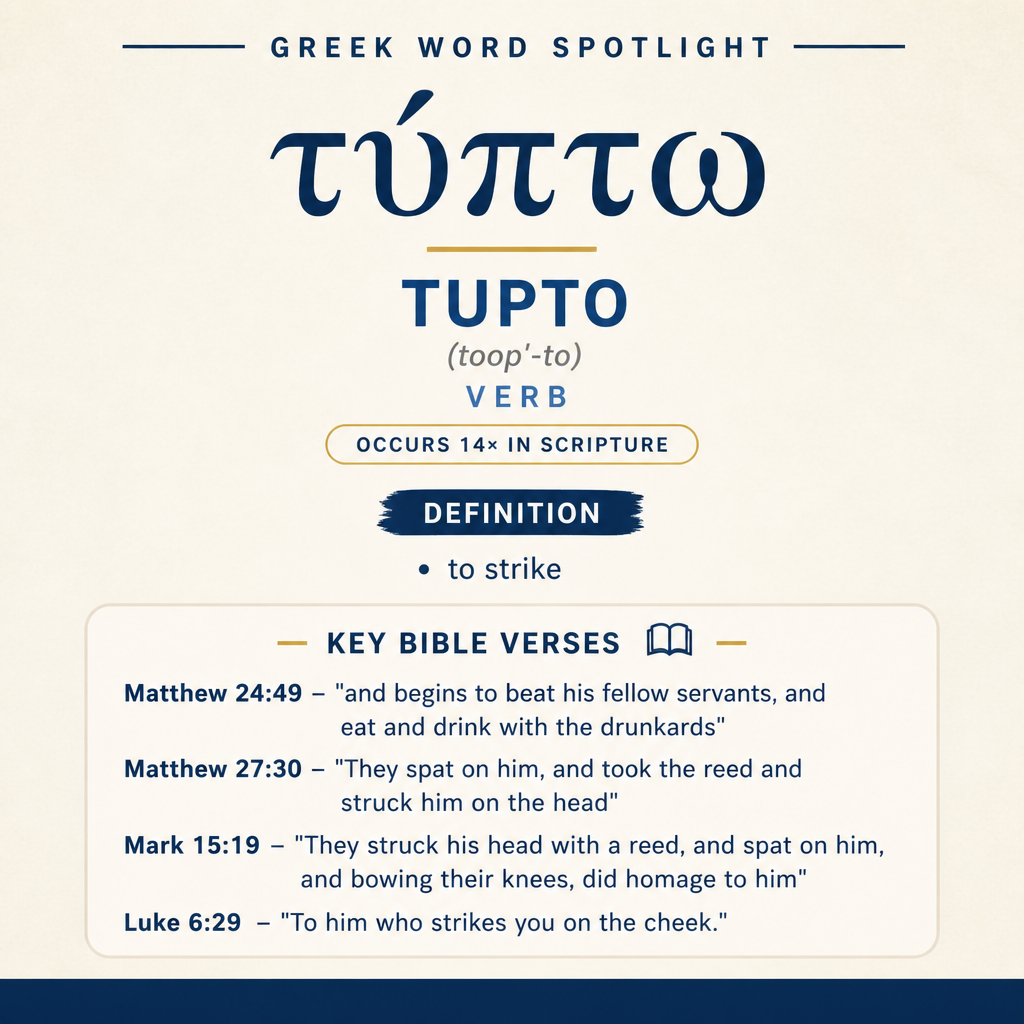
τύπτω means “to strike” and appears 14 times in Scripture, including in Matthew, Mark, and Luke.
Core Meaning
τύπτω means “to strike.” In the Gospel accounts, it describes physical blows and beating.
Learn More →Gospel Scenes
It is used of striking Jesus in Matthew 27:30, Mark 15:19, and Luke 22:64. It also appears in Jesus’ teaching about being struck (Luke 6:29).
Learn More →Human Response
It describes beating others in parabolic warnings (Matthew 24:49; Luke 12:45). It also describes beating one’s breast (Luke 18:13) and crowds returning home beating their breasts (Luke 23:48).
Learn More →Tupto means “to strike.” In the passages where it appears, it describes physical blows delivered in abuse, punishment, and mob violence, and it also depicts the striking of one’s own body as a visible sign of inner distress.
Occurrences
Matthew 24:49: “and begins to beat his fellow servants, and eat and drink with the drunkards,”
Here tupto expresses an outbreak of violence within a household setting: the servant “begins to beat his fellow servants.” The action is presented as the practical outworking of a settled attitude (“begins to…”) and is paired with reckless self-indulgence (“eat and drink with the drunkards”), so the striking marks not a single incident but a pattern of oppressive behavior.
Matthew 27:30: “They spat on him, and took the reed and struck him on the head.”
In this scene the striking is part of a sequence of humiliations (“spat… took… struck”). Tupto focuses attention on the blow itself—delivered with a “reed”—and specifies its target (“on the head”), making the act concrete and bodily, not merely verbal contempt.
Mark 15:19: “They struck his head with a reed, and spat on him, and bowing their knees, did homage to him.”
This occurrence again places tupto alongside spitting, but adds mock reverence (“bowing their knees… did homage”). The striking functions as a physical counterpoint to the feigned honor: the blow to the head with a reed exposes the “homage” as ridicule expressed through force.
Luke 6:29: “To him who strikes you on the cheek, offer also the other; and from him who takes away your cloak, don’t withhold your coat also.”
Tupto here appears in a direct address about how to respond when struck. The location “on the cheek” narrows the action to a personal, face-to-face affront. The instruction “offer also the other” assumes the blow is real and painful, yet treats it as something that can be met without immediate retaliation, placing the striking within a framework of patient endurance.
Luke 12:45: “But if that servant says in his heart, ‘My lord delays his coming,’ and begins to beat the menservants and the maidservants, and to eat and drink, and to be drunken,”
As in Matthew 24:49, tupto depicts a servant turning violent when he believes he will not be held accountable (“says in his heart”). The verb governs multiple victims (“the menservants and the maidservants”), widening the picture from a single target to a whole household being subjected to blows. The striking is part of a broader collapse into disorder (“eat and drink, and to be drunken”).
Luke 18:13: “But the tax collector, standing far away, wouldn’t even lift up his eyes to heaven, but beat his breast, saying, ‘God, be merciful to me, a sinner!’”
Here the striking is self-directed: he “beat his breast.” Tupto supplies the bodily gesture that matches his posture (“standing far away”) and refusal to look upward (“wouldn’t even lift up his eyes”). The blow is not aggression toward others but a physical expression of his plea for mercy.
Luke 22:64: “Having blindfolded him, they struck him on the face and asked him, “Prophesy! Who is the one who struck you?””
Tupto describes a blow delivered against a defenseless, blindfolded victim. The phrase “struck him on the face” emphasizes the intimacy and indignity of the assault. Their taunt (“Who is the one who struck you?”) turns the act of striking into a cruel game, where the attackers’ anonymity becomes part of the abuse.
Luke 23:48: “All the multitudes that came together to see this, when they saw the things that were done, returned home beating their breasts.”
In contrast to the violent striking in the passion scenes, tupto here portrays the crowd’s reaction: they go home “beating their breasts.” The repeated motion implied by “beating” conveys a collective, visible grief or remorse as they process “the things that were done.” The striking is again self-directed, functioning as a public sign of inner turmoil.
Acts 18:17: “Then all the Greeks seized Sosthenes, the ruler of the synagogue, and beat him before the judgment seat. Gallio didn’t care about any of these things.”
Tupto here is mob violence carried out in a civic space: Sosthenes is “seized” and “beat… before the judgment seat.” The location underscores the brazenness of the assault—done in front of official authority—while the closing comment (“Gallio didn’t care”) heightens the sense of unchecked striking.
Acts 21:32: “Immediately he took soldiers and centurions and ran down to them. They, when they saw the chief captain and the soldiers, stopped beating Paul.”
This occurrence shows striking in progress and then interrupted. The crowd “stopped beating Paul” only when confronted by military presence (“the chief captain and the soldiers”). Tupto thus captures ongoing physical harm that requires intervention to end, and the verb’s placement after “stopped” implies repeated blows rather than a single strike.
Acts 23:2: “The high priest, Ananias, commanded those who stood by him to strike him on the mouth.”
Tupto appears as an ordered act rather than spontaneous violence. The command targets “the mouth,” making the blow a silencing action within a judicial setting. The striking is delegated (“those who stood by him”), reflecting how authority can enlist others to deliver a blow.
Acts 23:3: “Then Paul said to him, “God will strike you, you whitewashed wall! Do you sit to judge me according to the law, and command me to be struck contrary to the law?””
In Paul’s response, tupto is used both as a prediction (“God will strike you”) and as a reference to the ordered assault (“command me to be struck”). The word holds together two spheres: the immediate courtroom violence and the expectation of a decisive blow in return. Within the quoted speech, the striking is framed as a contradiction of legal judgment (“judge… according to the law” yet “command… contrary to the law”).

Sense and Usage
Across these passages, tupto consistently denotes the act of striking, but its narrative function varies with who delivers the blow, who receives it, and where it occurs. In household scenes (Matthew 24:49; Luke 12:45), striking is a mark of abuse of power: the servant’s violence is tied to moral unraveling and the exploitation of those under his control. In the passion narratives (Matthew 27:30; Mark 15:19; Luke 22:64), tupto is embedded in ritualized humiliation—spitting, mock homage, blindfolding, and taunting—where the blow is not only painful but also degrading, especially when directed at the head or face.
Luke 6:29 places tupto in the realm of interpersonal offense (“on the cheek”) and focuses less on the striker’s intent than on the struck person’s response. The verb’s concreteness—someone “strikes you”—grounds the instruction in lived bodily experience rather than abstract wrongdoing. Acts expands the social scope: tupto describes public beatings (Acts 18:17; 21:32) and sanctioned violence within a hearing (Acts 23:2–3), showing that striking can be both lawless (a crowd beating) and authorized (a command to strike). In these contexts, the verb helps readers feel the immediacy of physical force pressing into public life, whether officials ignore it (“Gallio didn’t care”) or soldiers halt it (“stopped beating Paul”).
Distinctively, tupto also depicts self-striking as a gesture of distress (Luke 18:13; 23:48). In both cases the motion is directed to the breast, and the surrounding details interpret the gesture: the tax collector’s beating accompanies a plea for mercy and an abased stance, while the crowd’s beating accompanies their return home after witnessing grave events. Thus, while the word’s core action remains striking, its occurrences include both violence inflicted and a bodily sign enacted—an outward, physical act that communicates an inward state.
Imagery
The imagery of tupto in these texts is intensely physical: reeds striking a head, a face struck under a blindfold, a mouth targeted by command, a man beaten in front of a judgment seat, a crowd halted mid-beating by soldiers. Alongside these blows are the quieter but equally embodied images of people beating their own breasts, where striking becomes a wordless language of guilt, sorrow, or urgent pleading.
Sources: Lexical data from Strong’s Exhaustive Concordance and the Translators Brief Lexicon of Extended Strongs for Greek (STEPBible, CC BY). Occurrence data from the Translators Amalgamated Greek New Testament (STEPBible, CC BY). Scripture quotations from the World English Bible (public domain).