
Exploring the Meaning of Tuphoo in Greek
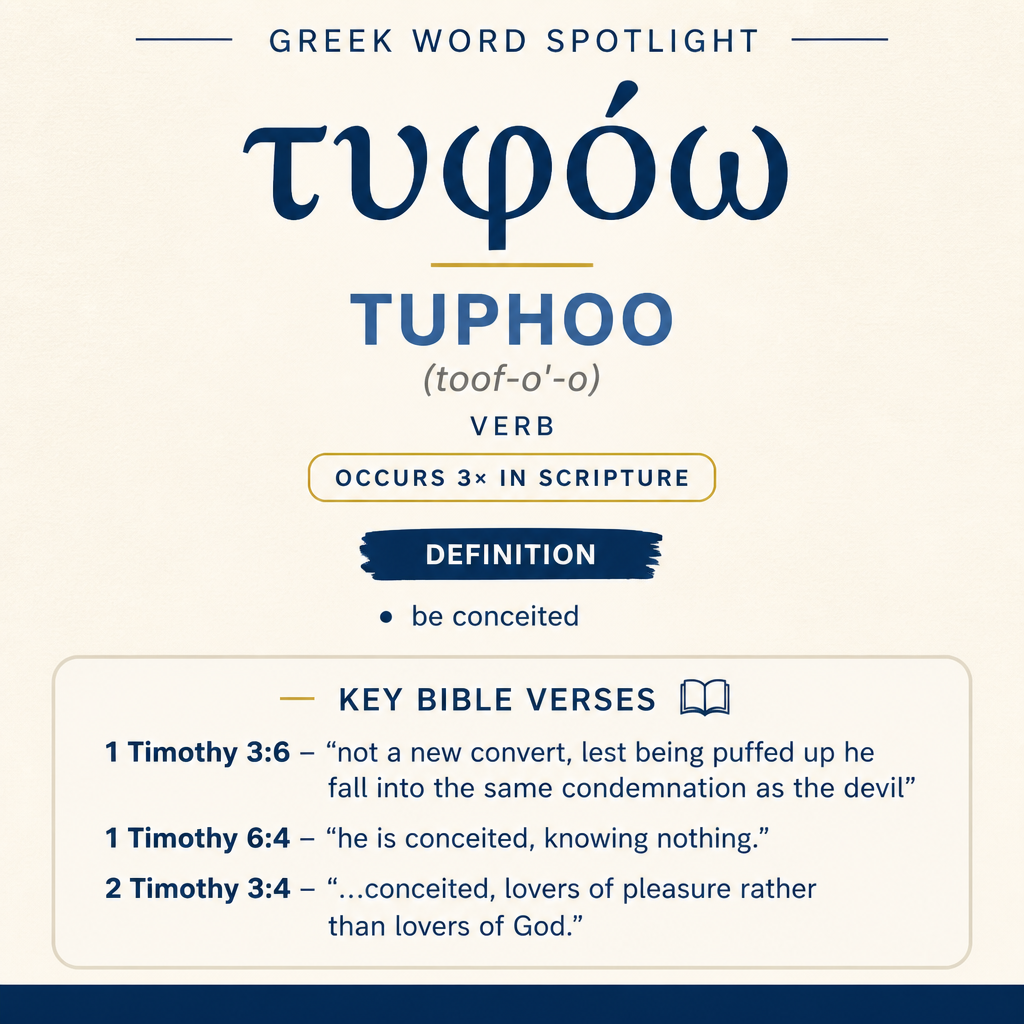
τυφόω means “be conceited” and occurs three times: 1 Timothy 3:6; 1 Timothy 6:4; 2 Timothy 3:4.
Pauline Warnings
In 1 Timothy 3:6, it describes being “puffed up,” leading to condemnation like the devil’s. In 1 Timothy 6:4, it marks a person as conceited and “knowing nothing.”
Learn More →End-Times Portrait
In 2 Timothy 3:4, τυφόω characterizes people as “traitors, headstrong, conceited.”
Learn More →τυφόω describes being conceited, a moral and spiritual inflation that distorts judgment and relationships. It appears in pastoral instruction about leadership qualifications and in lists of destructive character traits.
Root and Related Words
τυφόω (Tuphoo) is related to τύφω (typho), “to smoulder” (Strong’s G5188). The related verb evokes the picture of something producing heat and haze from within rather than clear light, a fitting backdrop for the way conceit clouds perception in the passages where τυφόω appears.

Occurrences
“not a new convert, lest being puffed up he fall into the same condemnation as the devil.” (1 Timothy 3:6)
Here τυφόω is set within a safeguard for appointing overseers: the person must be “not a new convert.” The danger is not mere inexperience but an inner change triggered by position and visibility—“lest being puffed up.” Conceit is portrayed as an escalator into peril: it can lead someone to “fall into the same condemnation as the devil.” In this line, conceit is not treated as a private personality quirk; it is a spiritual hazard with consequences that reach beyond the individual, serious enough to shape the church’s criteria for recognized leadership.

“he is conceited, knowing nothing, but obsessed with arguments, disputes, and word battles, from which come envy, strife, insulting, evil suspicions,” (1 Timothy 6:4)
In this sentence τυφόω marks the inner posture behind a particular pattern of teaching and community harm. The conceited person is described as “knowing nothing,” a blunt assessment that directly contradicts the self-assurance implied by conceit. The verse then traces what this posture produces: an “obsessed” fixation on “arguments, disputes, and word battles.” The flow is important: conceit stands at the head of a chain that moves from inflated self-regard to combative speech, then to relational toxins—“envy, strife, insulting, evil suspicions.” τυφόω therefore contributes more than the label of pride; it helps explain why a person can be noisy and quarrelsome while actually lacking true understanding, and why their influence fractures fellowship.
“traitors, headstrong, conceited, lovers of pleasure rather than lovers of God,” (2 Timothy 3:4)
In this catalog of vices, τυφόω appears as one trait among several that describe a deeply disordered character. The immediate neighbors—“headstrong” and “lovers of pleasure rather than lovers of God”—frame conceit as part of a wider pattern of self-driven life. “Headstrong” suggests a pushy insistence on one’s own way, and the contrast between pleasure and God presents the person’s controlling loves. Within that cluster, “conceited” names the inflated self-estimate that fits with reckless self-will and misplaced devotion. The word functions here as a diagnostic term: it does not stand alone but helps fill out a composite portrait of people whose loyalties and choices are turned inward.
Sense and Usage
Across these three contexts, τυφόω consistently points to an inner swelling of self that warps how a person sees themselves and therefore how they act. In 1 Timothy 3:6 it is tied to rapid elevation: a “new convert” may be thrust into responsibility before humility has been tested, and conceit becomes the doorway to a catastrophic fall. The emphasis is preventative and pastoral; the community is instructed to avoid placing someone in a setting where self-inflation is likely to be triggered.
In 1 Timothy 6:4 the term is given its most detailed behavioral footprint. Conceit sits beside a striking contradiction: the conceited person is “knowing nothing.” The verse does not treat ignorance as innocent; it is paired with argumentative obsession. The result is a social atmosphere marked by envy and conflict. τυφόω, then, is not merely self-confidence taken too far; it is self-exaltation that resists correction and feeds contention, because it seeks to win rather than to understand.
In 2 Timothy 3:4 τυφόω is embedded in a list that sketches the moral climate of people who are dangerous to trust (“traitors”), impulsively self-directed (“headstrong”), and wrongly oriented in desire (“lovers of pleasure rather than lovers of God”). The word contributes the sense that their actions grow out of an inflated self-importance. When conceit is present, the self becomes the measure, the self becomes the cause, and the self becomes the goal—an internal posture that coheres with the surrounding traits even when those traits take different outward forms.
Taken together, these passages show τυφόω operating in two main arenas: (1) the shaping of leaders and the prudence required in appointing them, and (2) the unraveling of community life through contentious speech and vice-lists that name destructive dispositions. The common thread is that conceit is portrayed as active and productive: it leads somewhere. It generates consequences—condemnation and falling (1 Timothy 3:6), quarrels and corrosive suspicion (1 Timothy 6:4), and alignment with self-serving loves (2 Timothy 3:4).
Imagery and Tone
The relationship to τύφω, “to smoulder,” suits the way these verses present conceit: as something kindled within that sends up a haze. In 1 Timothy 3:6, the haze precedes a “fall,” suggesting loss of stability and clear footing. In 1 Timothy 6:4, the haze turns conversation into “word battles,” filling the space between people with heat instead of light, and the result is a bitter harvest of “envy” and “strife.” In 2 Timothy 3:4, conceit belongs to a broader moral smoke that accompanies headstrong living and the preference of pleasure over God. The tone throughout is not amused or mild; τυφόω is treated as a serious inner condition with outward fallout.
Sources: Lexical data from Strong’s Exhaustive Concordance and the Translators Brief Lexicon of Extended Strongs for Greek (STEPBible, CC BY). Occurrence data from the Translators Amalgamated Greek New Testament (STEPBible, CC BY). Scripture quotations from the World English Bible (public domain).




