Exploring the Meaning of Tupos in Greek
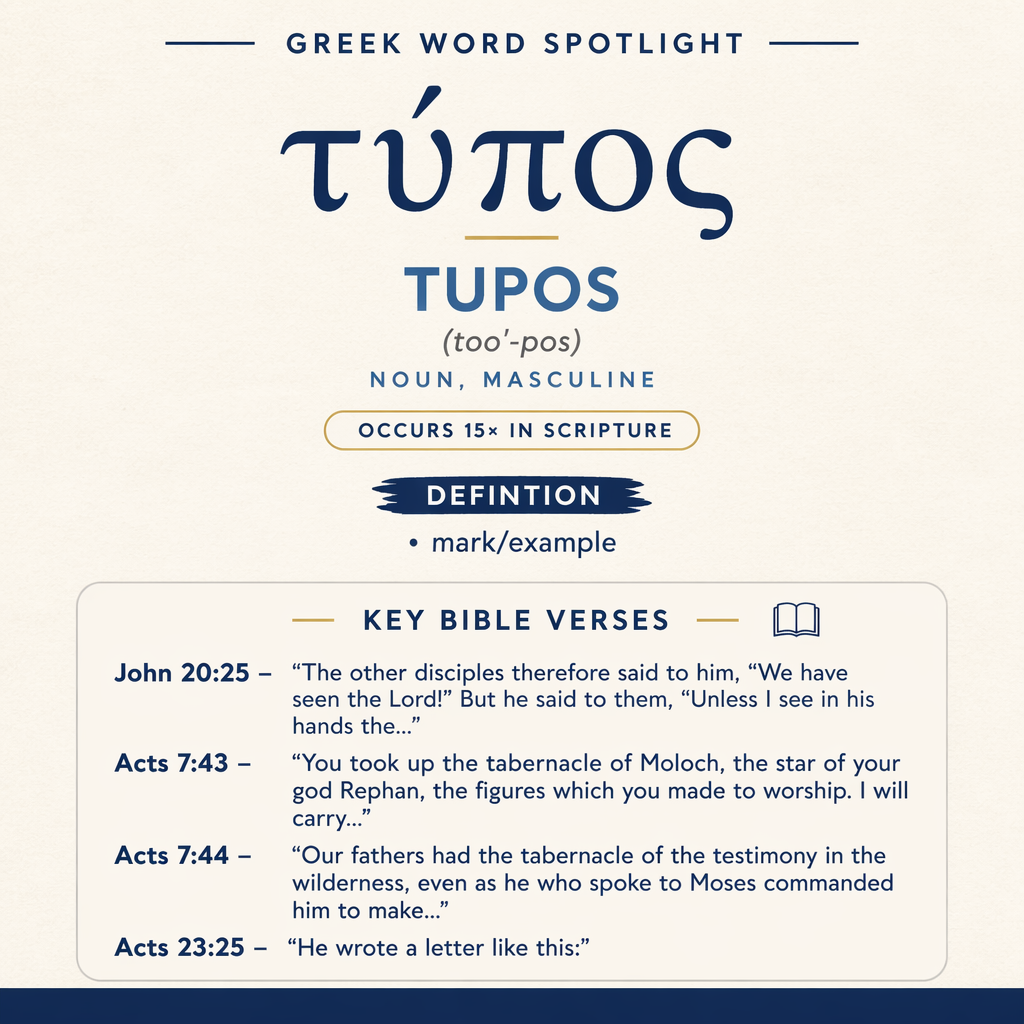
τύπος (Tupos) means “mark/example” and appears 15 times in Scripture, including John 20:25; Acts 7:43–44; Romans 5:14; 1 Corinthians 10:6; and Philippians 3:17.
Core Meaning
τύπος is defined as “mark/example.” It is a Greek word used in Scripture.
Learn More →Scripture Occurrences
It occurs 15 times in Scripture. Listed references include John 20:25; Acts 7:43–44; Acts 23:25; Romans 5:14; Romans 6:17; 1 Corinthians 10:6; and Philippians 3:17.
Learn More →Usage Snapshots
John 20:25 uses it in the context of seeing marks in Jesus’ hands. In 1 Corinthians 10:6 and Philippians 3:17 it is connected with examples to follow or learn from.
Learn More →τύπος carries the idea of a mark that can function as an example. In the passages where it appears, it ranges from a physical impression to a guiding pattern, and from illustrative events to lives held up for imitation.
Occurrences
John 20:25: The other disciples therefore said to him, “We have seen the Lord!” But he said to them, “Unless I see in his hands the print of the nails, put my finger into the print of the nails, and put my hand into his side, I will not believe.”
Here τύπος is the “print of the nails,” a concrete mark tied to the crucifixion wounds. The scene is driven by Thomas’s demand for contact with an identifiable impression: seeing the mark, inserting a finger into it, and placing a hand into Jesus’s side. The word’s force is evidential—an observable mark that can be checked by sight and touch—and it anchors belief to a specific, bodily trace.
Acts 7:43: You took up the tabernacle of Moloch, the star of your god Rephan, the figures which you made to worship. I will carry you away beyond Babylon.’
In Stephen’s speech, τύπος occurs in the setting of “the figures which you made to worship.” The emphasis falls on made objects (“figures”) associated with worship. Within the quotation, τύπος contributes to the portrayal of crafted items taken up and revered, underscoring the humanly produced character of what is being carried and honored.
Acts 7:44: “Our fathers had the tabernacle of the testimony in the wilderness, even as he who spoke to Moses commanded him to make it according to the pattern that he had seen;
τύπος appears as “the pattern” shown to Moses. The tabernacle is not improvised; it is made “according to” a seen pattern. The word thus functions as a guiding model that determines construction, linking what is built in the wilderness to an authoritative template witnessed beforehand.
Acts 23:25: He wrote a letter like this:
In this brief narrative line, τύπος frames the form of what follows: “a letter like this.” The word points to a set piece—an example or specimen of the letter’s content and shape—presented as a copy or standard instance rather than a mere summary.
Romans 5:14: Nevertheless death reigned from Adam until Moses, even over those whose sins weren’t like Adam’s disobedience, who is a foreshadowing of him who was to come.
Paul places τύπος in a historical comparison. Adam is described as “a foreshadowing of him who was to come,” so the earlier figure functions as an example with forward reference within the argument. The surrounding statement about death’s reign sets a broad stage (from Adam to Moses), and τύπος marks Adam’s role as a representative example within that sweep.
Romans 6:17: But thanks be to God, that, whereas you were bondservants of sin, you became obedient from the heart to that form of teaching to which you were delivered.
Here τύπος is “that form of teaching.” The stress is not on an isolated lesson but on a recognizable shape or mold of instruction—something with definable contours to which obedience can correspond “from the heart.” The clause “to which you were delivered” presents this form as something received and entrusted, not self-generated.
1 Corinthians 10:6: Now these things were our examples, to the intent we should not lust after evil things, as they also lusted.
τύπος is “our examples” drawn from earlier “things” Paul has just referenced. The function is moral and preventive: the examples aim “that we should not lust after evil things.” The word ties past events to present instruction by treating them as illustrative marks that are meant to shape desire and restraint.
Philippians 3:17: Brothers, be imitators together of me, and note those who walk this way, even as you have us for an example.
τύπος is the “example” embodied in Paul and those who “walk this way.” The appeal to imitation shows τύπος operating in lived practice: a pattern visible in conduct that can be followed. The word’s contribution is relational and communal—an example provided “to” the brothers and recognized by “not[ing] those who walk this way.”
1 Thessalonians 1:7: so that you became an example to all who believe in Macedonia and in Achaia.
τύπος describes the Thessalonian believers as an “example” with regional reach. The verse portrays their life as a model for “all who believe” in specified areas, so the word carries the idea of a replicable pattern of faithfulness that others can look toward.
2 Thessalonians 3:9: not because we don’t have the right, but to make ourselves an example to you, that you should imitate us.
τύπος is intentionally crafted here: “to make ourselves an example to you.” The purpose clause—“that you should imitate us”—shows the example functioning as a deliberate template for behavior. The verse also highlights self-restraint (“not because we don’t have the right”), presenting the example as something formed through choices that could have gone differently.
1 Timothy 4:12: Let no man despise your youth; but be an example to those who believe, in word, in your way of life, in love, in spirit, in faith, and in purity.
τύπος is a directive for Timothy’s public and private credibility. The example is multidimensional: speech (“in word”), conduct (“in your way of life”), and inner or relational qualities (“in love, in spirit, in faith, and in purity”). The word gathers these domains under one idea: a life that leaves a clear mark for “those who believe” to follow, countering the potential stigma of youth.
Titus 2:7: In all things be showing yourself an example of good works. In your teaching, be showing integrity, seriousness, incorruptibility,
τύπος again appears as a charge: “be showing yourself an example of good works.” The verse links example not only to actions (“good works”) but also to the manner of instruction (“In your teaching, be showing integrity, seriousness, incorruptibility”). The word thus covers both deed and pedagogy, presenting the teacher’s life and teaching as a model meant to be seen.

Sense and Usage
Across these texts, τύπος moves between the physical and the moral without losing its central idea. In John 20:25, it is a tangible impression—the kind of mark that can be verified by contact. That concrete use helps illuminate the more figurative ones: the “pattern” of Acts 7:44 and the “form of teaching” in Romans 6:17 both present something with definite shape, something one can conform to rather than merely admire. In Acts 23:25, the word sits at the level of document form, introducing a sample instance that can be read as a model of official communication.
When τύπος functions as “example” in the letters, it regularly bears an imitative pull. The examples of 1 Corinthians 10:6 are not neutral illustrations; they are meant to exert pressure on desire and choice (“to the intent we should not lust after evil things”). In Philippians 3:17 and 2 Thessalonians 3:9, τύπος is explicitly linked to imitation: the community is asked to copy a visible pattern of walking and to follow leaders who present themselves as a model. In 1 Thessalonians 1:7, the direction of influence widens so that a local church becomes an example for believers across regions. In the pastoral instructions (1 Timothy 4:12; Titus 2:7), the word’s range includes speech, lifestyle, virtues, works, and teaching demeanor—domains where a leader’s conduct can function as a template for the believing community.
Romans 5:14 places τύπος in an argument about representative figures across time. There, the word’s value is comparative and illustrative: a person can serve as an example with forward-facing significance within a larger theological line of thought. Taken together, the occurrences show τύπος as a word that can name (1) an identifiable mark, (2) a guiding pattern or form, and (3) an example presented for others to observe and imitate.
Imagery
These passages repeatedly link τύπος with what can be “seen”: a nail-print to be inspected (John 20:25), a pattern shown for construction (Acts 7:44), a letter set out in a recognizable form (Acts 23:25), and lives that can be “not[ed]” and imitated (Philippians 3:17). Even where the word is used for moral instruction, it carries the feel of something impressed—an example that leaves a discernible outline in conduct, teaching, and communal memory.
Sources: Lexical data from Strong’s Exhaustive Concordance and the Translators Brief Lexicon of Extended Strongs for Greek (STEPBible, CC BY). Occurrence data from the Translators Amalgamated Greek New Testament (STEPBible, CC BY). Scripture quotations from the World English Bible (public domain).