Exploring the Meaning of Trachelizo in Greek
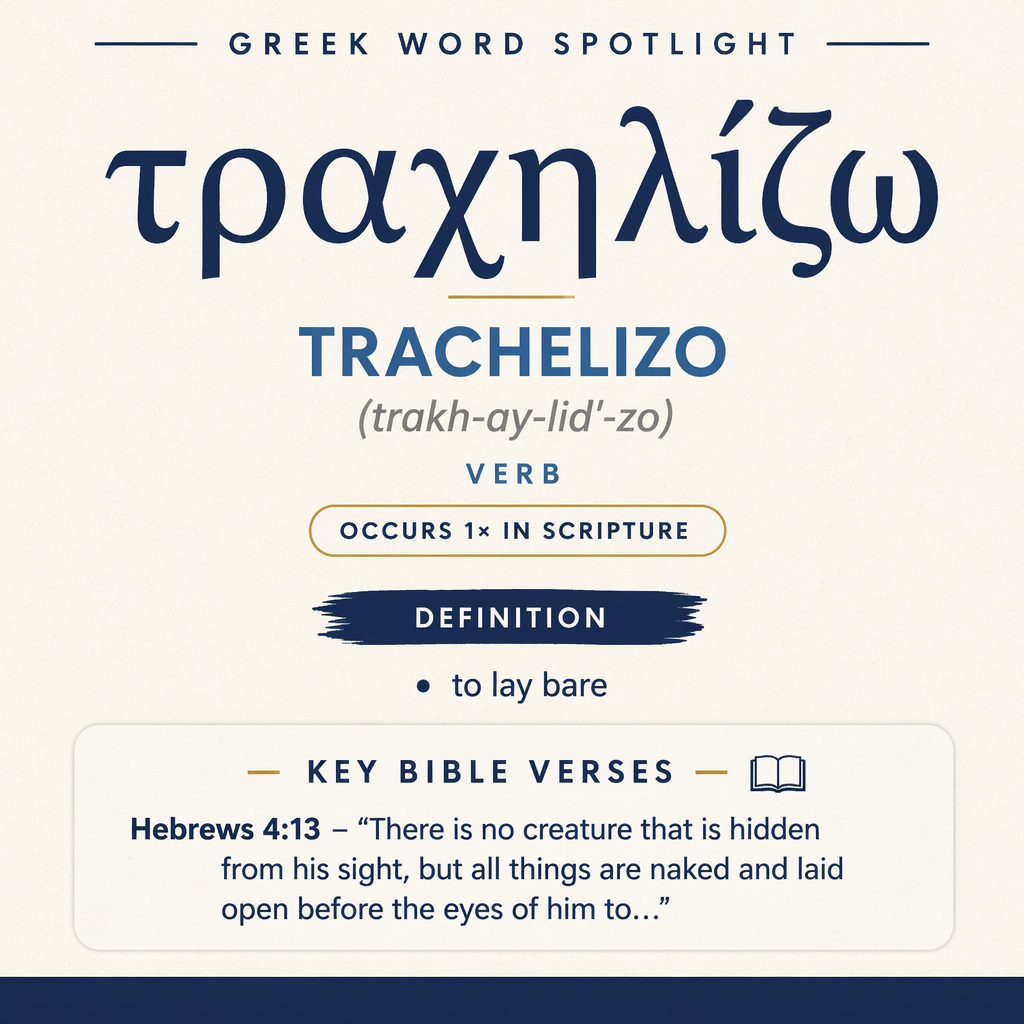
τραχηλίζω means “to lay bare” and appears once in Scripture, in Hebrews 4:13.
Biblical Occurrence
This verb occurs 1 time in Scripture. It appears in Hebrews 4:13.
Learn More →Verse Context
In Hebrews 4:13, it describes all things as “naked and laid open” before God’s eyes.
Learn More →τραχηλίζω means “to lay bare,” and it appears once in the New Testament, in Hebrews 4:13. In that setting it intensifies the claim that nothing in creation can remain concealed before God’s searching gaze.
Root and Related Words
τραχηλίζω is derived from trachelos (τράχηλος), “neck” (Strong’s G5137). The connection with “neck” anchors the verb’s imagery in bodily exposure, fitting the context of visibility and disclosure before God.

Occurrences
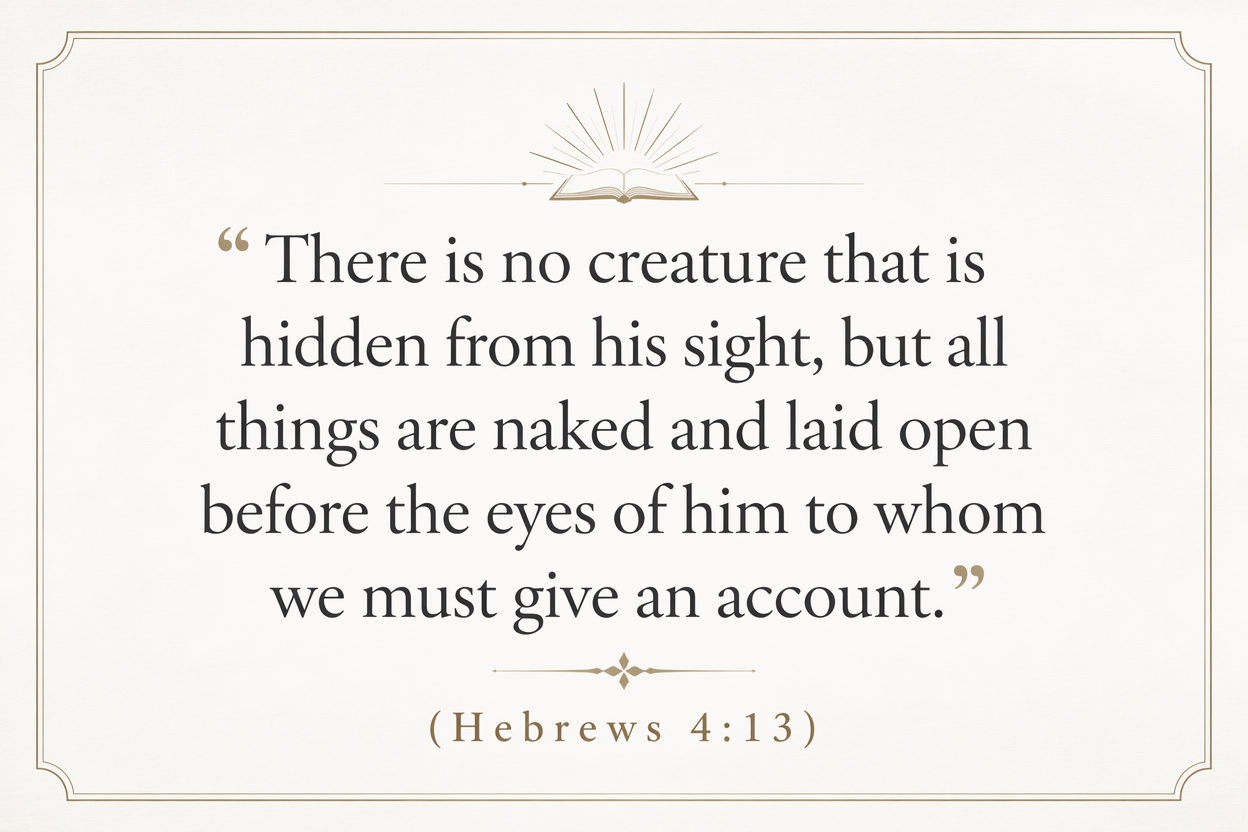
“There is no creature that is hidden from his sight, but all things are naked and laid open before the eyes of him to whom we must give an account.” (Hebrews 4:13)
Hebrews 4:13 sets up a total contrast: nothing is “hidden from his sight,” and instead “all things” stand in the open. Within that sweep, “laid open” works alongside “naked” to describe exposure in the fullest possible terms. The verse does not speak of a partial unveiling, or of certain areas of life being known while others remain private; it states that every “creature” falls under the same condition, and it drives that point home by stacking two descriptions of uncoveredness. “Laid open” portrays disclosure as something complete and irreversible in relation to “the eyes of him.”
The wording also fixes the direction of this exposure: it is “before the eyes of him,” not merely before human observers or before one’s own conscience. The exposure is relational and judicial in tone, because it is tied directly to accountability: “to whom we must give an account.” In that light, “laid open” carries the force of being fully exposed in the presence of the One who evaluates. The verb contributes a sense that concealment is impossible at the very point where reckoning is unavoidable; the one who sees is also the one “to whom” the account is rendered.
The verse frames this exposure as universal (“all things”) and comprehensive (“no creature”). That breadth matters for the verb’s effect: “laid open” is not limited to outward actions, public reputation, or visible behavior. In this sentence, it belongs to a claim about the entire created order as it stands under divine scrutiny. The result is a picture of total transparency: everything is uncovered, and it is uncovered specifically in God’s sight.
Sense and Usage
In Hebrews 4:13, “to lay bare” functions as an image of complete disclosure. The surrounding language supplies the contours of the sense: what is “laid open” is the opposite of what is “hidden,” and its sphere is “before the eyes” of God. The verb therefore expresses exposure in a way that is not merely accidental or momentary; it belongs to the settled reality of how God sees. The emphasis falls less on a process of revealing and more on the state of being fully exposed in God’s presence.
The pairing of “naked” with “laid open” sharpens the idea. “Naked” already communicates the lack of covering; “laid open” reinforces that there is no remaining barrier or closed-off area that could resist that gaze. The verse presents these as parallel descriptors of the same condition, pressing the reader to feel the weight of absolute visibility. Within the sentence, “laid open” is the culmination of the thought: if nothing is hidden, then everything stands uncovered and exposed before God.
The final clause—“to whom we must give an account”—shows why this exposure matters in context. “Laid open” is not a neutral observation about omniscience; it is tied to moral and personal responsibility. What lies bare is not merely observed; it is observed by the One to whom an account is owed. That linkage supplies the word’s rhetorical force: full exposure is the necessary prelude to true accounting, because nothing can be withheld, edited, or kept out of view when the reckoning is addressed to the One who sees all.
Because the verse speaks in absolute terms (“no creature,” “all things”), the usage also carries an inclusive reach. The condition described by “laid open” applies across the board, leaving no category of being exempt from exposure. The verb thus serves the verse’s larger claim that God’s sight penetrates every attempt at concealment, making the prospect of accounting unavoidable and fully informed.
Imagery
The imagery of “laid open” in Hebrews 4:13 is bodily and vivid, reinforced by the nearby word “naked.” Together they evoke the experience of standing with nothing to shield what one is before a searching gaze. The verse locates that gaze in “the eyes of him,” so the image is not simply about vulnerability in general but about being wholly exposed in the presence of the One who sees and before whom an account must be made.
Sources: Lexical data from Strong’s Exhaustive Concordance and the Translators Brief Lexicon of Extended Strongs for Greek (STEPBible, CC BY). Occurrence data from the Translators Amalgamated Greek New Testament (STEPBible, CC BY). Scripture quotations from the World English Bible (public domain).