
Exploring the Meaning of Trachonitis in Greek
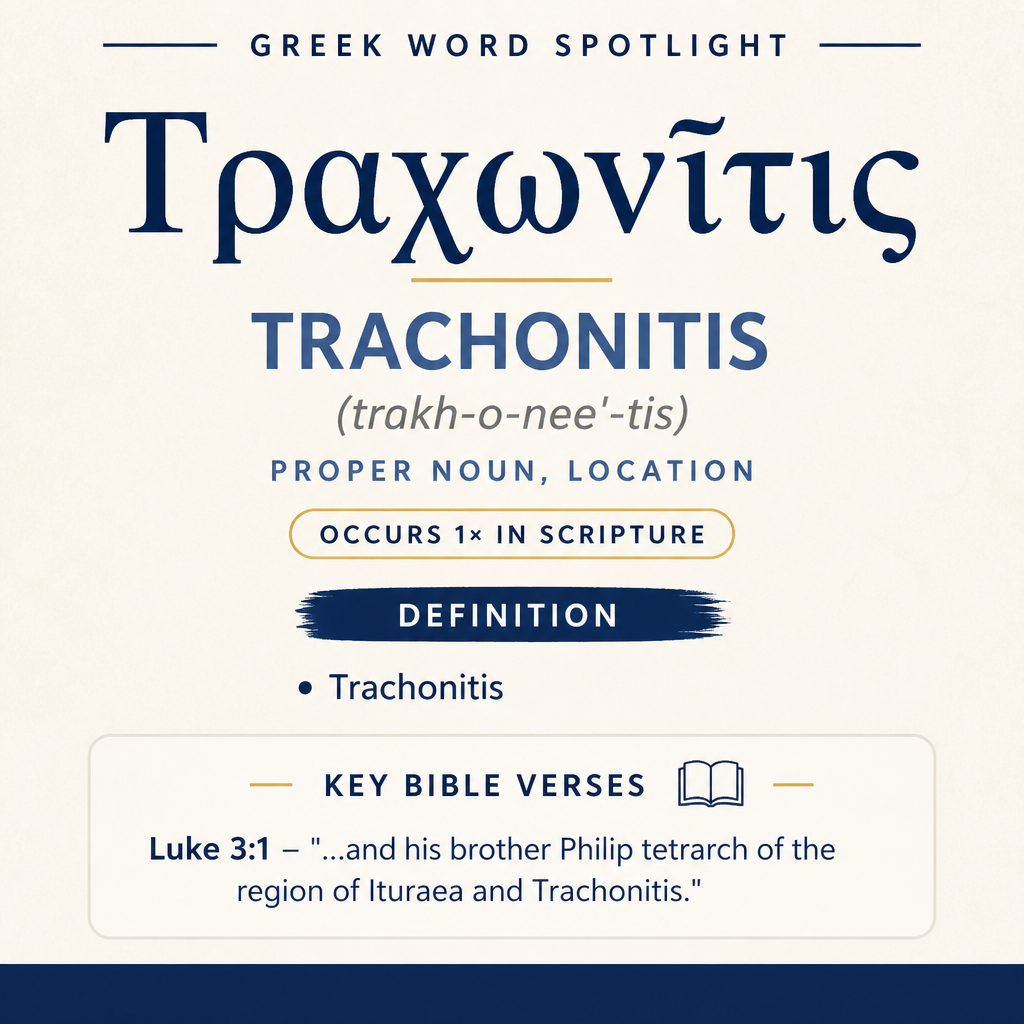
Τραχωνῖτις means “Trachonitis” and appears once in Scripture, in Luke 3:1.
Verse Context
In Luke 3:1, it appears within a historical notice naming rulers and officials.
Learn More →Trachonitis is a geographic name that appears in Luke’s opening historical framework for the beginning of John’s ministry. In that setting it functions as one item in a list of territories, helping locate political authority alongside other regions named in the same sentence.
Root and Related Words
The name Trachonitis is connected (as a derived form) with the adjective trachys (τραχύς), meaning “rough” (Strong’s G5138). This relationship links the place-name to a Greek descriptive term, presenting the location as a named region rather than merely a descriptive phrase within the narrative.

Occurrences
“Now in the fifteenth year of the reign of Tiberius Caesar, Pontius Pilate being governor of Judea, and Herod being tetrarch of Galilee, and his brother Philip tetrarch of the region of Ituraea and Trachonitis, and Lysanias tetrarch of Abilene,” (Luke 3:1)
In Luke 3:1, Trachonitis appears as part of a tightly structured catalogue of rulers and jurisdictions: an emperor (“Tiberius Caesar”), a governor (“Pontius Pilate”), and several tetrarchs with their respective spheres (“Herod… of Galilee,” “Philip… of the region of Ituraea and Trachonitis,” “Lysanias… of Abilene”). Within this list, Trachonitis contributes a concrete coordinate: it identifies a particular region governed by Philip and sets it alongside Ituraea as a paired description of his rule (“the region of Ituraea and Trachonitis”). Luke’s phrasing treats Trachonitis as a recognized territorial unit, parallel to Judea, Galilee, and Abilene in the same sentence.
The effect is not merely geographical. Because each territory is tied to a named official, the place-name helps anchor the narrative in public administration and jurisdiction. Luke’s opening line is built to situate events within an ordered political map—who governed where—so the mention of Trachonitis participates in that ordering. It narrows the reader’s sense of “where” by specifying that Philip’s tetrarchy included multiple regions, and it also contributes to the overall impression of a world of delineated borders and delegated authority.
Trachonitis is also significant in how it is grammatically coordinated with another region: “Ituraea and Trachonitis.” This coupling makes Trachonitis one of the defining components of Philip’s territory in Luke’s presentation. Luke does not treat it as an incidental landmark or a passing destination; it functions as part of the formal designation of a ruler’s domain, comparable in narrative weight to the other named districts attached to other rulers.
Sense and Usage
As used in Luke 3:1, Trachonitis functions as a proper place-name within a historical superscription. Luke begins the chapter by stacking names and titles in a single extended sentence; this style gives the impression of an official register. Trachonitis fits that register by serving as a formal identifier of a region, one of several that together define the political landscape against which John’s ministry is introduced. The name thus carries the force of administrative geography: it is not introduced for description of terrain, travel, or scenery, but to mark a jurisdiction and to situate authority.
The immediate context also shows how Luke uses multiple, specific regional names to create a layered map of control. “Judea” is tied to a governor; “Galilee” to a tetrarch; “the region of Ituraea and Trachonitis” to another tetrarch; “Abilene” to yet another. In that pattern, Trachonitis plays a parallel role: it is part of the territorial descriptor that completes the identification of the official named with it. The name therefore participates in Luke’s method of locating the narrative by referencing both persons and places in a coordinated structure.
The relationship to trachys (τραχύς), “rough,” provides a linguistic association that sits behind the proper name. In Luke’s sentence, however, the name behaves fully as a toponym: it is presented as a recognized region, paired with Ituraea and placed among other established territorial designations. The narrative does not pause to interpret the name; its communicative value in the verse lies in recognition—Trachonitis is one of the regions that help define Philip’s tetrarchy and, by extension, the broader political setting Luke is careful to delineate.
Imagery
Though Luke 3:1 is administrative in tone, the accumulation of regions—Judea, Galilee, Ituraea, Trachonitis, Abilene—evokes a landscape divided into named districts under named rulers. Trachonitis contributes to that panoramic sense of a mapped world, where authority is attached to particular territories and the story unfolds within those boundaries.
Sources: Lexical data from Strong’s Exhaustive Concordance and the Translators Brief Lexicon of Extended Strongs for Greek (STEPBible, CC BY). Occurrence data from the Translators Amalgamated Greek New Testament (STEPBible, CC BY). Scripture quotations from the World English Bible (public domain).




