Exploring the Meaning of Stomachos in Greek
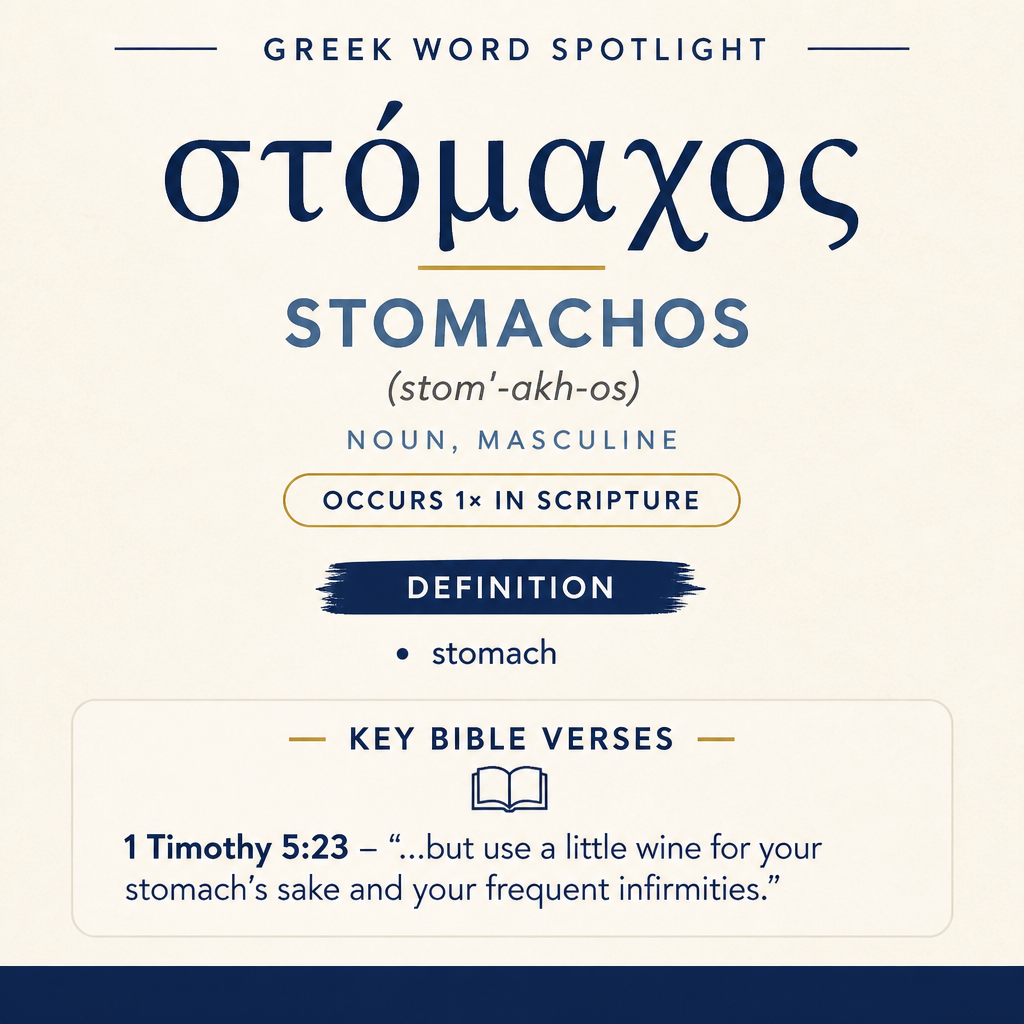
στόμαχος means “stomach” and appears once in Scripture, in 1 Timothy 5:23.
Verse Context
In 1 Timothy 5:23, it refers to using a little wine for the stomach’s sake amid frequent infirmities.
Learn More →στόμαχος means “stomach” and appears in a single New Testament passage, where it is brought into a practical instruction about health and diet. In that setting, the word points to a specific bodily organ as the reason for a measured change in drink.
Root and Related Words
στόμαχος is related to stoma (στόμα), “mouth” (Strong’s G4750). The link between these terms keeps the focus on the bodily side of eating and drinking, moving from the point of intake (the mouth) to an internal organ specifically named in the instruction.

Occurrences
“Be no longer a drinker of water only, but use a little wine for your stomach’s sake and your frequent infirmities.” (1 Timothy 5:23)
In 1 Timothy 5:23, στόμαχος is the concrete, physiological reason given for the counsel that follows. The line begins by addressing an established pattern—“Be no longer a drinker of water only”—and then introduces an alternative described with restraint: “use a little wine.” The phrase “for your stomach’s sake” places the stomach in the position of beneficiary: the instruction is framed as being for the good of that organ, not as a general endorsement of excess. The mention of “your frequent infirmities” aligns the stomach with recurring bodily weakness, so that the counsel is explicitly medicinal in intention within the wording of the verse. The stomach is not treated as a metaphor or a symbol in this sentence; it is named as a part of the body that can be affected and for which a modest measure of wine is proposed as a practical aid.

Sense and Usage
The usage of στόμαχος here is striking for its specificity. Rather than speaking broadly about the body, health, or weakness in general, the verse singles out the stomach as an identifiable site of concern. This gives the instruction a grounded, almost clinical clarity: the suggested change is not merely a lifestyle preference but is tethered to a bodily need.
The grammar of the phrase “for your stomach’s sake” expresses purpose and benefit. The stomach is the stated reason for the recommendation; it supplies the “why” that justifies the “use a little wine.” By anchoring the counsel to the stomach, the verse keeps the discussion within the realm of physical care and moderation. Even without expanding beyond the sentence, the internal logic is clear: a limited amount (“a little”) is connected to a defined bodily concern (“your stomach”) alongside an ongoing condition (“your frequent infirmities”).
In this one occurrence, στόμαχος therefore functions as a plain anatomical term within an everyday pastoral directive. It contributes concreteness to the line: the reader is not left with an abstract idea of sickness but is pointed to a particular bodily organ that can be troubled and for which a practical, measured remedy is suggested. The result is a portrayal of spiritual leadership that is attentive to ordinary human frailty, expressed through the naming of the stomach as part of the person’s lived, physical experience.
Imagery
Although στόμαχος is a straightforward bodily term, it brings a quiet realism to the verse’s imagery. The scene implied is simple: a person who has been drinking only water is counseled to take “a little wine” with the stated aim of benefiting the stomach amid “frequent infirmities.” The stomach, unseen yet specifically named, draws attention to the hidden places of weakness that shape daily life and to the kind of care that addresses them directly.
Sources: Lexical data from Strong’s Exhaustive Concordance and the Translators Brief Lexicon of Extended Strongs for Greek (STEPBible, CC BY). Occurrence data from the Translators Amalgamated Greek New Testament (STEPBible, CC BY). Scripture quotations from the World English Bible (public domain).