Exploring the Meaning of Sunergos in Greek
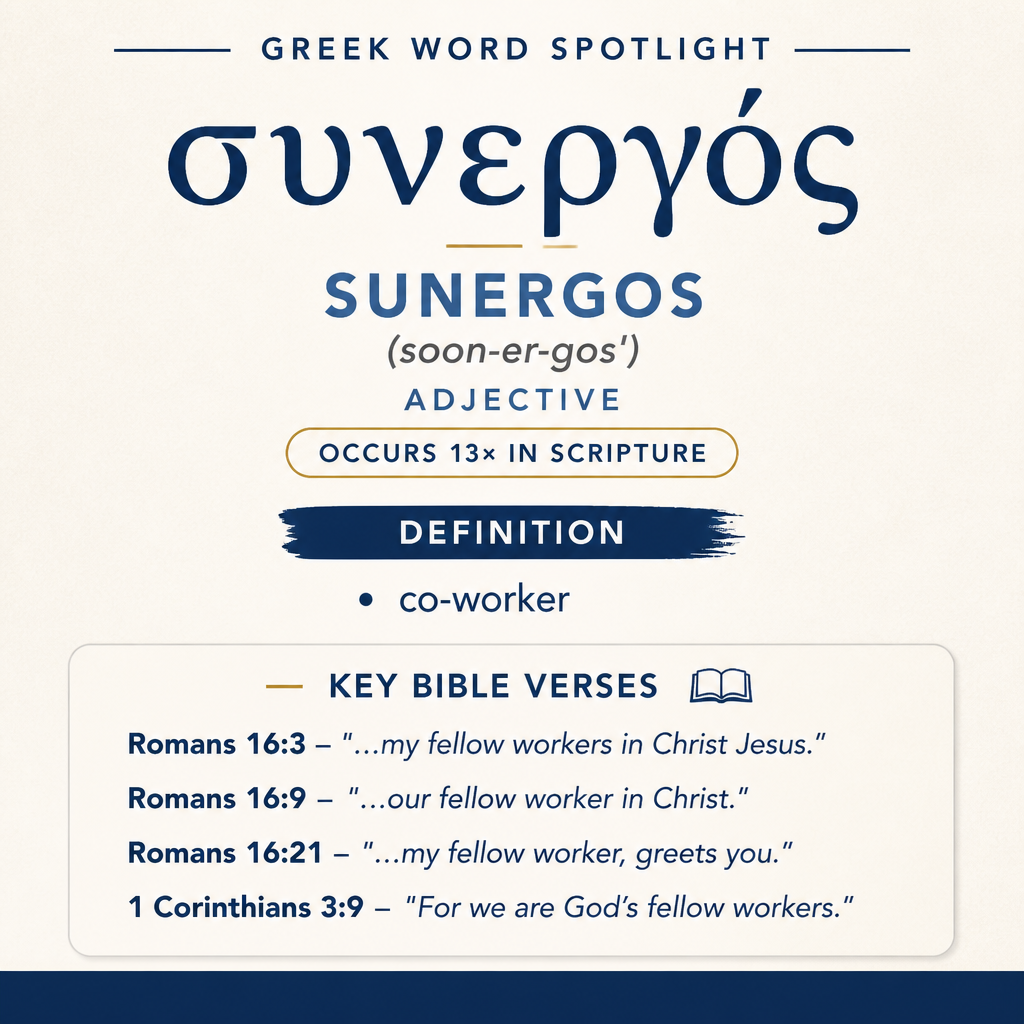
συνεργός (Sunergos) means “co-worker” and occurs 13 times in Scripture, including Romans 16 and Philippians 2–4.
Core Meaning
συνεργός is defined as “co-worker.” It is used to describe shared labor alongside others.
Learn More →Romans Greetings
In Romans 16:3, 16:9, and 16:21, Paul greets individuals as his “fellow worker(s)” in Christ. These include Prisca and Aquila, Urbanus, and Timothy.
Learn More →Ministry Partnership
συνεργός appears for God’s fellow workers (1 Corinthians 3:9) and fellow workers with others for their joy (2 Corinthians 1:24). It is also applied to Titus and Epaphroditus (2 Corinthians 8:23; Philippians 2:25).
Learn More →συνεργός describes someone who works alongside another as a co-worker. In the New Testament it appears in greetings, travel-and-ministry updates, and brief theological statements that frame Christian labor as shared work—among named individuals, with whole churches, and even in relation to God.
Occurrences
Romans 16:3: “Greet Prisca and Aquila, my fellow workers in Christ Jesus,”
Here συνεργός is a title of honor attached to Prisca and Aquila within a greeting. The phrase “my fellow workers” places Paul and this couple in the same field of labor, and “in Christ Jesus” specifies the sphere in which their shared work takes place: not simply personal cooperation, but cooperation shaped by their common relation to Christ.
Romans 16:9: “Greet Urbanus, our fellow worker in Christ, and Stachys, my beloved.”
In this greeting, συνεργός marks Urbanus as someone recognized by the wider group (“our fellow worker”), not only by Paul individually. As in Romans 16:3, “in Christ” narrows the kind of work in view: Urbanus’s labor is identified as belonging to the community’s Christ-centered service.
Romans 16:21: “Timothy, my fellow worker, greets you, as do Lucius, Jason, and Sosipater, my relatives.”
συνεργός functions as a relational descriptor within a list of people sending greetings. Timothy is singled out with a work-based bond (“my fellow worker”), which distinguishes his connection to Paul from the family-based bond named for others (“my relatives”). The word highlights a partnership defined by shared labor rather than shared ancestry.
1 Corinthians 3:9: “For we are God’s fellow workers. You are God’s farming, God’s building.”
This instance broadens the term beyond a named individual: “we” are called “God’s fellow workers.” The statement places the speakers’ labor in direct relation to God, immediately followed by two images for the Corinthians—“God’s farming” and “God’s building”—that portray the community as the sphere in which this work is taking shape. συνεργός thus supports the idea of collaborative labor connected to God’s purposes, while the metaphors emphasize that the recipients themselves are what is being tended and built.
2 Corinthians 1:24: “We don’t control your faith, but are fellow workers with you for your joy. For you stand firm in faith.”
Here συνεργός is explicitly paired with the preposition “with”: “fellow workers with you.” The line draws a contrast between controlling (“We don’t control your faith”) and cooperating (“but are fellow workers with you for your joy”). The word contributes the sense of shared effort aimed at the Corinthians’ “joy,” while also respecting their stability—“For you stand firm in faith”—as something not coerced by leaders.
2 Corinthians 8:23: “As for Titus, he is my partner and fellow worker for you. As for our brothers, they are the apostles of the assemblies, the glory of Christ.”
συνεργός is coupled with “partner,” and both are directed toward the Corinthians: Titus is “my partner and fellow worker for you.” The expression frames Titus’s relationship to Paul as close cooperation, and then frames the purpose of that cooperation as service oriented toward the church addressed. In the same verse, other workers are described by role and recognition (“apostles of the assemblies, the glory of Christ”), setting Titus’s “fellow worker” identity within a wider network of acknowledged servants.
Philippians 2:25: “But I counted it necessary to send to you Epaphroditus, my brother, fellow worker, fellow soldier, and your apostle and servant of my need,”
This verse stacks several relational terms, and συνεργός contributes the “work” dimension of Epaphroditus’s bond to Paul. “My brother” signals familial closeness within the Christian community; “fellow worker” identifies shared labor; “fellow soldier” adds a sense of joint struggle; and “your apostle and servant of my need” ties Epaphroditus’s service to both the Philippians and Paul’s situation. συνεργός here is one facet in a multi-angle portrayal of committed service.
Philippians 4:3: “Yes, I beg you also, true partner, help these women, for they labored with me in the Good News with Clement also, and the rest of my fellow workers, whose names are in the book of life.”
συνεργός appears in a setting of practical appeal: Paul urges a “true partner” to “help these women.” The reason given is their past labor: “for they labored with me in the Good News,” alongside Clement and “the rest of my fellow workers.” The term thus gathers a group defined by cooperative effort in gospel work. The added line—“whose names are in the book of life”—grounds this co-worker identity in a shared standing before God, giving the designation moral weight in the appeal for assistance and reconciliation.
Colossians 4:11: “and Jesus who is called Justus. These are my only fellow workers for God’s Kingdom who are of the circumcision, men who have been a comfort to me.”
In this note, συνεργός is limited to a particular subset: “my only fellow workers for God’s Kingdom who are of the circumcision.” The term frames these men as Paul’s cooperating laborers, and the phrase “for God’s Kingdom” specifies the direction of their work. The final clause—“men who have been a comfort to me”—shows that such co-working carries personal consequences: their shared labor brings encouragement as well as effectiveness.
1 Thessalonians 3:2: “and sent Timothy, our brother and God’s servant in the Good News of Christ, to establish you, and to comfort you concerning your faith,”
Although Timothy is not labeled with συνεργός in this sentence, the verse presents him in closely related terms of shared ministry: “our brother and God’s servant in the Good News of Christ.” In the flow of these letters, συνεργός belongs to the same relational world as being commissioned and sent for the churches’ benefit—here “to establish you, and to comfort you concerning your faith.” The co-worker idea fits the scene’s emphasis on collaborative service directed toward strengthening believers.
Philemon 1:1: “Paul, a prisoner of Christ Jesus, and Timothy our brother, to Philemon, our beloved fellow worker,”
συνεργός here becomes part of address and identification: Philemon is “our beloved fellow worker.” The term establishes a bond of shared labor between Paul, Timothy, and Philemon at the outset of the letter, and “beloved” adds affection to the work-based connection. The designation prepares the reader to hear the letter as communication within an existing partnership, not as a detached command from outside.
Philemon 1:24: “as do Mark, Aristarchus, Demas, and Luke, my fellow workers.”
In this closing greeting, συνεργός labels a set of companions collectively: Mark, Aristarchus, Demas, and Luke are “my fellow workers.” The word binds them to Paul through ongoing cooperation, and its placement in a list underscores that such co-working often takes place in teams rather than in isolated individual effort.

Sense and Usage
Across these passages, συνεργός functions as a relational credential: it tells the audience how a named person should be regarded in connection with Paul and with the gospel mission implied by the surrounding language (“in Christ Jesus,” “in Christ,” “in the Good News,” “for God’s Kingdom”). The word is flexible in scope. It can be intensely personal (“my fellow worker”), communal (“our fellow worker”), and corporate in theological framing (“God’s fellow workers”). It can name bilateral cooperation (Paul with Timothy, Titus, Epaphroditus, Philemon) and also gather a wider circle (“the rest of my fellow workers”).
The term also helps differentiate kinds of relationships within the same breath. Romans 16:21 sets “my fellow worker” beside “my relatives,” distinguishing partnership in labor from family ties. Philippians 2:25 places “fellow worker” among other descriptors—brother, soldier, apostle, servant—showing that co-working is one recognized aspect of faithful service, alongside affection, shared struggle, representation, and practical care. In 2 Corinthians 1:24, the co-worker relationship explicitly rejects domination: leaders are not controllers of faith but collaborators “for your joy,” an orientation that treats the church as an active participant (“with you”), not merely a passive recipient.
Finally, συνεργός regularly points outward to a goal beyond the workers themselves. In 2 Corinthians 8:23, co-working is “for you,” aimed at the benefit of the congregation. In Colossians 4:11, co-working is “for God’s Kingdom,” giving the partnership a defined direction. Even in the brief greeting formulas, the title “fellow worker” signals that the persons named are not merely friends of Paul but participants in work that belongs to the Christian message and community.
Imagery
Two metaphors in 1 Corinthians 3:9 give the strongest picture accompanying συνεργός: “You are God’s farming, God’s building.” In that setting, co-workers are portrayed as laboring in a field and on a structure that belong to God. Elsewhere, the word keeps its imagery close to ordinary cooperation—partners, teams, and companions whose shared work produces tangible outcomes such as comfort (Colossians 4:11) and joy (2 Corinthians 1:24), and whose mutual standing (“names… in the book of life,” Philippians 4:3) makes their cooperation a matter of spiritual seriousness as well as practical effort.
Sources: Lexical data from Strong’s Exhaustive Concordance and the Translators Brief Lexicon of Extended Strongs for Greek (STEPBible, CC BY). Occurrence data from the Translators Amalgamated Greek New Testament (STEPBible, CC BY). Scripture quotations from the World English Bible (public domain).