Exploring the Meaning of Sunegeiro in Greek
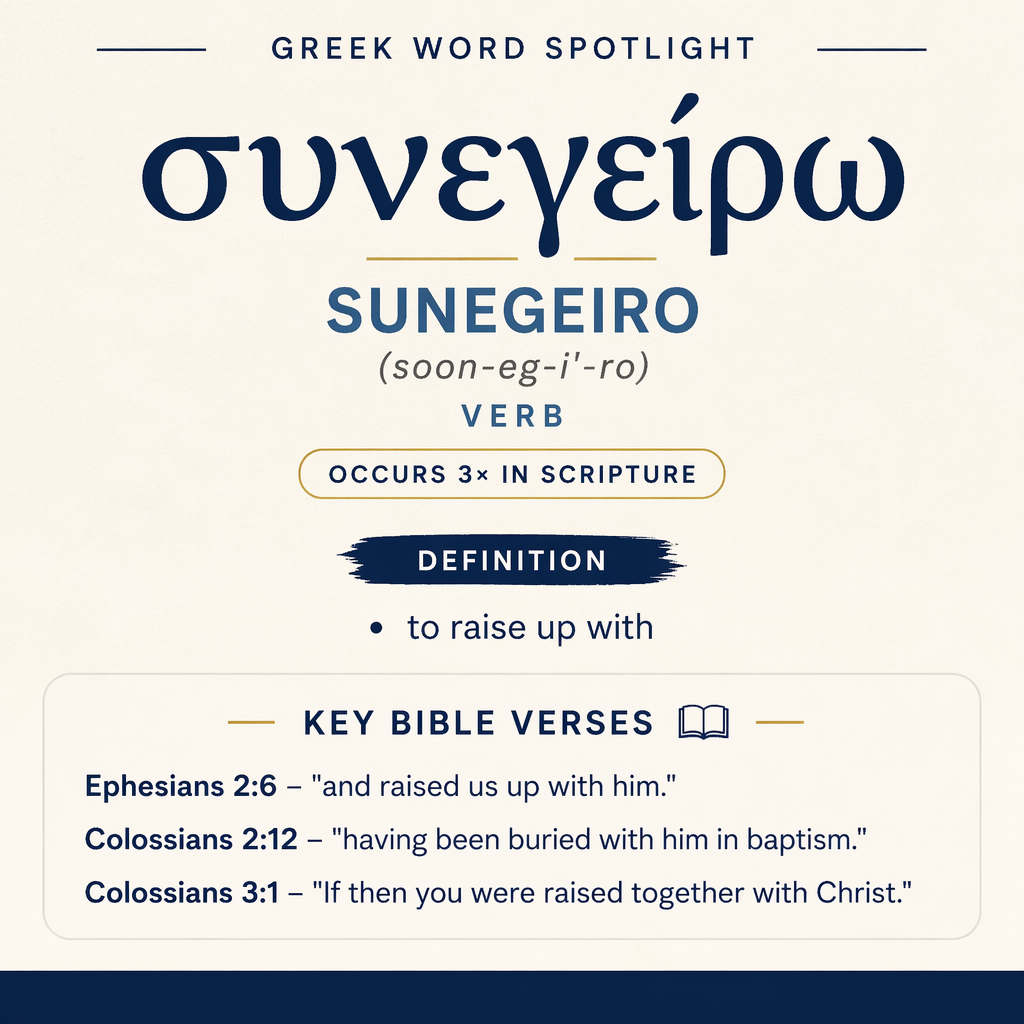
συνεγείρω means “to raise up with” and appears three times in Scripture: Ephesians 2:6; Colossians 2:12; Colossians 3:1.
Core Meaning
συνεγείρω means “to raise up with.” The listed verses use it for being raised with him or with Christ.
Learn More →Scripture Occurrences
This verb occurs in Ephesians 2:6; Colossians 2:12; and Colossians 3:1. Each occurrence includes the idea of being raised with him.
Learn More →Context in Verses
Ephesians 2:6 pairs being “raised us up with him” with being seated with him in the heavenly places in Christ Jesus. Colossians 2:12 and 3:1 speak of being raised with him/with Christ.
Learn More →συνεγείρω expresses the action of being “raised up with,” and it appears in three New Testament passages that describe believers’ participation in Christ’s exaltation. In these contexts it is tied to Christ’s own being raised, and it frames Christian life in terms of a shared elevation with him.
Root and Related Words
συνεγείρω (Sunegeiro) is built from the preposition σύν (syn), “with” (Strong’s G4862), joined to the verb ἐγείρω (egeiro), “to arise” (Strong’s G1453). The combination highlights a “with-” relationship: the raising is not pictured as isolated, but as a raising that occurs in company with another.

Occurrences
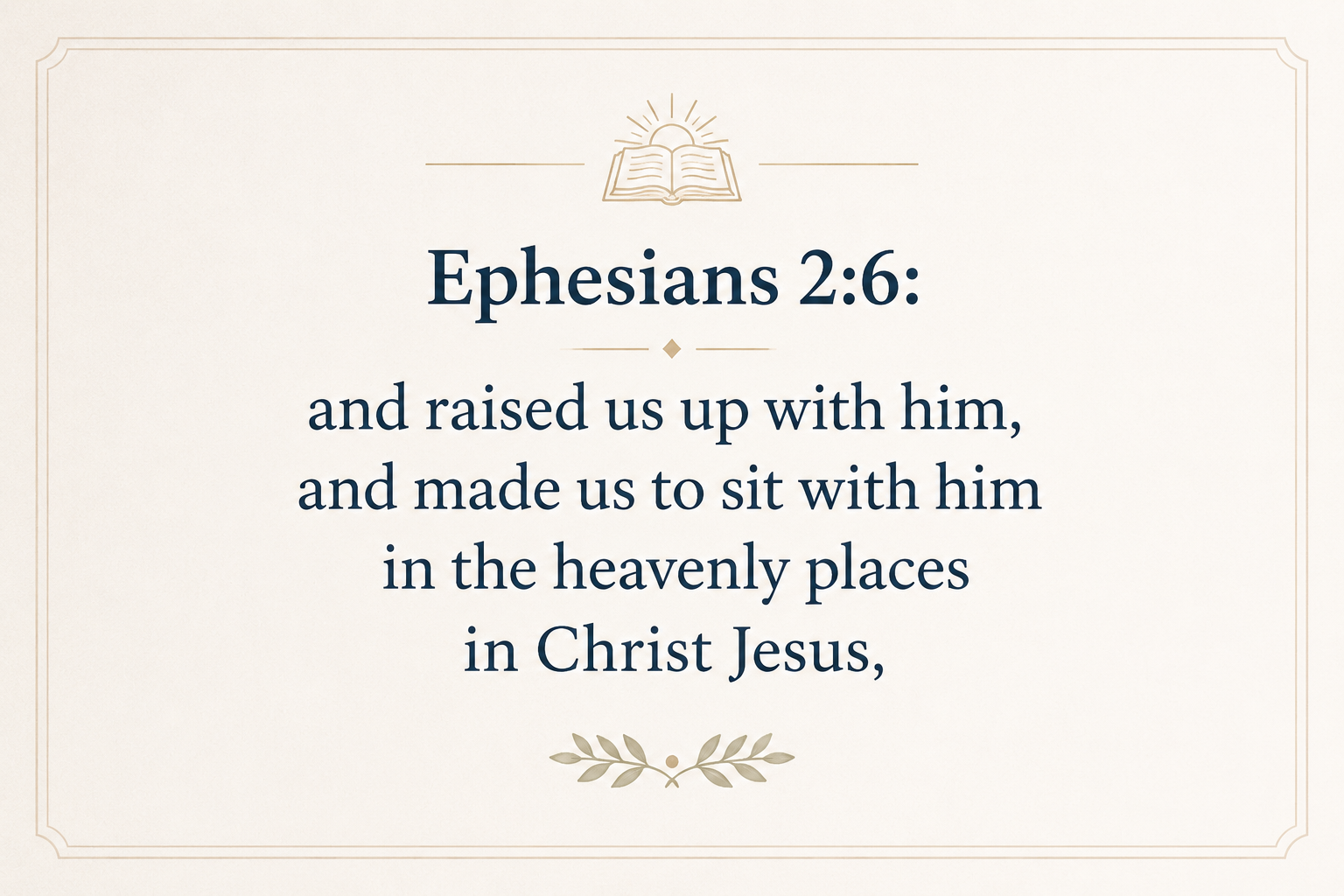
Ephesians 2:6: and raised us up with him, and made us to sit with him in the heavenly places in Christ Jesus,
Here the verb is paired with two coordinated outcomes: being “raised…up with him” and being “made…to sit with him.” The wording places the raising alongside an enthronement-like seating, located “in the heavenly places in Christ Jesus.” In this sentence, “with him” is not a minor detail; it is the organizing idea that links believers’ new status to Christ’s own position. The raising is presented as an accomplished act (“raised us up”), and its force in the line is to move the subject from one state to another in a way that is inseparable from Christ (“with him…in Christ Jesus”).
Colossians 2:12: having been buried with him in baptism, in which you were also raised with him through faith in the working of God, who raised him from the dead.
This occurrence is embedded in a sequence of joined events: burial “with him” in baptism, and being “also raised with him.” The verb functions as the second half of a paired movement—downward into burial and upward into raising—both described with the same relational phrase “with him.” The passage also supplies a stated means and agency: the raising is “through faith in the working of God,” and God is the one “who raised him from the dead.” In this setting, συνεγείρω contributes the idea that the believer’s raising is tied to God’s act of raising Christ, and that this shared raising is connected to baptism as the context in which the burial-and-raising pattern is spoken of.
Colossians 3:1: If then you were raised together with Christ, seek the things that are above, where Christ is, seated on the right hand of God.
In this conditional statement, the raising “together with Christ” is treated as the basis for a continuing response: “seek the things that are above.” The verse immediately defines “above” by reference to Christ’s location and posture: “where Christ is, seated on the right hand of God.” The verb thus serves as a hinge between identity and practice. Because the reader is addressed as already having been raised with Christ, the passage directs attention upward, aligning the believer’s pursuit (“seek”) with the realm associated with Christ’s seating. The “together with Christ” phrasing presses the relational dimension: the reader’s raised condition is framed as participation in Christ’s own exalted placement.
Sense and Usage
Across these three passages, συνεγείρω consistently carries a shared, accompanying raising—never a solitary elevation, but one that happens “with him” or “together with Christ.” The “with-” element is reinforced by the surrounding wording: Ephesians joins the raising to being made to sit “with him,” and both are located “in the heavenly places in Christ Jesus.” Colossians 2 places the raising alongside burial “with him,” and it explicitly anchors the shared raising in “the working of God,” who is said to have raised Christ from the dead. Colossians 3 then treats the shared raising as a settled premise that reshapes orientation and desire, directing the raised ones to “seek the things that are above” precisely because Christ is already there, “seated on the right hand of God.”
These contexts also show how the verb can function rhetorically. In Ephesians 2:6 it stands in a declarative statement of what has been done; the raising is presented as a completed divine act with an immediate relational and spatial consequence. In Colossians 2:12 it is coordinated with baptismal imagery of burial and raising, drawing attention to a transition described in relational terms and linked to faith and God’s action. In Colossians 3:1 it appears in a conditional opening (“If then…”), not to cast doubt on the raising, but to use it as a foundation for exhortation; the raised-with-Christ reality is made the reason for an upward-directed pursuit.
Within these verses, the verb’s contribution is not merely to speak of “raising” in general, but to specify the company and connection of that raising. The subject is raised in association with Christ, and the immediate co-texts keep returning to Christ’s own exalted position (“in the heavenly places,” “seated,” “on the right hand of God”). Thus the sense is enacted in a consistent pattern: shared raising leads into shared placement with Christ, and shared placement frames the believer’s ongoing outlook and aims.
Imagery in Context
The passages paint a coherent picture of movement and location: from burial “with him” to being “raised with him,” and from being raised to being seated where Christ is. Ephesians 2:6 and Colossians 3:1 especially concentrate the imagery in the idea of being brought into the realm where Christ is already seated—“in the heavenly places in Christ Jesus” and “where Christ is, seated on the right hand of God.” In these scenes, συνεγείρω functions as the verb that carries believers upward into that Christ-centered setting, emphasizing participation “with him” as the defining feature of the action.
Sources: Lexical data from Strong’s Exhaustive Concordance and the Translators Brief Lexicon of Extended Strongs for Greek (STEPBible, CC BY). Occurrence data from the Translators Amalgamated Greek New Testament (STEPBible, CC BY). Scripture quotations from the World English Bible (public domain).