Exploring the Meaning of Sumphuletes in Greek
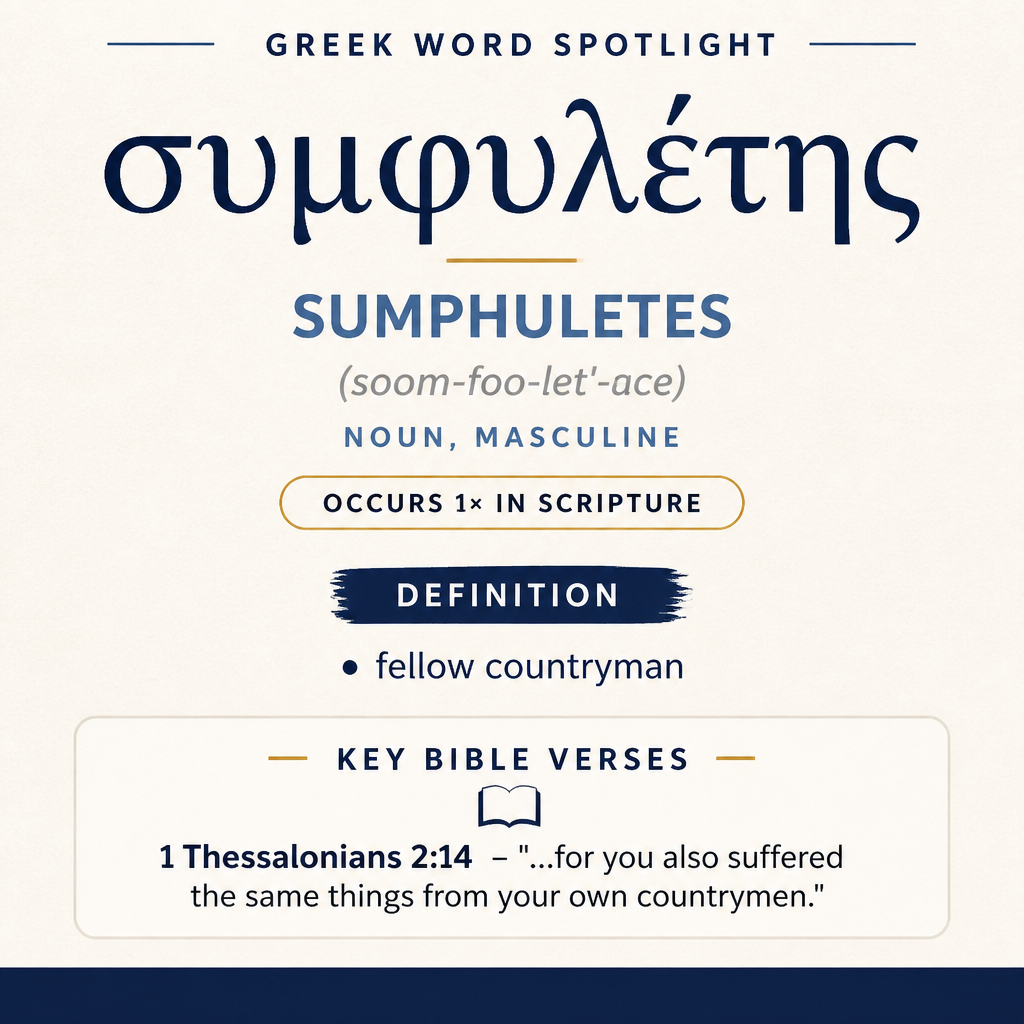
συμφυλέτης means “fellow countryman” and occurs once in Scripture, in 1 Thessalonians 2:14.
Scripture Occurrence
This word occurs 1 time in Scripture. Its occurrence is in 1 Thessalonians 2:14.
Learn More →Verse Context
In 1 Thessalonians 2:14, Paul addresses the brothers and speaks of their suffering.
Learn More →συμφυλέτης means “fellow countryman” and appears in Paul’s description of suffering shared by believers in Thessalonica and in Judea. In its lone New Testament appearance it helps name the source of the opposition faced by those communities.
Root and Related Words
συμφυλέτης is built from two elements reflected in related forms: syn (σύν), meaning “with” (Strong’s G4862), and phyle (φυλή), meaning “tribe” (Strong’s G5443). Put together, these components form a term that marks association “with” one’s own “tribe,” yielding the social category expressed in the gloss “fellow countryman.”

Occurrences
“For you, brothers, became imitators of the assemblies of God which are in Judea in Christ Jesus; for you also suffered the same things from your own countrymen, even as they did from the Jews” (1 Thessalonians 2:14)
Here συμφυλέτης appears in the plural within a comparison: the Thessalonian believers have become “imitators” of the Judean assemblies, and the imitation is not about outward style but about shared experience—“you also suffered the same things.” The term sharpens the point of that parallel by identifying where the pressure came from. The Thessalonians’ hardship arises “from your own countrymen,” that is, from people belonging to the same people-group and local civic world as the sufferers themselves. The word therefore places the conflict close to home: opposition is not portrayed as distant, foreign, or merely abstract, but as coming from those who would normally be expected to stand near—people linked by common homeland identity.
The sentence then balances that clause with a corresponding Judean situation: “even as they did from the Jews.” In the verse’s logic, “your own countrymen” for the Thessalonians functions as the structural counterpart to “the Jews” for the Judean assemblies. συμφυλέτης helps make the analogy precise. Paul is not only saying both groups suffered; he is mapping the pattern of suffering onto the social reality that persecution can arise from one’s own national or regional community. Thus the word contributes to the verse’s rhetorical symmetry: two communities (“you, brothers” / “the assemblies of God…in Judea”), one shared allegiance (“in Christ Jesus”), and one shared kind of opposition (harm inflicted by those who belong to the sufferers’ own wider people).
Because the term is relational, it also implies an implicit contrast: the Thessalonians’ primary bonds are now defined by belonging to “the assemblies of God…in Christ Jesus,” yet their opponents are described by an older, ordinary bond—common country. The verse does not flatten these identities into one; rather, it juxtaposes them. συμφυλέτης names the natural social category that would ordinarily create solidarity, and in this scene it becomes the very category from which hostility emerges. The word therefore serves the passage’s portrayal of suffering as a cost of allegiance: the believers’ new pattern of life aligns them with other assemblies far away (“in Judea”), while the pain is inflicted by those nearby (“your own countrymen”).
Sense and Usage
The definition “fellow countryman” is concrete and social: it identifies someone by shared homeland identity. In 1 Thessalonians 2:14, that shared identity functions as a measure of nearness. The sufferers are not isolated individuals opposed by strangers; they are members of a local community experiencing conflict that arises within the same broader populace. The term therefore communicates the sting of proximity without adding any new charge beyond the bare relationship. It points to the kind of tie that typically carries expectations of mutual recognition—common locale, common peoplehood—so that suffering “from your own countrymen” reads as suffering that comes from within one’s own environment.
At the same time, the verse uses this relationship term to support a larger argument about imitation and shared experience among churches. The Thessalonian believers “became imitators” of the Judean assemblies, and the imitation is anchored in their parallel suffering. συμφυλέτης helps define the Thessalonian side of that parallel by showing that the shape of their suffering matches the Judean pattern: each community faces hostility arising from a group associated with its own people. This is not merely a note about geography; it is a way of describing how opposition can track along existing social lines. The word’s force lies in its capacity to mark insiders—people connected by country—and thus to frame the conflict as one in which the believers’ faithfulness creates rupture within what would otherwise be their natural social network.
The components syn (“with”) and phyle (“tribe”) also fit the verse’s relational emphasis. The passage is full of association language: “brothers,” “imitators,” “assemblies,” “in Christ Jesus,” “the same things.” συμφυλέτης participates in this network of connections by naming a kind of “with-ness” rooted in shared peoplehood. Yet within the verse it is precisely that “with-ness” that does not prevent suffering; it becomes the setting in which suffering takes place. The term can therefore carry a sobering nuance in context: being “from the same country” does not guarantee peace, and the believers’ alignment “in Christ Jesus” may set them at odds with their own wider community.
Imagery
In this passage the imagery of συμφυλέτης is not visual but social: a circle of familiar belonging—one’s own people—becomes the sphere from which affliction comes. The verse places that experience beside the Judean assemblies’ suffering, so that the word evokes a pattern of local hostility repeated in different regions, binding the communities together through the shared reality of opposition arising among one’s own countrymen.
Sources: Lexical data from Strong’s Exhaustive Concordance and the Translators Brief Lexicon of Extended Strongs for Greek (STEPBible, CC BY). Occurrence data from the Translators Amalgamated Greek New Testament (STEPBible, CC BY). Scripture quotations from the World English Bible (public domain).