Exploring the Meaning of Sumphutos in Greek
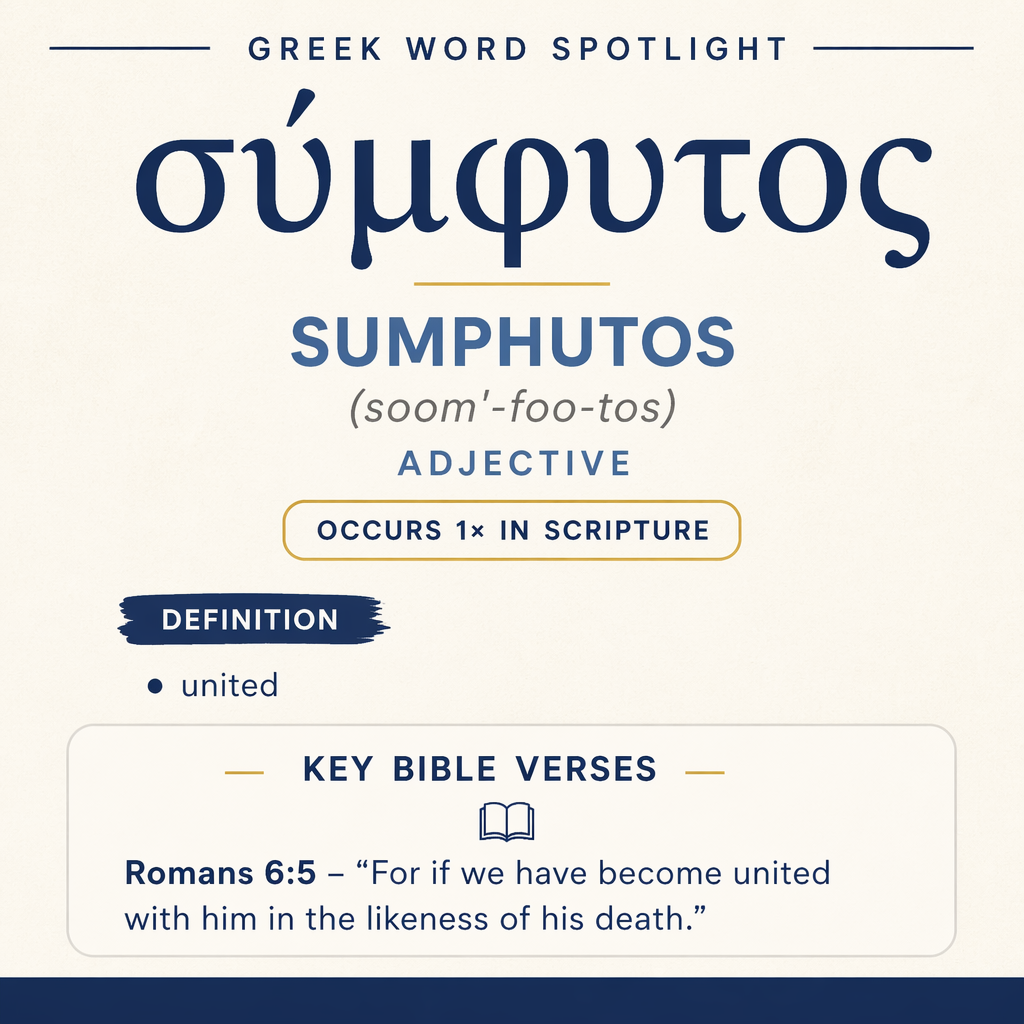
σύμφυτος means “united” and appears once in Scripture, in Romans 6:5.
Romans 6:5 Context
Romans 6:5 uses it for being “united with him in the likeness of his death.” The verse adds, “we will also be part of his resurrection.”
Learn More →σύμφυτος means “united,” and it appears once in the New Testament, in Paul’s argument about believers’ connection to Christ in Romans 6:5. In that setting it anchors the logic of participation: what is true “in the likeness of his death” sets the expectation of what will follow regarding resurrection.
Root and Related Words
σύμφυτος is connected with syn (σύν), meaning “with,” and phyo (φύω), meaning “to grow.”

Occurrences
“For if we have become united with him in the likeness of his death, we will also be part of his resurrection;” (Romans 6:5)
In Romans 6:5, “united” functions as the hinge between two coordinated claims: a completed reality (“if we have become united with him in the likeness of his death”) and a consequent expectation (“we will also be part of his resurrection”). The adjective marks a relationship that is not merely external association but a real togetherness “with him,” expressed within the phrase “in the likeness of his death.” The surrounding syntax makes this unity the premise of Paul’s reasoning: because this unity has occurred, a further participation is anticipated.
The verse places the word inside a conditional clause (“if …”), but it is not presented as uncertain in itself; it is assumed as the basis for what follows. The unity is also described in relation to a specific “likeness”—not a generic union detached from content, but one defined by its reference point, “his death.” In the logic of the sentence, this defining reference does not remain isolated; it projects forward to resurrection. Thus “united” supplies the connective tissue between death-language and resurrection-language within a single argument, so that resurrection participation is framed as the natural counterpart to the already-established unity.
Because the verse immediately pairs “united with him” with “part of his resurrection,” σύμφυτος carries the weight of continuity: the same persons who are described by one relational reality are the persons spoken of in the other. The adjective ties the subject (“we”) to Christ (“him”) in a way that allows Paul to speak coherently of sharing in what belongs to Christ—first in relation to his death’s likeness, then in relation to his resurrection. Without this term, the move from death to resurrection would sound like a leap; with it, the movement is presented as inference grounded in union.
Sense and Usage
The single New Testament use of σύμφυτος presents “united” as a participatory bond that supports a theological inference. The verse does not treat union as an abstract label; it is a condition that structures the whole sentence. The unity is expressly “with him,” keeping the focus on relationship rather than on a detached state. At the same time, the unity is located “in the likeness of his death,” which constrains the idea of being united to a particular sphere described by the verse’s wording. In Romans 6:5, then, “united” names a relational condition defined by likeness to Christ’s death, and from that condition Paul draws the future-oriented conclusion that “we will also be part of his resurrection.”
The way the verse is written gives σύμφυτος a directional force: it points from one shared reality to another. “United … in the likeness of his death” is cast as something believers “have become,” suggesting an achieved state that now characterizes “we.” That achieved state is not left as an endpoint; it becomes the basis for “we will also be part of his resurrection.” The adjective therefore serves as a bridge-term, allowing Paul to speak of two distinct but connected participations without changing subjects or introducing a new mechanism. Unity, once established, is sufficient to ground the movement from death-likeness to resurrection participation.
Within the limits of this occurrence, σύμφυτος also carries an implicit contrast between mere resemblance and relational attachment. The verse includes “likeness,” which could be read in isolation as simple similarity; yet the presence of “united with him” prevents the statement from collapsing into comparison alone. The likeness is the mode or domain in which the union is expressed, and the union is the relational reality that makes the likeness consequential. In this way the adjective ensures that “likeness of his death” functions within a shared-with-Christ framework, rather than as a standalone imitation.
Imagery
The combination of syn (σύν), “with,” and phyo (φύω), “to grow,” gives the word a natural image of togetherness that fits Paul’s argument in Romans 6:5: a unity that has formed and now holds. In the verse’s own terms, that formed unity is the premise from which Paul speaks confidently about a corresponding share “of his resurrection,” linking the believer’s connection to Christ across the two scenes named in the sentence.
Sources: Lexical data from Strong’s Exhaustive Concordance and the Translators Brief Lexicon of Extended Strongs for Greek (STEPBible, CC BY). Occurrence data from the Translators Amalgamated Greek New Testament (STEPBible, CC BY). Scripture quotations from the World English Bible (public domain).