Exploring the Meaning of Sumphonesis in Greek
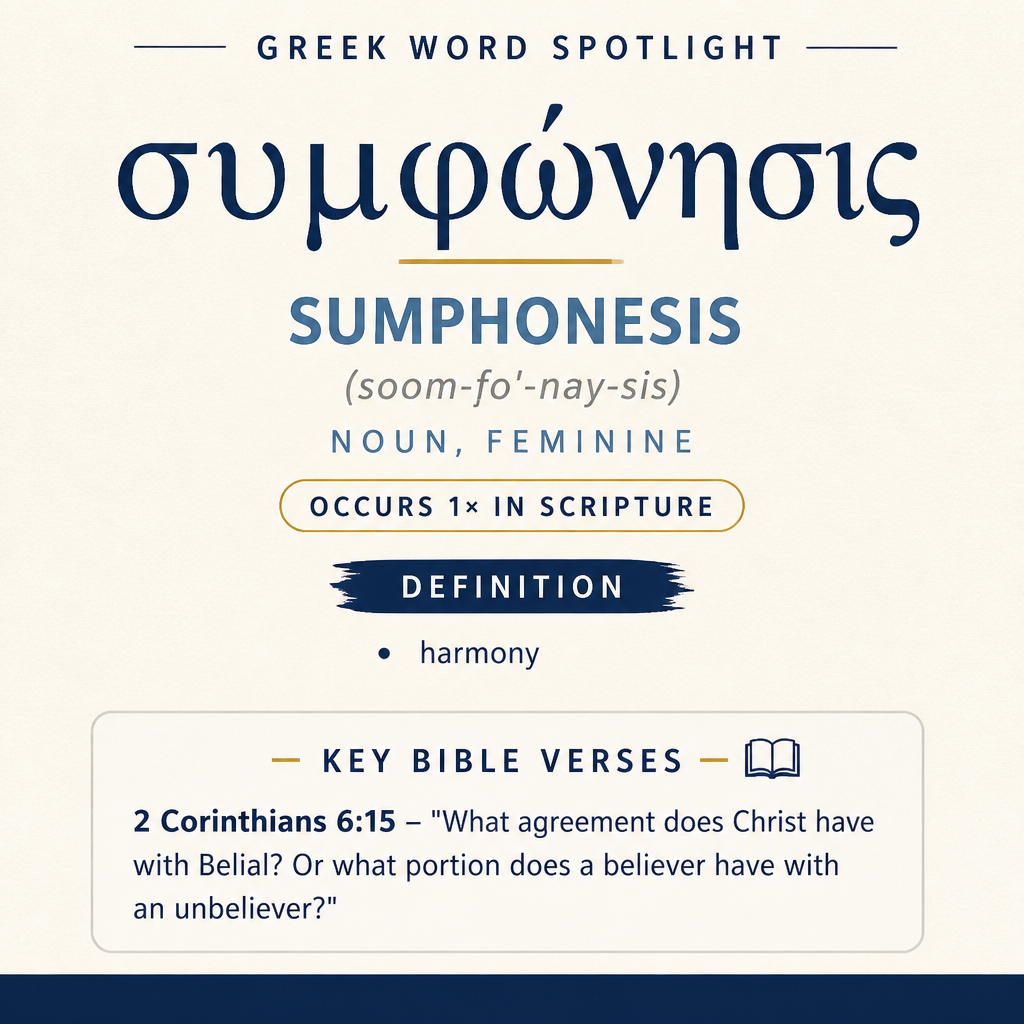
συμφώνησις means “harmony” and appears once in Scripture, in 2 Corinthians 6:15.
Verse Context
In 2 Corinthians 6:15 it is used in the question, “What agreement does Christ have with Belial?”
Learn More →συμφώνησις means “harmony” and appears in Paul’s rhetorical questions about incompatible allegiances in 2 Corinthians 6:15. In that single setting it names the kind of fitting correspondence Paul denies between Christ and Belial.
Root and Related Words
συμφώνησις is related to the verb symphoneō (συμφωνέω), “to agree with” (Strong’s G4856). In 2 Corinthians 6:15 the noun form sharpens the idea of agreement into a stated state or condition: not merely the act of agreeing, but a settled consonance.

Occurrences
“What agreement does Christ have with Belial? Or what portion does a believer have with an unbeliever?” (2 Corinthians 6:15)
Within this pair of questions, συμφώνησις stands as the key term in the first: Paul asks what “agreement” Christ can have with Belial. The quoted line frames Christ and Belial as mutually exclusive poles, so the word “agreement” is not treated as a minor point of negotiation; it is presented as something fundamentally impossible across that boundary. By choosing a noun that denotes “harmony,” the question presses beyond surface-level cooperation and points to the deeper notion of two realities being able to fit together in a coherent, mutually resonant way. The form of the question expects the answer “none,” and the noun carries the force of that denial: the two names are not simply different; they cannot be brought into a harmonious relation.

The second question (“Or what portion does a believer have with an unbeliever?”) runs parallel to the first and helps locate what “harmony” would imply in practice. Even though the second question uses a different term (“portion”), it clarifies the relational terrain: Paul is not discussing fleeting contact but shared standing, shared belonging, and shared alignment. In that light, συμφώνησις functions as the conceptual counterpart to “portion”: harmony would mean a shared fit, a congruent alignment, a real joining of interests and loyalties. The parallel structure—Christ/Belial, believer/unbeliever—puts the noun in a moral and confessional frame: the issue is not aesthetic harmony but harmony as a relationship of congruence between identities that define one another. The verse’s rhythm makes the word do boundary work: it marks what cannot be jointly held.
Sense and Usage
Because συμφώνησις is defined here as “harmony,” its sense is best felt as more than simple concurrence. Harmony implies an accord in which elements correspond, fit together, and sound together without clashing. In 2 Corinthians 6:15, Paul leverages that implication by placing it between two named principals—“Christ” and “Belial”—whose very pairing is treated as a contradiction. The term therefore serves as a measure of compatibility: it asks whether there can be a coherent, settled alignment between two sides, not merely whether they can temporarily act in parallel.
The verse’s rhetorical strategy is to set “harmony” alongside “portion” and to treat both as ways of describing shared life. Harmony, in this setting, belongs to the realm of what can be jointly inhabited: a state of relationship where the parties are not pulling against each other but belong together. The expected negative answer turns “harmony” into a diagnostic word: where the identities are opposed (Christ vs. Belial), harmony is excluded; where identities are opposed (believer vs. unbeliever), a shared portion is excluded. The noun thus highlights the kind of agreement that is comprehensive enough to define association, not merely a narrow point of agreement. It is precisely because harmony suggests a whole-relationship congruence that it can serve as a decisive criterion in Paul’s question.
The verse also shows that “harmony” can be used with a possessive nuance (“does Christ have…”), which makes the concept concrete: harmony is pictured as something one might possess or share with another. That grammatical framing treats harmony as an objective reality between parties, not only as a subjective feeling. The question is not “Do they feel harmonious?” but “What harmony exists between them?”—pushing the reader to evaluate the relationship itself. In this way, συμφώνησις becomes a term that assesses whether a relationship can be structurally coherent, given the identities named.
Imagery
Even in a single occurrence, the word carries a vivid relational image. “Harmony” evokes the picture of two lines meant to match and move together; Paul’s question about Christ and Belial depicts instead a mismatch that refuses to resolve. The terse pairing in 2 Corinthians 6:15 leaves the impression of two realities that cannot be tuned to one another, so that harmony—rather than being achieved—functions as a sharp line of separation.
Sources: Lexical data from Strong’s Exhaustive Concordance and the Translators Brief Lexicon of Extended Strongs for Greek (STEPBible, CC BY). Occurrence data from the Translators Amalgamated Greek New Testament (STEPBible, CC BY). Scripture quotations from the World English Bible (public domain).