Exploring the Meaning of Stratia in Greek
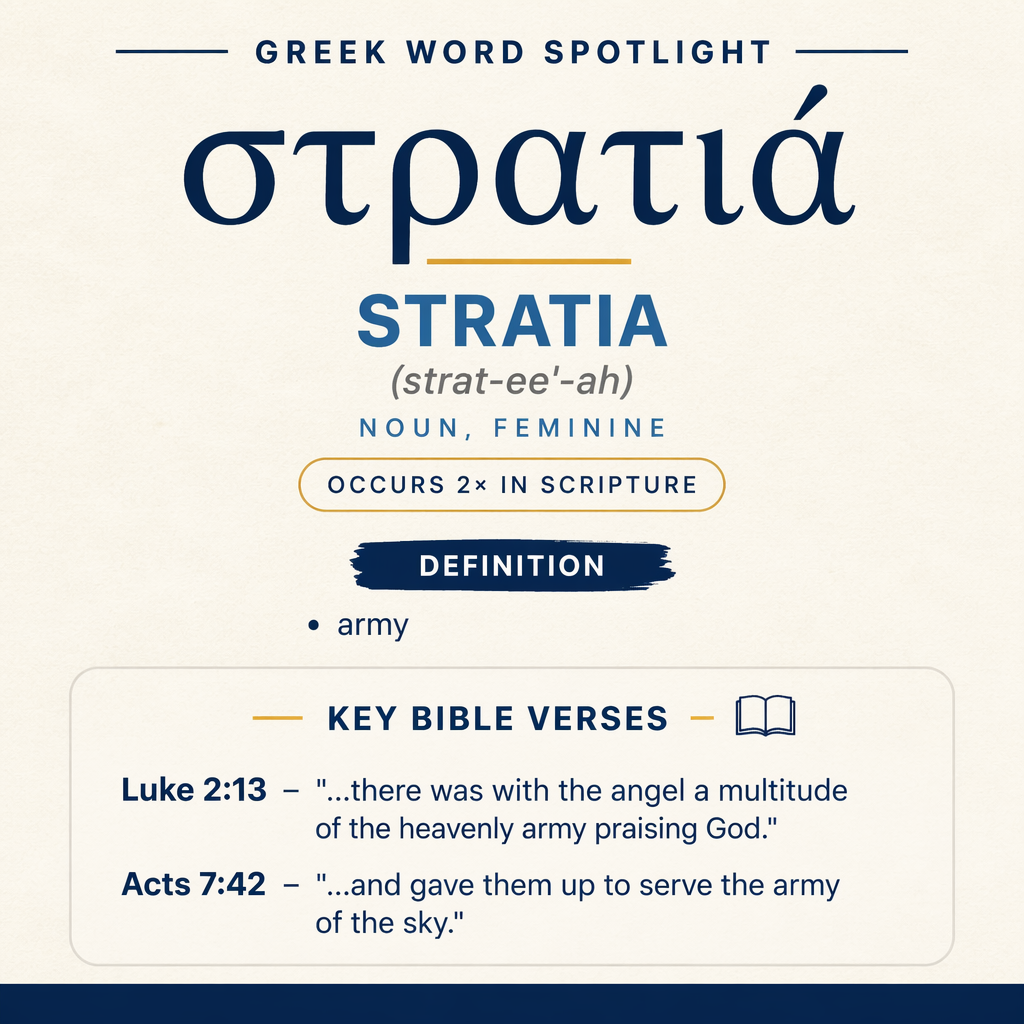
στρατιά means “army” and appears twice in Scripture, in Luke 2:13 and Acts 7:42.
Contextual Usage
In Luke 2:13 it describes a “multitude of the heavenly army” praising God. In Acts 7:42 it refers to the “army of the sky.”
Learn More →στρατιά refers to an “army,” and it appears in two scenes that frame the word with strikingly different settings: a heavenly chorus at Jesus’ birth and a polemical recollection of idolatrous worship directed toward the sky. In both, the term evokes a large, ordered body identified by its sphere of belonging.
Occurrences
“Suddenly, there was with the angel a multitude of the heavenly army praising God, and saying,” (Luke 2:13)
Here στρατιά is qualified as “heavenly,” and the immediate picture is not of combat but of coordinated, collective praise. The narrative begins with “the angel” and then expands: “Suddenly, there was with the angel a multitude,” so the word helps name what that multitude is—a συγκροτημένη body rather than a merely accidental crowd. The phrasing “the heavenly army” places this multitude within the realm of heaven and frames the beings present as a host belonging to that realm. The verb that governs their activity is “praising,” which supplies the action for this “army”: their order is expressed through worshipful speech rather than through any description of weaponry or conflict. In the flow of the sentence, στρατιά also heightens the contrast between the quiet, singular appearance of “the angel” and the sudden swelling into a vast company; the word supports the sense that this is an organized mass, assembled and acting together.
The collocation “a multitude of the heavenly army” joins size (“multitude”) with identity (“army”). In this scene, στρατιά functions as a collective noun that gathers many individuals into a single unit, so that the reader sees not merely “many” but “many as one.” The effect is to present the praise as more than individual exclamations; it is the voice of a host. Within the verse, the word therefore contributes an atmosphere of grandeur and coordinated honor offered to God, with the “heavenly” descriptor anchoring the army’s origin and allegiance.
“But God turned, and gave them up to serve the army of the sky, as it is written in the book of the prophets, ‘Did you offer to me slain animals and sacrifices forty years in the wilderness, O house of Israel?” (Acts 7:42)
In Acts 7:42, στρατιά appears in a sharply different moral and rhetorical setting. The clause “God turned, and gave them up to serve” describes a decisive divine response, and what follows identifies the object of that service: “the army of the sky.” The word “army” again conveys a collective, numerous body, but here it is located “of the sky” and is presented as the recipient of religious service. The verb “serve” sets the relationship: this “army” is treated as an object of devotion. The term therefore helps Stephen’s speech depict idolatry not merely as scattered superstition but as directed allegiance toward a large, ordered array associated with the sky.
The immediate continuation cites a prophetic indictment: “Did you offer to me slain animals and sacrifices forty years in the wilderness, O house of Israel?” Within this question, the earlier phrase “gave them up to serve the army of the sky” functions as an explanatory frame for the failure of proper worship. στρατιά helps characterize what drew Israel’s service away: not one isolated entity but an organized plurality. The word’s collective force thus supports the contrast implied by the quotation—between offerings rightly directed and worship misdirected. The scene is not descriptive of a physical battlefield; instead, the “army” is a religious object within a narrative of covenantal unfaithfulness and divine judgment.

Sense and Usage
Across these two occurrences, στρατιά consistently names an “army” as a collective entity: a multitude understood as a single, identifiable body. The passages show that this collectivity can be specified by realm (“heavenly” in Luke; “of the sky” in Acts) and can be integrated into different kinds of action. In Luke 2:13, the army is defined by its coordinated praise—an assembled host whose unity is expressed in worship directed toward God. The term, paired with “multitude,” underlines scale while still presenting the group as structured rather than chaotic.
Acts 7:42 demonstrates that the same noun can also function to identify the object around which service is organized. The people are “gave[n]… up to serve the army of the sky,” and the word helps present the sky as populated by an array that can attract allegiance. In this context, στρατιά conveys the sense of a comprehensive, ordered expanse—an “army” in the sense of a massed company—rather than a lone idol. The rhetorical weight falls on the direction of service: the people’s devotion is redirected toward a collective associated with the sky, in contrast to the worship that the prophetic citation assumes should have been offered to God.
Taken together, the two passages show στρατιά operating as a flexible collective noun whose basic sense can be shaped by qualifiers and verbs. When modified by “heavenly” and coupled with “praising God,” the word contributes a picture of an immense, organized company that honors God in unison. When paired with “of the sky” and governed by “serve,” it contributes a picture of an organized plurality treated as a religious focus. In both, the term’s force lies in presenting many as one body—an identifiable host—whether that host is portrayed as rightly ordered in praise or wrongly engaged as the recipient of service.
Imagery
Luke 2:13 casts στρατιά in luminous, sudden expansion: from a single angel to “a multitude of the heavenly army,” filling the scene with coordinated acclaim. Acts 7:42 casts it in sobering reversal: a people “gave… up to serve the army of the sky,” where the very idea of an “army” becomes a way to picture the breadth and pull of misplaced devotion.
Sources: Lexical data from Strong’s Exhaustive Concordance and the Translators Brief Lexicon of Extended Strongs for Greek (STEPBible, CC BY). Occurrence data from the Translators Amalgamated Greek New Testament (STEPBible, CC BY). Scripture quotations from the World English Bible (public domain).