
Exploring the Meaning of Strategos in Greek
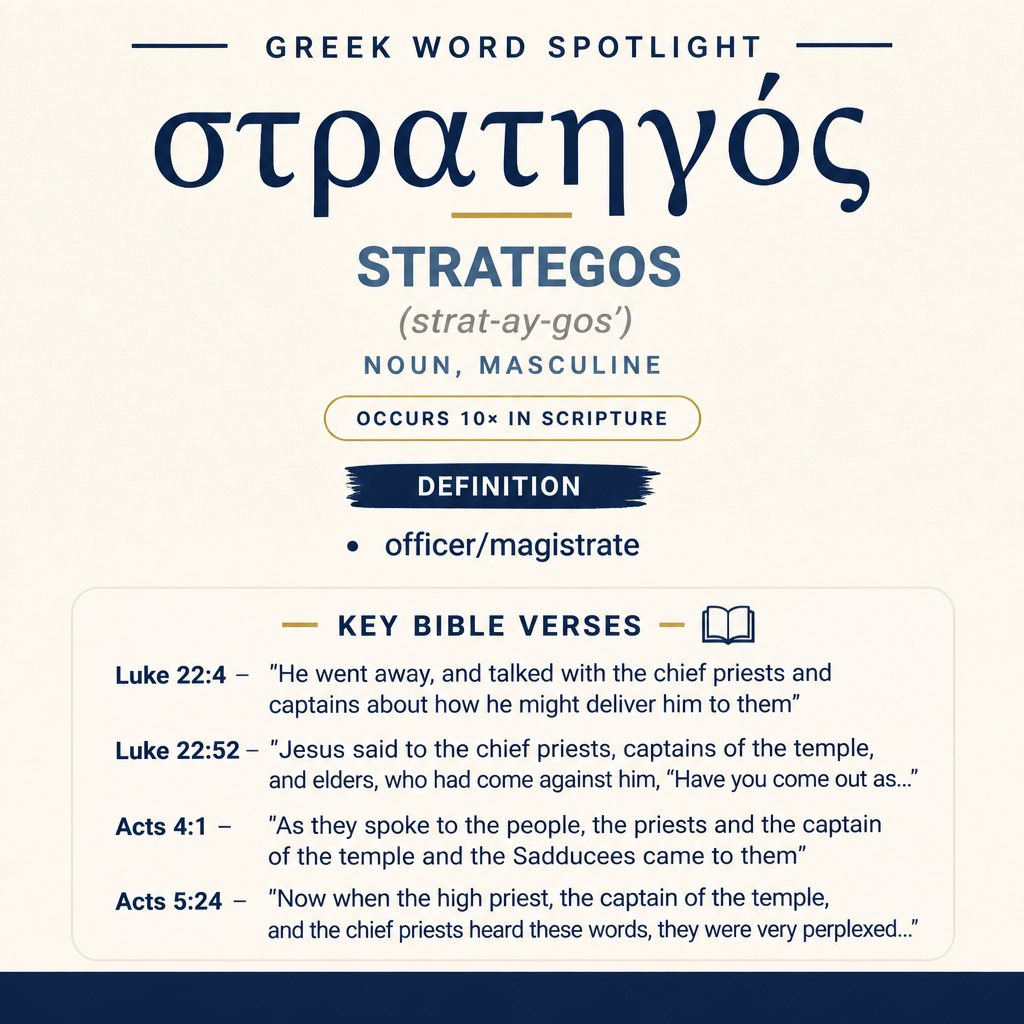
στρατηγός means officer/magistrate and appears 10 times in Scripture, including Luke 22:4, Luke 22:52, Acts 4:1, Acts 5:24, Acts 5:26, and Acts 16:20.
Luke Occurrences
In Luke 22:4 and 22:52 it is used of “captains,” alongside chief priests and elders.
Learn More →Acts Occurrences
In Acts it refers both to the “captain of the temple” (Acts 4:1; 5:24, 26) and to “magistrates” (Acts 16:20, 22, 35).
Learn More →στρατηγός refers to an officer or magistrate, appearing in narratives of arrest, civic disturbance, and public order. In these passages it designates recognized authorities who can negotiate, command subordinates, and authorize restraint or release.
Occurrences
Luke 22:4 — “He went away, and talked with the chief priests and captains about how he might deliver him to them.”
Here στρατηγός (“captains”) stands alongside “the chief priests,” placing these officers within the circle of leadership involved in planning an arrest. The word contributes the idea of an official capacity relevant to carrying out a handover: the conversation is not merely private hostility but coordination with persons who have recognized authority and operational control.
Luke 22:52 — “Jesus said to the chief priests, captains of the temple, and elders, who had come against him, “Have you come out as against a robber, with swords and clubs?”
In this confrontation, στρατηγός identifies “captains of the temple” as part of the group that “had come against him,” and the mention of “swords and clubs” underscores enforcement action. The word marks these figures as officials acting in an organized way, participating with other leaders (“chief priests” and “elders”) in an armed approach that Jesus questions as though it were an action against a violent criminal.
Acts 4:1 — “As they spoke to the people, the priests and the captain of the temple and the Sadducees came to them,”
στρατηγός appears in the singular as “the captain of the temple,” grouped with “the priests” and “the Sadducees.” The word signals an officer positioned to intervene in public speech (“as they spoke to the people”), so that the approach is not a casual inquiry but a move by authorities to stop, challenge, or control what is being said in a public setting.
Acts 5:24 — “Now when the high priest, the captain of the temple, and the chief priests heard these words, they were very perplexed about them and what might become of this.”
Again, στρατηγός (“the captain of the temple”) appears among top leadership—“the high priest” and “the chief priests”—and shares their reaction of perplexity. The word contributes an administrative, responsible role: the issue is not only theological disagreement but a developing situation that concerns officials who must respond to unfolding events and their consequences (“what might become of this”).
Acts 5:26 — “Then the captain went with the officers, and brought them without violence, for they were afraid that the people might stone them.”
Here στρατηγός (“the captain”) is shown in action, moving “with the officers” and managing an arrest “without violence.” The word emphasizes a leadership role over subordinates (“the officers”) and situational judgment: the captain’s method is shaped by public pressure, since they fear “that the people might stone them.” The officer’s task is order-keeping under constraint, aiming to achieve custody without provoking an outbreak.
Acts 16:20 — “When they had brought them to the magistrates, they said, “These men, being Jews, are agitating our city”
In Philippi, στρατηγός is rendered “the magistrates,” the civic authorities to whom the accused are “brought.” The word marks the destination of a formal complaint; the charge is framed as public disturbance (“agitating our city”), which is presented as a matter for official adjudication and enforcement rather than private dispute.
Acts 16:22 — “The multitude rose up together against them and the magistrates tore their clothes from them, then commanded them to be beaten with rods.”
στρατηγός (“the magistrates”) are depicted exercising direct authority amid crowd hostility: “The multitude rose up together,” and the magistrates issue commands that lead to corporal punishment (“commanded them to be beaten with rods”). The word contributes the sense of public office empowered to command penalties; it also shows magistrates acting decisively in a volatile scene where mass pressure and legal power converge.
Acts 16:35 — “But when it was day, the magistrates sent the sergeants, saying, “Let those men go.””
In the next development, στρατηγός (“the magistrates”) send intermediaries (“the sergeants”) with an instruction: “Let those men go.” The word highlights the administrative chain by which a magistrate’s decision becomes action—orders are transmitted through designated agents, and release is framed as an official directive rather than a personal favor.
Acts 16:36 — “The jailer reported these words to Paul, saying, “The magistrates have sent to let you go; now therefore come out and go in peace.””
Here the magistrates’ authority is communicated through the jailer, who treats their message as determinative: “The magistrates have sent to let you go.” στρατηγός thus underlines the legal weight behind the proposed release. The jailer’s phrasing assumes that once the magistrates issue such an order, the appropriate response is immediate compliance—“come out and go in peace.”
Acts 16:38 — “The sergeants reported these words to the magistrates, and they were afraid when they heard that they were Romans,”
Finally, στρατηγός (“the magistrates”) receive a report from “the sergeants” and react with fear upon learning a new fact about the prisoners’ status (“they were Romans”). The word contributes the idea of accountable officials: the magistrates’ emotional response is tied to their role as public authorities whose prior commands and actions carry consequences, now sharpened by the social and legal implications signaled in the report.

Sense and Usage
Across Luke and Acts, στρατηγός consistently functions as a title for persons who operate with official standing and practical authority in matters of public control. In Luke, the word clusters with leadership terms (“chief priests,” “elders”) and is associated with coordinated action: planning “how he might deliver him to them” (Luke 22:4) and arriving “with swords and clubs” (Luke 22:52). The scenes present these officers as part of an organized response, where authority is expressed through planning, presence, and the capacity to bring force.
In Acts 4–5 the title “captain of the temple” locates the officer in a setting where public speech and crowd dynamics intersect with institutional oversight. The captain comes upon speakers addressing “the people” (Acts 4:1), shares in leadership deliberation and concern (Acts 5:24), and then actively directs the retrieval of detainees “with the officers” (Acts 5:26). The portrayal is not merely of status but of command structure: the στρατηγός stands above “the officers,” and the narrative stresses strategy and restraint (“without violence”) when public reaction could turn dangerous.
In Acts 16 the same word is used for civic “magistrates,” showing its applicability to city governance in a context of accusation and punishment. The accused are brought to these authorities as disturbers of civic peace (Acts 16:20), and the magistrates issue punitive orders in the face of a hostile multitude (Acts 16:22). Yet the office also includes the power to reverse course, using formal channels (“sent the sergeants”) to release prisoners (Acts 16:35–36). The closing scene (Acts 16:38) shows magistrates as officials responsive to information and its ramifications; their fear underscores that the role is bounded by accountability and the potential repercussions of their decisions.
Taken together, στρατηγός conveys an office with recognized authority to coordinate actions, command subordinates, and make enforceable decisions in tense public situations. Whether attached to temple oversight or city administration, it marks those who stand at the point where leadership decisions become concrete measures—arrest, restraint, punishment, or release.
Imagery
The word’s narrative imagery is administrative power in motion: officers conferring with religious leaders, an armed party approaching at night, an official arriving to stop public speech, and a chain of command that includes “officers,” “sergeants,” and a jailer. These passages consistently place στρατηγός at moments when authority is tested by crowds, controversy, or sudden turns of events—scenes where official decisions must be enacted in public view.
Sources: Lexical data from Strong’s Exhaustive Concordance and the Translators Brief Lexicon of Extended Strongs for Greek (STEPBible, CC BY). Occurrence data from the Translators Amalgamated Greek New Testament (STEPBible, CC BY). Scripture quotations from the World English Bible (public domain).




