
Exploring the Meaning of Stoicheo in Greek
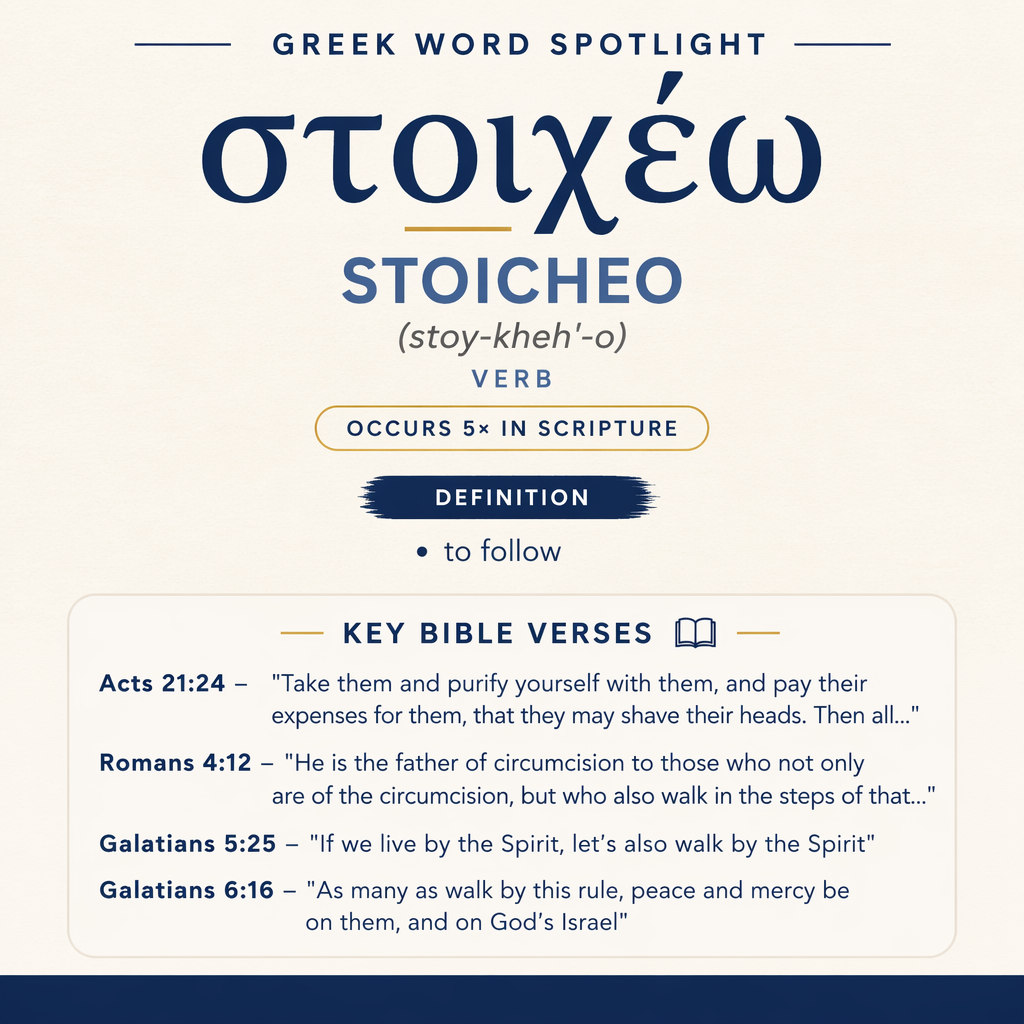
στοιχέω means “to follow” and occurs five times in Scripture: Acts 21:24; Romans 4:12; Galatians 5:25; Galatians 6:16; Philippians 3:16.
Scripture Occurrences
This verb appears 5 times in Scripture. It is found in Acts 21:24; Romans 4:12; Galatians 5:25; Galatians 6:16; and Philippians 3:16.
Learn More →Verse Contexts
In Galatians 5:25, it is used with “walk by the Spirit.” In Philippians 3:16, it appears with “walk by the same rule.”
Learn More →στοιχέω describes action as “to follow,” and in its New Testament usage it is framed as a kind of walking that aligns a person with a standard, pattern, or course. It appears in scenes ranging from public questions about law-keeping to exhortations about life “by the Spirit” and “by the same rule.”
Occurrences
“Take them and purify yourself with them, and pay their expenses for them, that they may shave their heads. Then all will know that there is no truth in the things that they have been informed about you, but that you yourself also walk keeping the law.” (Acts 21:24)
Here the word is set in a public, observable setting: actions are taken “that they may shave their heads,” and the intended result is that “all will know” something about Paul’s conduct. In that context, “walk keeping the law” presents following as a lived course of behavior that others can recognize. The statement is not merely about agreement with the law as an idea; it is about a pattern of conduct that can be demonstrated through concrete steps (purifying, paying expenses) so that the accusation “there is no truth in the things that they have been informed about you” is answered by the shape of Paul’s life.
“He is the father of circumcision to those who not only are of the circumcision, but who also walk in the steps of that faith of our father Abraham, which he had in uncircumcision.” (Romans 4:12)
In this sentence, “walk” is tied to “steps,” and the steps are specifically “of that faith.” The verb portrays following as tracing a path already marked out: the “steps” belong to Abraham’s faith, and those addressed are characterized not only by a status (“of the circumcision”) but by a way of proceeding that conforms to that faith. The wording “walk in the steps” makes following sound like ordered movement along an established track, and it links identity with the continuity of that movement.
“If we live by the Spirit, let’s also walk by the Spirit.” (Galatians 5:25)
The occurrence is framed as an if/then exhortation: if life is sourced “by the Spirit,” conduct should correspond. The parallelism between “live” and “walk” uses following-language to press for consistency between an inner principle of life and the outward course taken day by day. The imperative “let’s also” places the verb in the realm of communal commitment: following is not presented as isolated effort but as a shared pattern expected of “we.”
“As many as walk by this rule, peace and mercy be on them, and on God’s Israel.” (Galatians 6:16)
Here following is measured “by this rule,” and the verb sets the rule as a guiding line for conduct. The sentence treats “walk by this rule” as the defining mark of a group (“as many as”), and it attaches a pronouncement—“peace and mercy be on them”—to those whose course is aligned with that standard. The language keeps the focus on direction and conformity: following is pictured as taking steps in agreement with a stated rule, not as an abstract sentiment.
“Nevertheless, to the extent that we have already attained, let’s walk by the same rule. Let’s be of the same mind.” (Philippians 3:16)
This usage combines progression (“to the extent that we have already attained”) with stability (“walk by the same rule”). Following is urged precisely at the point where some measure of attainment exists; it is a call to continue in line with what has already been reached rather than to splinter into competing directions. The paired exhortation “Let’s be of the same mind” places the verb alongside communal unity: following “the same rule” is presented as a practical expression of shared thinking, a coordinated movement that matches a coordinated outlook.
Sense and Usage
Across these passages, “to follow” is expressed through the metaphor of walking, and that metaphor carries two consistent features: (1) it is directional, and (2) it is assessable by reference to something external to the walker. In Acts 21:24, following is described as “walk keeping the law,” where the law functions as a recognized standard and the walk is public enough that “all will know.” In Romans 4:12, following takes the shape of patterned movement—“walk in the steps”—where the steps are already laid down by the example of Abraham’s faith. In Galatians 5:25, following is governed by an animating source (“by the Spirit”), and the verb presses for a course of conduct that matches the life-principle claimed. In Galatians 6:16 and Philippians 3:16, the verb is explicitly tethered to “rule,” highlighting that following is not an improvised path but one that can be described, shared, and held in common.
The verb’s uses also show that following can be spoken of with different kinds of reference points—law, steps, Spirit, rule—yet it remains the same kind of action: a continuing course. That ongoing aspect is reinforced by the repeated “walk” phrasing: it is not a single act but a way of proceeding. The exhortations in Galatians and Philippians cast following as a communal responsibility (“let’s also walk,” “as many as walk,” “let’s walk”), and they connect this shared following with shared outcomes and shared posture: “peace and mercy be on them,” and “Let’s be of the same mind.” Even in Romans, where the focus is on identity markers and ancestry, the decisive point is not merely belonging but walking—following a set of steps that embody faith. The picture is thus practical: following is the shape that convictions, standards, and sources of life take when they are translated into regular movement.
Finally, the occurrences show a consistent moral and communal weight. Acts 21:24 places following under scrutiny: it answers public claims about what someone is like. Galatians 6:16 and Philippians 3:16 place following within the boundaries of a “rule” that unifies a community and provides a basis for blessing and harmony. In these contexts, “to follow” is not framed as private preference; it is the lived alignment of a person (and a people) with what they recognize as guiding, whether expressed as law, faith’s steps, Spirit, or rule.
Imagery
The repeated choice to speak of following as “walk” creates a steady image of ordered movement. Acts 21:24 ties it to visible practices that prove a claim; Romans 4:12 gives it the texture of stepping where another has stepped; Galatians 5:25 sets it under the guidance of the Spirit; Galatians 6:16 and Philippians 3:16 place it alongside a “rule” that keeps many walkers moving together. In all five, following is pictured as a path taken—an embodied, continuing direction rather than a momentary decision.
Sources: Lexical data from Strong’s Exhaustive Concordance and the Translators Brief Lexicon of Extended Strongs for Greek (STEPBible, CC BY). Occurrence data from the Translators Amalgamated Greek New Testament (STEPBible, CC BY). Scripture quotations from the World English Bible (public domain).




