
Exploring the Meaning of Stoma in Greek
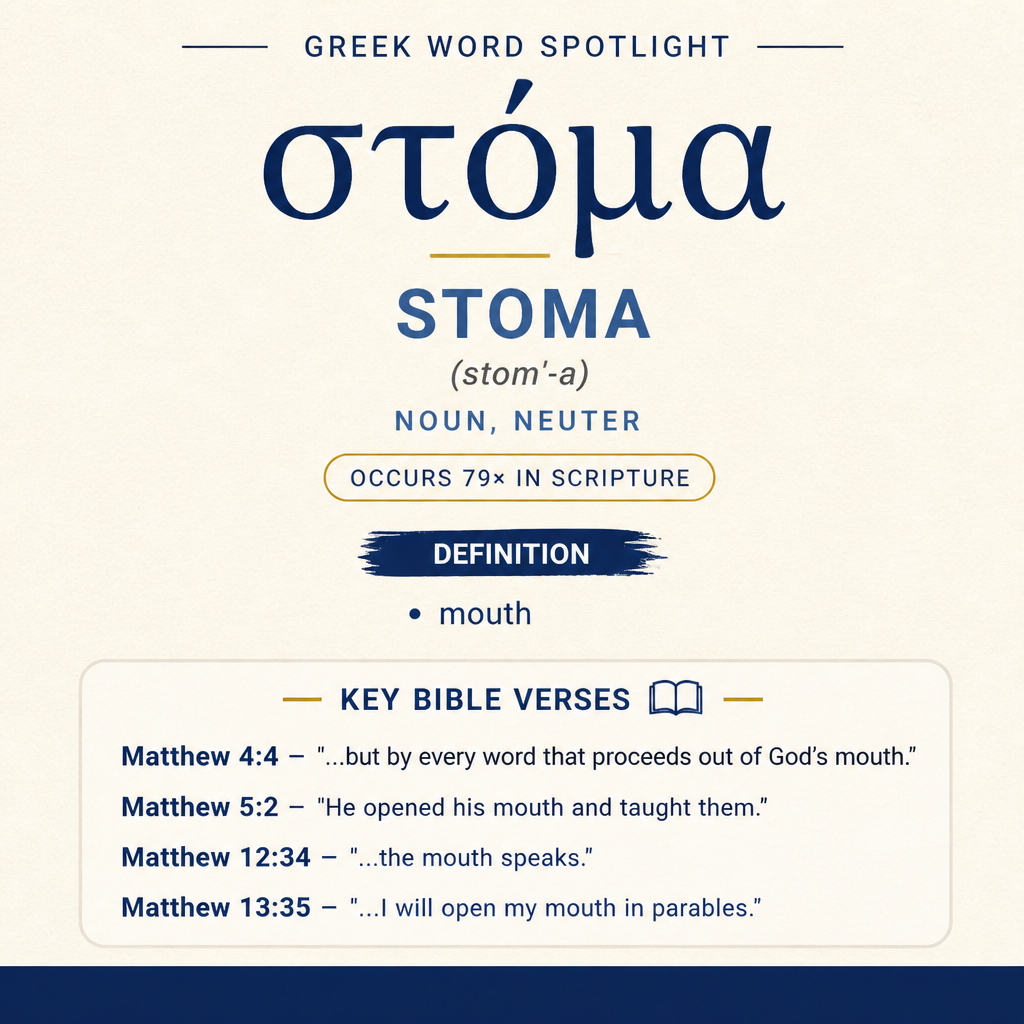
στόμα means “mouth” in Greek and occurs 79 times in Scripture, including Matthew 4:4; 5:2; 12:34; 13:35; and 15:8–18.
Basic Meaning
στόμα is defined as “mouth.” In Matthew, it refers to God’s mouth and a person’s mouth that speaks.
Learn More →Matthew Examples
Jesus answers that every word proceeds out of God’s mouth (Matthew 4:4). He also opens his mouth to teach (Matthew 5:2).
Learn More →What Comes Out
Matthew 15:11–18 contrasts what enters the mouth with what proceeds out of the mouth. What proceeds out of the mouth comes out of the heart (Matthew 15:18).
Learn More →στόμα refers to the mouth, and in these passages it appears in teaching, quotation, and narrative scenes where speaking, eating, and bodily opening or closing are in view. The word can point to the mouth as an organ, to the mouth as the place from which speech proceeds, and to the mouth as a vivid image in moral and legal language.
Occurrences
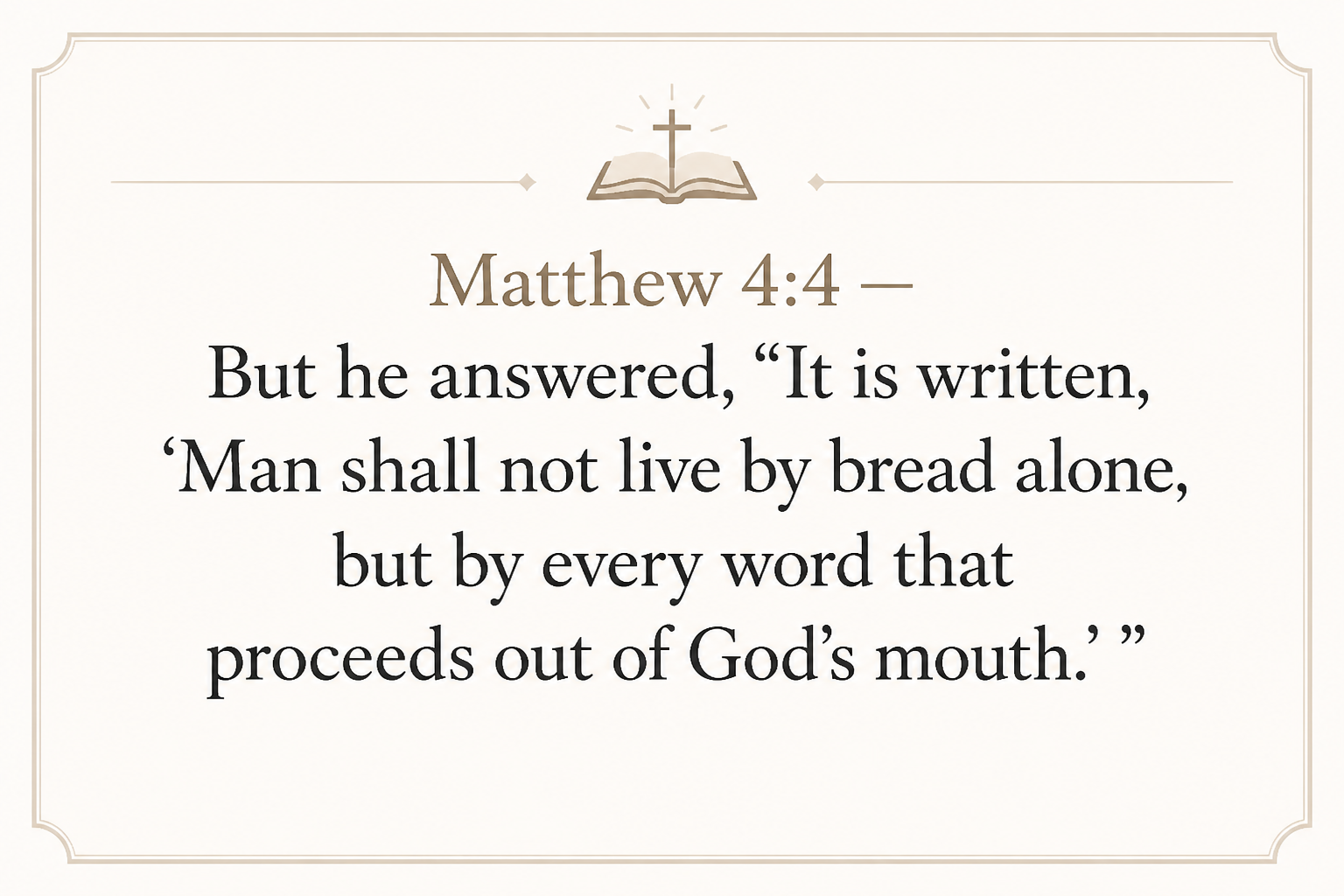
Matthew 4:4 — But he answered, “It is written, ‘Man shall not live by bread alone, but by every word that proceeds out of God’s mouth.’ ”
Here στόμα is part of a quotation contrasting “bread” with “every word.” The mouth is presented as the source from which God’s words proceed, grounding life not merely in food but in speech that comes forth from God’s mouth.
Matthew 5:2 — He opened his mouth and taught them, saying,
In this narrative introduction to Jesus’ teaching, the mouth is described as being “opened,” marking the beginning of instruction. στόμα emphasizes the physical act that initiates public teaching: speech is about to come from an opened mouth.
Matthew 12:34 — You offspring of vipers, how can you, being evil, speak good things? For out of the abundance of the heart, the mouth speaks.
στόμα stands in a moral diagnosis of speech. The mouth is the speaking instrument, but its speech is tied to an inner source: “out of the abundance of the heart.” The mouth, in this saying, functions as the outward channel through which what fills the heart becomes audible.
Matthew 13:35 — that it might be fulfilled which was spoken through the prophet, saying, “I will open my mouth in parables; I will utter things hidden from the foundation of the world.”
Again the mouth is “opened,” now within a quotation that frames parabolic teaching. στόμα marks the start of utterance (“I will utter…”), highlighting the mouth as the bodily point of release for speech that conveys “things hidden.”
Matthew 15:8 — ‘These people draw near to me with their mouth, and honor me with their lips; but their heart is far from me.
στόμα appears paired with “lips” in a critique of worship that is verbally near while inwardly distant. The mouth represents outward approach and honor expressed in speech, set in tension with a heart described as “far.”
Matthew 15:11 — That which enters into the mouth doesn’t defile the man; but that which proceeds out of the mouth, this defiles the man.”
Here the mouth is the gateway for intake (“enters into the mouth”) and the point of exit (“proceeds out of the mouth”). The statement uses the mouth to distinguish between what comes from outside into the body and what comes from within outward, locating defilement in what proceeds out from the mouth.
Matthew 15:17 — Don’t you understand that whatever goes into the mouth passes into the belly, and then out of the body?
στόμα is used in a straightforward bodily description of eating. The mouth is the entry point of food, which then “passes into the belly” and continues through the body; the mouth is the first stage in an ordinary physical process.
Matthew 15:18 — But the things which proceed out of the mouth come out of the heart, and they defile the man.
This develops the earlier contrast by tracing what proceeds out of the mouth back to the heart. στόμα is where the defiling “things” emerge into the world, but their origin is identified as internal; the mouth is the outlet through which the heart’s contents become expressed.
Matthew 17:27 — But, lest we cause them to stumble, go to the sea, cast a hook, and take up the first fish that comes up. When you have opened its mouth, you will find a stater coin. Take that, and give it to them for me and you.”
In this concrete narrative instruction, the mouth belongs to a fish. στόμα is purely anatomical and spatial: opening the fish’s mouth reveals a coin. The mouth is portrayed as a container-like opening that can be opened to expose what is inside.
Matthew 18:16 — But if he doesn’t listen, take one or two more with you, that at the mouth of two or three witnesses every word may be established.
στόμα appears in a legal-sounding formula: “at the mouth of two or three witnesses.” The mouth stands for the witnesses’ spoken testimony by which “every word may be established,” linking establishment of a matter with oral witness.
Matthew 21:16 — and said to him, “Do you hear what these are saying?” Jesus said to them, “Yes. Did you never read, ‘Out of the mouth of babes and nursing babies you have perfected praise?’ ”
In this quotation, the mouth is associated with very young speakers: “babes and nursing babies.” στόμα highlights the surprising source from which “praise” comes—praise is pictured as proceeding out of their mouths.
Luke 1:64 — His mouth was opened immediately and his tongue freed, and he spoke, blessing God.
στόμα is central to the narrated moment of restored speech: “His mouth was opened immediately.” The opening of the mouth is paired with the freeing of the tongue and results in speaking that blesses God, presenting the mouth as the bodily locus whose opening enables audible blessing.

Sense and Usage
Across these contexts, στόμα consistently anchors communication and consumption in a concrete bodily location. Several passages treat the mouth as the point from which speech emerges. This is explicit when “the mouth speaks” (Matthew 12:34) and when a speaker “open[s] [the] mouth” to teach or to utter parables (Matthew 5:2; 13:35). In such lines the mouth is not merely named; it is activated—opened, speaking, uttering—so that the reader is invited to picture the physical act of speaking as the outward edge of instruction and revelation.
Other passages place the mouth within moral and devotional evaluation. Matthew 15:8 opposes an approach “with their mouth” to a heart that is “far,” using the mouth to represent verbal honor that can exist without inner proximity. Matthew 15:11 and 15:18 sharpen the moral focus by contrasting what enters the mouth with what proceeds out of it: the mouth becomes the dividing line between intake and expression, and the ethical weight falls on what comes out—speech and expressed “things”—as connected to what is in the heart.
At the same time, στόμα keeps its plain physical force. Matthew 15:17 describes the mouth as the entryway in digestion, tracing the route from mouth to belly and onward. Matthew 17:27 uses the mouth as a literal opening that can be pried open to find what is inside, reinforcing that στόμα can denote a tangible part of an animal’s body in an everyday scene. Luke 1:64 joins the physical and the expressive: the mouth is “opened,” the tongue is “freed,” and then speech follows; bodily opening is narrated as the immediate condition for spoken blessing.
Finally, the phrase “at the mouth of two or three witnesses” (Matthew 18:16) shows how mouth-language can function in judicial settings as a way of locating testimony in spoken utterance. The establishment of “every word” is linked to what is said at the witnesses’ mouths, presenting the mouth as the human point of articulation by which a matter is confirmed.
Imagery
Within these passages, the mouth serves as a vivid threshold: it can be opened to begin teaching (Matthew 5:2), opened to utter hidden things in parables (Matthew 13:35), opened so that blessing is spoken (Luke 1:64), and opened even in a fish to reveal a coin (Matthew 17:27). It is also the boundary where inner realities become outwardly heard—whether in speech that reflects a heart’s abundance (Matthew 12:34), in honor that may remain only verbal (Matthew 15:8), or in praise that comes from the mouths of the very young (Matthew 21:16).
Sources: Lexical data from Strong’s Exhaustive Concordance and the Translators Brief Lexicon of Extended Strongs for Greek (STEPBible, CC BY). Occurrence data from the Translators Amalgamated Greek New Testament (STEPBible, CC BY). Scripture quotations from the World English Bible (public domain).




