Exploring the Meaning of Sophronos in Greek
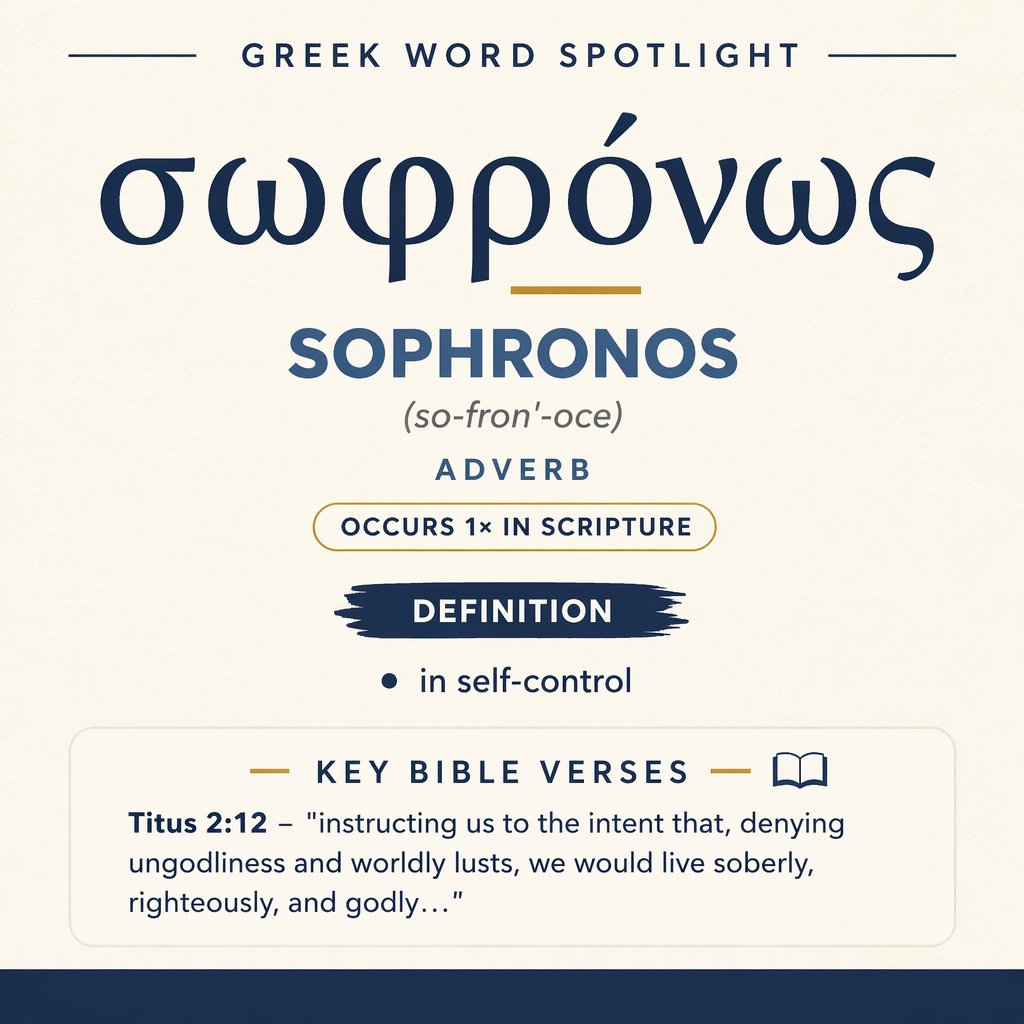
σωφρόνως means “in self-control” and appears once in Scripture, in Titus 2:12.
Biblical Usage
It occurs one time in Scripture. In Titus 2:12, it describes how believers are to live: “soberly, righteously, and godly.”
Learn More →Titus 2:12 Context
In Titus 2:12, σωφρόνως appears within instruction to deny ungodliness and worldly lusts. It is paired with living righteously and godly.
Learn More →σωφρόνως means “in self-control.” It appears once in the New Testament, in Titus 2:12, where it belongs to a cluster of adverbs describing the kind of life aimed at “in this present age.”
Root and Related Words
σωφρόνως is related to the adjective sophron (σώφρων), “self-controlled” (Strong’s G4998). The adverb expresses in adverbial form what the adjective characterizes in a person: the manner in which life is to be lived.

Occurrences
“instructing us to the intent that, denying ungodliness and worldly lusts, we would live soberly, righteously, and godly in this present age;” (Titus 2:12)
In Titus 2:12, σωφρόνως stands in a tightly structured sentence that moves from training (“instructing us”) to moral refusal (“denying ungodliness and worldly lusts”) to a positive aim (“we would live … in this present age”). Within that aim, σωφρόνως occupies the first position in a threefold description of how life is to be lived: “soberly, righteously, and godly.” Its placement gives it a foundational role: it names a manner of living characterized by self-control, set alongside living in a way that is “righteously” and “godly.”

The immediate context in the verse frames self-control as a deliberate stance taken amid competing desires. The participial phrase “denying ungodliness and worldly lusts” describes an active refusal, and σωφρόνως then describes the lived alternative that follows that refusal. In other words, self-control here is not presented as a private temperament detached from choices; it is tied to a pattern of life that turns away from “worldly lusts” and expresses itself in conduct that can be described with multiple moral terms. The adverb therefore functions as a concrete descriptor of lifestyle—how one “would live”—rather than as an abstract label.
σωφρόνως also gains definition from its coordination with the other two adverbs. “Righteously” points to conduct evaluated in moral terms, and “godly” points to conduct shaped by reverence and alignment with God. By being listed with these, “soberly” (as the English renders it here) is not reduced to a single narrow sphere, but participates in an all-of-life description. The trio suggests an integrated way of living: self-control as the manner of life, righteousness as the moral quality of that life, and godliness as its orientation. Within the verse’s syntax, σωφρόνως contributes the first aspect of that integrated picture.
Finally, the time marker “in this present age” keeps the instruction grounded in the current setting of the readers’ lives. The verse does not postpone self-controlled living to an ideal future; it places it within the pressures and patterns of the present. σωφρόνως, therefore, describes a practical mode of life intended for ordinary time and real temptations, in a world where “worldly lusts” are an available alternative.
Sense and Usage
The sense “in self-control” in Titus 2:12 functions as a manner adverb modifying “live.” It describes not merely what actions are performed, but the way the whole of life is conducted. The verse presents self-control as something learned and reinforced through instruction (“instructing us to the intent that…”), and it places that learned discipline in the flow of moral decision-making (“denying…” leading to “we would live…”). In this usage, self-control is shown as purposive: it is the intended outcome of instruction, and it is expressed as a sustained way of living.
Because the verse links self-control with denial of “ungodliness and worldly lusts,” the self-control in view is not an undefined restraint; it is restraint with a direction. It involves saying “no” to certain patterns and impulses described as “worldly lusts,” and saying “yes” to a life that can simultaneously be called “righteously” and “godly.” The word’s contribution is to name the controlled, measured manner in which such a life proceeds, as opposed to a life driven by lusts.
The coordination of σωφρόνως with “righteously” and “godly” also shows how self-control relates to broader moral and spiritual aims. The verse does not isolate self-control as an end in itself; it sits within a triad that captures the shape of a whole life in the present age. Self-control thus functions as an essential component of a life that is morally upright and oriented toward God, describing the inner governance and steadiness that supports that outward and upward orientation.
In this single attestation, σωφρόνως appears as part of exhortational prose aimed at forming conduct. That setting highlights its practical, behavioral force: it is the kind of quality that can be exhorted, learned, and embodied over time. The term’s adverbial form makes it especially suited to describing ongoing practice—how life is lived—rather than labeling someone with a title. It speaks to the texture of daily living in “this present age,” where self-control is presented as both necessary and possible within a trained, deliberate moral life.
Imagery
The verse’s imagery is understated but clear: there is a turning away (“denying”) from one set of desires and a steady walking into a different kind of life (“we would live … in this present age”). σωφρόνως belongs to the picture of steadiness—life governed rather than swept along—set in the ordinary timeframe of the “present age,” where ungodliness and lusts are real pressures and self-controlled living is the intended outcome of instruction.
Sources: Lexical data from Strong’s Exhaustive Concordance and the Translators Brief Lexicon of Extended Strongs for Greek (STEPBible, CC BY). Occurrence data from the Translators Amalgamated Greek New Testament (STEPBible, CC BY). Scripture quotations from the World English Bible (public domain).