Exploring the Meaning of Sophronismos in Greek
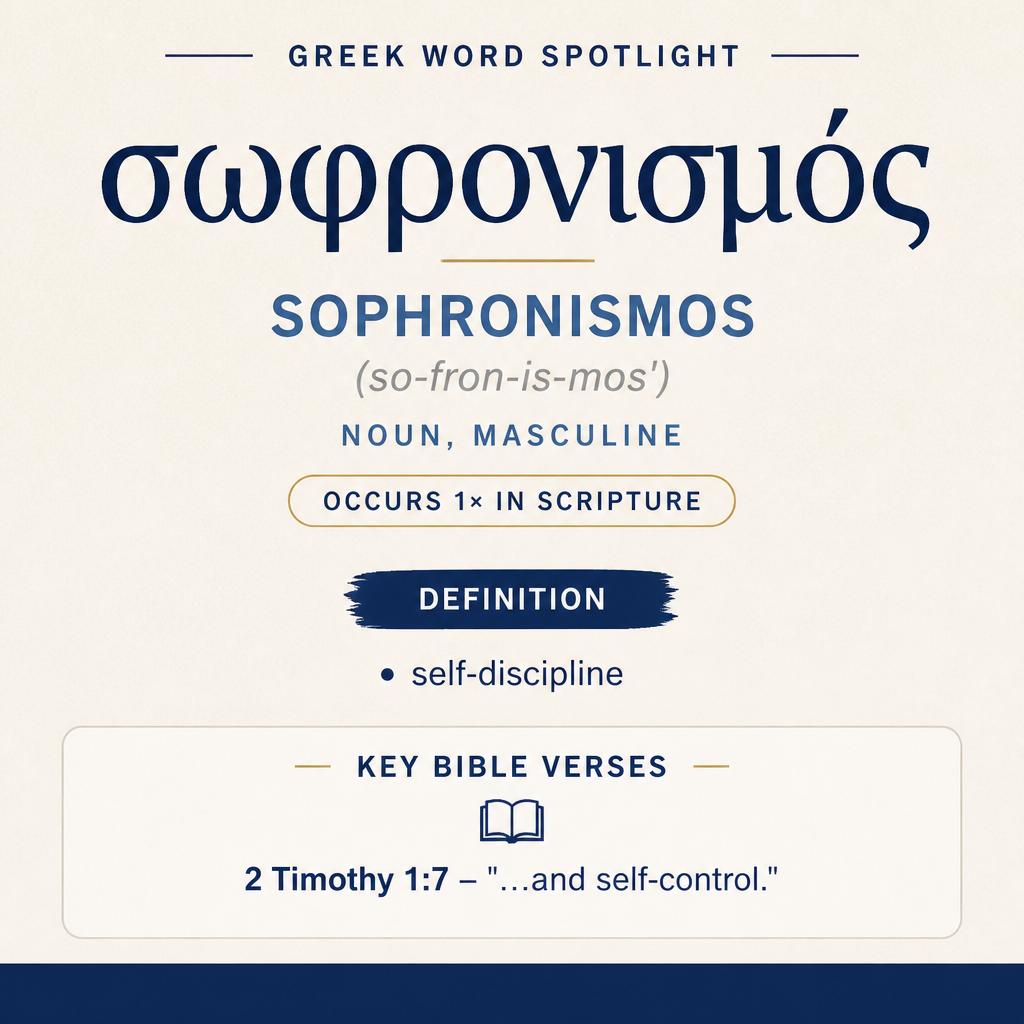
σωφρονισμός means “self-discipline” and appears once in Scripture, in 2 Timothy 1:7.
Verse Context
In 2 Timothy 1:7, it appears alongside power and love, contrasted with fear.
Learn More →σωφρονισμός means “self-discipline” and appears in Paul’s description of what God has given believers in 2 Timothy 1:7. The term is set alongside “power” and “love” as a defining feature of the spirit God gives, contrasted with “fear.”
Root and Related Words
σωφρονισμός is related to the verb sophronizo (σωφρονίζω), “to train” (Strong’s G4994). The noun’s sense of self-discipline fits naturally with the idea of training: a formed capacity rather than a passing impulse.

Occurrences
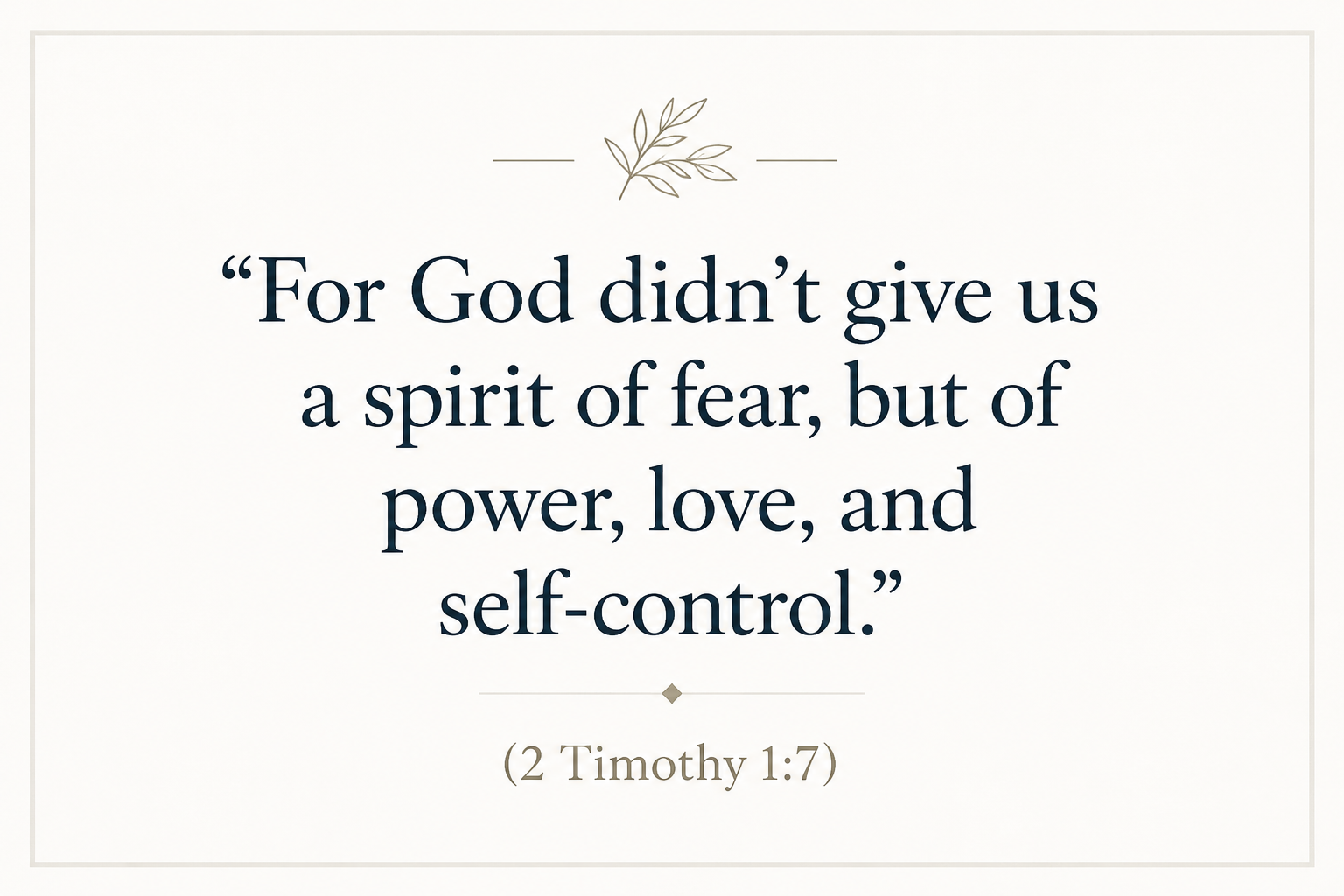
“For God didn’t give us a spirit of fear, but of power, love, and self-control.” (2 Timothy 1:7)
Here σωφρονισμός stands in a tightly balanced contrast. On one side is “a spirit of fear,” something depicted as not originating from God; on the other side is the spirit God gives, characterized by three coordinated qualities: “power, love, and self-control.” In this line, “self-control” functions as one element in a threefold description of the believer’s disposition and readiness, not an isolated virtue. The placement implies that self-discipline belongs with strength (“power”) and relational commitment (“love”), forming a coherent picture of an inner orientation that is neither driven by fear nor scattered by it.
Because the verse speaks of “a spirit,” σωφρονισμός is framed as part of a person’s settled posture. The word contributes the idea that the God-given spirit includes a capacity to govern oneself—an inner steadiness that counters fear’s destabilizing effect. In the flow of the sentence, fear is not merely an emotion to be managed; it is treated as a spirit that does not come from God. Against that, self-discipline is presented as a mark of what God does provide. The contrast gives the noun a practical edge: it is not simply restraint for restraint’s sake, but a disposition that aligns with the constructive aims suggested by “power” and “love.”
The list structure also clarifies the role of self-discipline in relation to the other two terms. “Power” without self-discipline can be reckless; “love” without self-discipline can become impulsive or easily redirected. In this verse, σωφρονισμός supplies the stabilizing element that keeps the other qualities from being swallowed up by fear or distorted by it. Paul’s phrasing places “self-control” as a positive endowment: it is something given, not merely demanded, and it sits within a trio that describes what that gift looks like in lived experience.
Sense and Usage
The definition “self-discipline” is given concrete shape in 2 Timothy 1:7 by its immediate opposition to fear and its pairing with power and love. In this setting, self-discipline is not portrayed as cold detachment or a narrowing of life; it is presented as part of a God-given spirit that enables a person to act with strength and affection without being dominated by fear. The sentence makes the term relational and active by context: it is not simply an inward technique, but a quality that supports purposeful action (“power”) and committed regard for others (“love”).
The verse’s grammar emphasizes that self-discipline belongs to the “spirit” God gives, which casts it as an enduring characteristic rather than a momentary decision. That framing does not reduce human responsibility, but it does locate self-discipline within divine gifting: it is a feature of the life God imparts. Within the triad, self-discipline functions as a governing capacity, the kind of inner training that keeps one’s responses proportionate and directed. In the logic of the contrast, fear is a constricting or derailing force; self-discipline is the opposite—a steadying force that makes room for power to be constructive and love to be consistent.
Because σωφρονισμός occurs here as one item in a coordinated list, it should be read with the other two terms in view rather than treated as an abstract ideal. The sentence offers a composite picture: a God-given spirit is simultaneously strong, loving, and self-disciplined. This combination implies that self-discipline is not merely about saying “no” to something; in this verse it is part of saying “yes” to a life that is neither governed by fear nor deprived of affection and courage. The term’s contribution is to name the inner orderliness of that life—the trained steadiness that keeps fear from ruling the person’s spirit.
Imagery
The imagery in 2 Timothy 1:7 is the stark contrast between two “spirits,” one characterized by fear and the other by a threefold strength. Within that contrast, σωφρονισμός evokes the picture of an inward steadiness: a life not whipped about by fear, but held in a disciplined, governed posture that fits naturally with power and love.
Sources: Lexical data from Strong’s Exhaustive Concordance and the Translators Brief Lexicon of Extended Strongs for Greek (STEPBible, CC BY). Occurrence data from the Translators Amalgamated Greek New Testament (STEPBible, CC BY). Scripture quotations from the World English Bible (public domain).