
Exploring the Meaning of Sophroneo in Greek
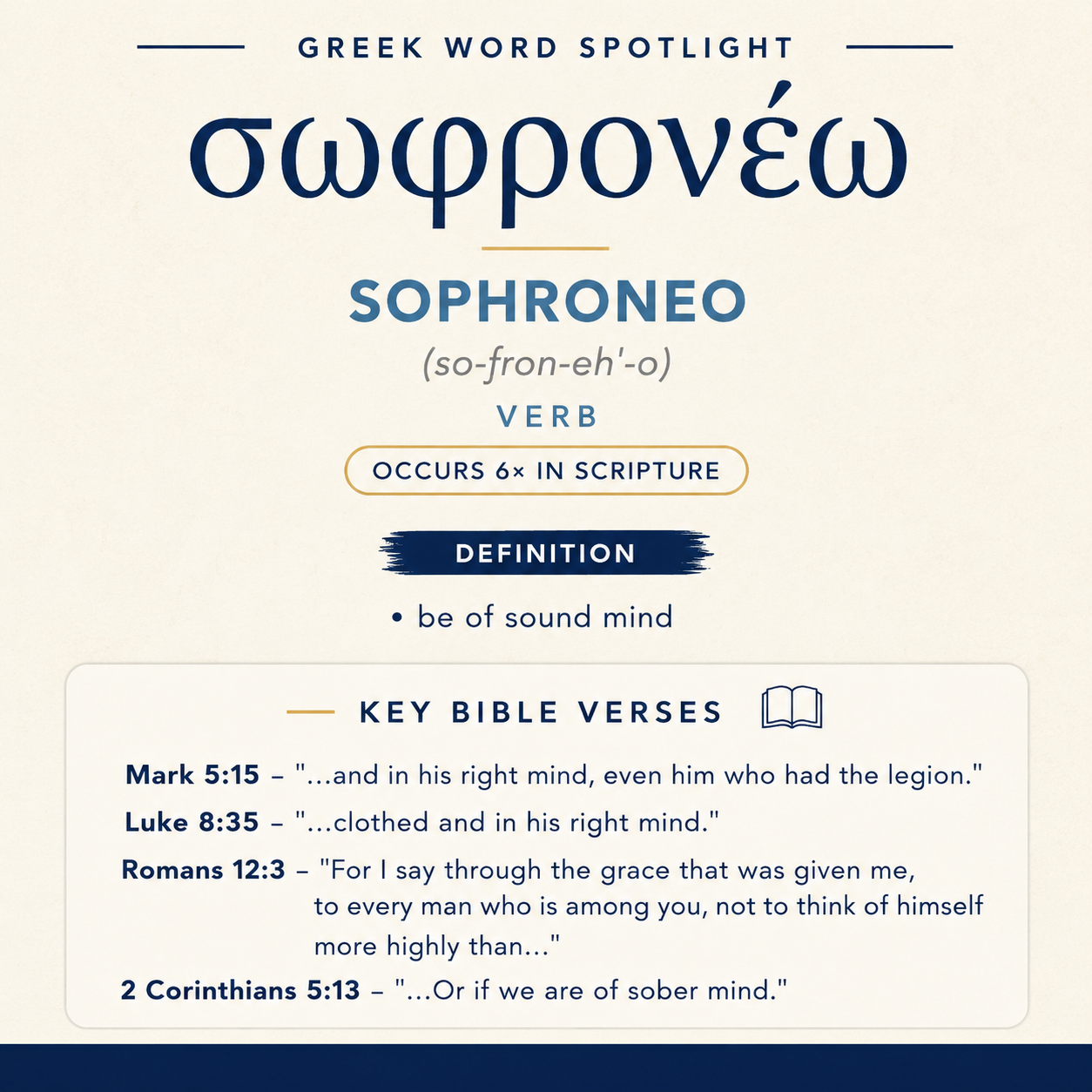
σωφρονέω means “be of sound mind” and occurs 6 times: Mark 5:15; Luke 8:35; Romans 12:3; 2 Corinthians 5:13; Titus 2:6; 1 Peter 4:7.
Gospel Scenes
In Mark 5:15 and Luke 8:35, it describes the formerly demon-possessed man as “in his right mind.”
Learn More →Apostolic Exhortation
Romans 12:3, 2 Corinthians 5:13, Titus 2:6, and 1 Peter 4:7 apply it to sober-minded, sound-minded living.
Learn More →σωφρονέω means “be of sound mind.” It appears in narrative descriptions of restored mental clarity and in exhortations that call for measured, sober-minded thinking and conduct.
Occurrences
“They came to Jesus, and saw him who had been possessed by demons sitting, clothed, and in his right mind, even him who had the legion; and they were afraid.” (Mark 5:15)
Here the term is embedded in a concrete, visible scene: the man is “sitting, clothed, and in his right mind.” Sound-mindedness is presented as part of an observable restoration that others can recognize immediately upon arrival. The description sets “in his right mind” alongside posture (“sitting”) and appearance (“clothed”), portraying a settled, stable condition rather than agitation. The response—“and they were afraid”—shows that this return to sound-mindedness is startling to onlookers, not merely private or internal.

“People went out to see what had happened. They came to Jesus and found the man from whom the demons had gone out, sitting at Jesus’ feet, clothed and in his right mind; and they were afraid.” (Luke 8:35)
This parallel account adds relational positioning: the man is “sitting at Jesus’ feet,” then “clothed and in his right mind.” Sound-mindedness is again portrayed as a recognizable outcome, but Luke places it in a posture of calm attentiveness. The wording “from whom the demons had gone out” frames sound-mindedness as the condition that follows a prior oppression and its removal. As in Mark, the crowd’s fear underscores the magnitude of the change; the mind restored to order becomes part of the public evidence of what “had happened.”
“For I say through the grace that was given me, to every man who is among you, not to think of himself more highly than he ought to think; but to think reasonably, as God has apportioned to each person a measure of faith.” (Romans 12:3)
In Romans, the focus shifts from a narrative observation to deliberate self-assessment. Sound-mindedness expresses itself as refusing inflated self-estimation (“not to think of himself more highly than he ought to think”) and adopting a measured mindset (“to think reasonably”). The verse places this reasonable thinking under the banner of grace and ties it to divine apportionment: “as God has apportioned to each person a measure of faith.” The term thus contributes the idea of mental balance—thinking that stays within proper bounds and corresponds to what has been given, rather than expanding into self-exaltation.
“For if we are beside ourselves, it is for God. Or if we are of sober mind, it is for you.” (2 Corinthians 5:13)
Here sound-mindedness is contrasted with being “beside ourselves.” The sentence is framed as an either/or: one condition is oriented “for God,” and the other—“of sober mind”—is oriented “for you.” The term contributes a sense of composure that serves the audience; being of sound mind is presented as a stance taken with others in view. The contrast does not define either state in detail, but it clearly uses sound-mindedness as the category for intelligible, steady, other-regarding engagement.
“Likewise, exhort the younger men to be sober minded.” (Titus 2:6)
This brief imperative uses the word as a direct pastoral exhortation. Sound-mindedness is treated as a defining trait to be urged upon “the younger men,” suggesting that it is a learnable, cultivable pattern rather than a passing mood. The adverb “Likewise” ties it to a broader set of instructions, and the concise wording gives the term weight: it stands on its own as a summary demand for mental steadiness and restraint in outlook.
“But the end of all things is near. Therefore be of sound mind, self-controlled, and sober in prayer.” (1 Peter 4:7)
In 1 Peter, sound-mindedness is grounded in an eschatological horizon: “the end of all things is near.” The “Therefore” makes the mental posture a practical response to that nearness. The term is paired with two additional descriptors—“self-controlled” and “sober in prayer”—placing sound-mindedness within a cluster of disciplines that shape how one prays. Here it functions as an orientation that keeps the mind clear and steady, supporting watchful, restrained prayer rather than impulsive or clouded devotion.

Sense and Usage
Across these passages, “being of sound mind” consistently marks a movement toward clarity, order, and measured perception. In the Gospel narratives (Mark 5:15; Luke 8:35), the term describes an externally evident state: the man’s composure can be seen in his posture and presence. Sound-mindedness is not merely an inward feeling; it is part of a whole-person restoration that others can recognize at a glance. The repeated pairing with “sitting” and “clothed” gives the phrase a tangible quality—stability, settledness, and social readability—so that “in his right mind” reads like a return to ordinary, grounded life.
In the epistles, the word moves from description to exhortation and evaluation. Romans 12:3 locates sound-mindedness in thought patterns: it governs how a person estimates himself and calls for thinking that remains proportionate. The verse’s internal parallelism (“not… more highly… but… reasonably”) portrays sound-mindedness as the middle path between distortion and proper perspective. It is not mere intellectual capability but a disciplined refusal to let the mind run beyond appropriate limits, especially in self-regard.
2 Corinthians 5:13 places the term on a social axis: “of sober mind” is “for you.” Sound-mindedness is presented as the condition that enables communication and service to others. Even without elaborating on what it looks like in practice, the verse uses the term to signal a mode of presence that is comprehensible and directed toward the good of the hearers.
Titus 2:6 and 1 Peter 4:7 show sound-mindedness as a moral-spiritual posture that can be summoned by instruction. In Titus, it stands as a targeted exhortation to younger men, implying that sound-mindedness is a needed strength in that segment of the community. In 1 Peter, it is explicitly linked to prayer: sound-mindedness is part of the mental and spiritual readiness suited to a time described as near its culmination. The pairing with “self-controlled” and “sober in prayer” keeps the concept practical: it is the kind of mental steadiness that supports deliberate, disciplined communion with God.
Taken together, these uses show the word operating on two planes that reinforce each other: (1) a restored or present condition of mental wholeness that can be seen in calm, ordered life; and (2) an instructed, chosen posture that governs self-assessment, public conduct, and prayer. The definition “be of sound mind” remains constant, but the passages display its range from visible restoration (in the Gospels) to measured thinking (Romans), to socially oriented composure (2 Corinthians), to community instruction (Titus), to eschatologically motivated prayerful discipline (1 Peter).
Imagery
The most vivid picture is the man “sitting… clothed… in his right mind” (Mark 5:15; Luke 8:35). Sound-mindedness is framed as quiet order after disturbance, a settled presence that can be located—at Jesus’ feet—and recognized by a crowd. In the letters, the imagery becomes less visual but no less concrete: a mind that does not overreach itself (Romans 12:3), a steadiness that serves others (2 Corinthians 5:13), and a clear-headed posture that steadies prayer in a time described as near its end (1 Peter 4:7).
Sources: Lexical data from Strong’s Exhaustive Concordance and the Translators Brief Lexicon of Extended Strongs for Greek (STEPBible, CC BY). Occurrence data from the Translators Amalgamated Greek New Testament (STEPBible, CC BY). Scripture quotations from the World English Bible (public domain).




