Exploring the Meaning of Schedon in Greek
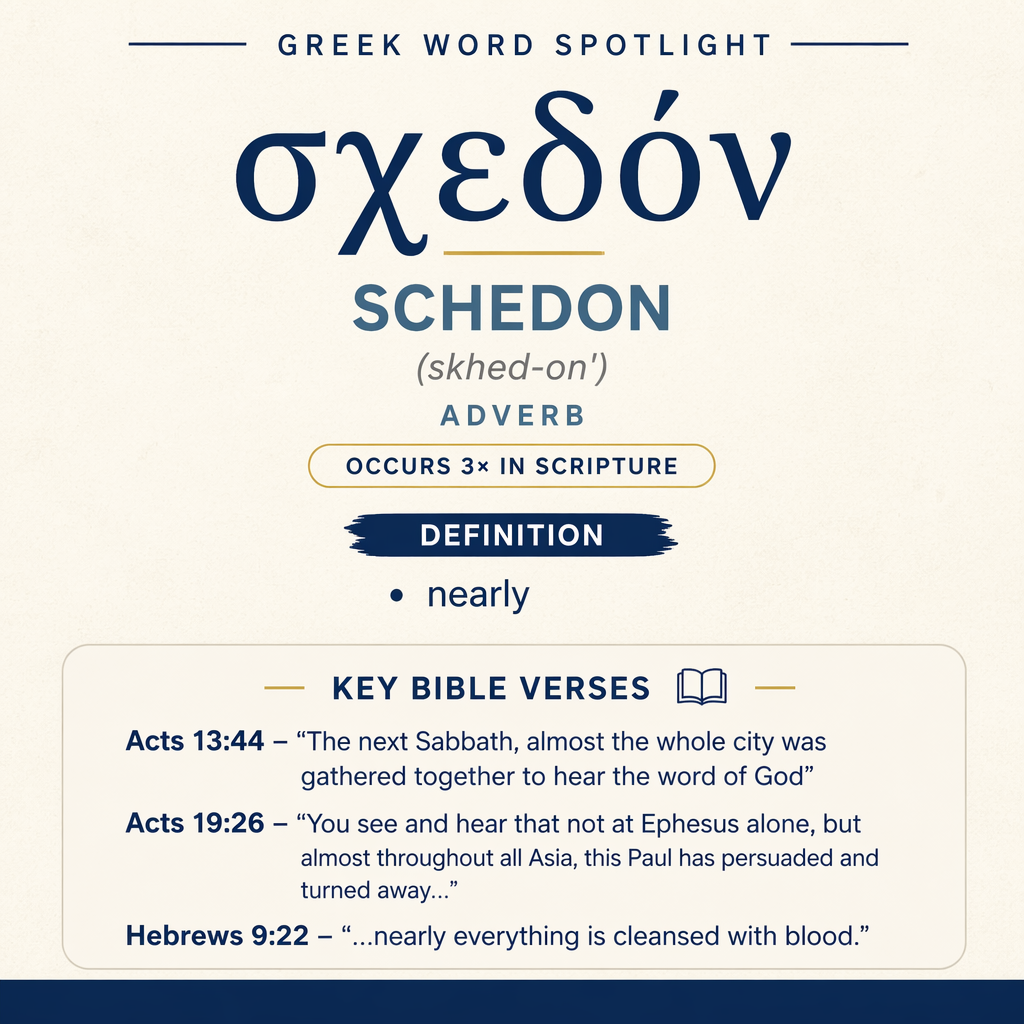
σχεδόν means “nearly” and appears three times in Scripture: Acts 13:44, Acts 19:26, and Hebrews 9:22.
Core Sense
σχεδόν communicates the idea of “nearly,” indicating something that is almost the case.
Learn More →Acts Usage
In Acts 13:44, it describes almost the whole city gathering to hear the word of God. In Acts 19:26, it describes Paul’s influence almost throughout all Asia.
Learn More →Hebrews Usage
In Hebrews 9:22, it states that nearly everything is cleansed with blood according to the law, tied to remission requiring shedding of blood.
Learn More →σχεδόν expresses nearness to a limit without presenting the limit as fully reached. It appears in Acts and Hebrews in statements about the scale of a gathering, the breadth of an influence, and the scope of ritual cleansing.
Root and Related Words
σχεδόν is connected with echo (ἔχω), “to have/be” (Strong’s G2192).

Occurrences
Acts 13:44 — The next Sabbath, almost the whole city was gathered together to hear the word of God.
Here σχεδόν marks the crowd as approaching the total population implied by “the whole city,” without presenting it as an absolute census-level total. The sentence already frames the event as public and citywide (“the whole city…gathered together”), and σχεδόν calibrates that description: the gathering is so extensive that “whole city” is an almost-fitting summary. In this scene the adverb serves to keep the statement both expansive and careful—maximizing the perceived reach of the audience (“gathered together to hear the word of God”) while leaving room for exceptions within the city.
Acts 19:26 — You see and hear that not at Ephesus alone, but almost throughout all Asia, this Paul has persuaded and turned away many people, saying that they are no gods that are made with hands.
In this report of what can be “see[n] and hear[d],” σχεδόν stretches the impact outward geographically. The contrast is explicit: “not at Ephesus alone” sets a starting point, and “throughout all Asia” names a sweeping region; σχεδόν places the claim just short of covering the whole of that region. The statement also ties this broad reach to observable effects—“this Paul has persuaded and turned away many people”—and to a specific message, “that they are no gods that are made with hands.” The adverb therefore functions as a boundary-marker: the persuasion is portrayed as widespread enough to be considered regional in scope, yet described with a qualifier that avoids presenting it as uniformly universal.
Hebrews 9:22 — According to the law, nearly everything is cleansed with blood, and apart from shedding of blood there is no remission.
In this legal-ritual framing (“According to the law”), σχεδόν governs the range of what is “cleansed with blood.” The statement is comprehensive in feel (“everything”), and the adverb narrows it slightly, presenting the rule as near-total rather than exceptionless. That near-totality supports the following assertion, “apart from shedding of blood there is no remission,” which is expressed without qualification in the verse’s second clause. In this context σχεδόν allows the writer to articulate a strong general pattern about cleansing practices while still speaking with measured precision about the scope of “everything.”
Sense and Usage
Across these passages, σχεδόν consistently works as a qualifier that sits beside large, sweeping terms—“the whole city,” “all Asia,” “everything”—and draws them back from being read as strict totals. The effect is not to weaken the statement into something small, but to present the described reality as pressing up against a natural boundary: a crowd so extensive that a city seems gathered, an influence so broad that an entire region is the frame of reference, and a ritual pattern so pervasive that “everything” is the right category even when not intended as a mathematical absolute.
The word also helps the reader track what kind of claim is being made. In Acts 13:44, the emphasis falls on the scale of an audience assembled for hearing “the word of God,” so the qualifier refines a public, communal scene. In Acts 19:26, the emphasis is on the spread of persuasion—measured geographically and socially (“throughout all Asia,” “many people”)—so the qualifier keeps the regional claim expansive but bounded. In Hebrews 9:22, the emphasis is on the general force of a legal principle (“According to the law”), so the qualifier signals that the principle is framed as a near-universal rule within that legal setting. In each case, σχεδόν allows strong language to remain strong while guarding it from being overread as exhaustively complete.
Because it regularly modifies maximal-sounding expressions, σχεδόν is especially suited to summaries: it compresses a complex reality into a broad statement while signalling that the reality still has edges. That combination—bold scope with a built-in margin—lets the text speak about a city’s response, a region’s disturbance, and a law’s pattern with both rhetorical force and careful control.
Imagery
The imagery suggested by these uses is the feel of something that fills a space almost to its limits: a city nearing full attendance at a gathering (Acts 13:44), a message spreading across a wide province (Acts 19:26), and a legal-ritual practice extending over nearly all relevant cases (Hebrews 9:22). In each scene, the word evokes “near-total” reach—whether in crowds, geography, or practice—without turning that reach into an absolute.
Sources: Lexical data from Strong’s Exhaustive Concordance and the Translators Brief Lexicon of Extended Strongs for Greek (STEPBible, CC BY). Occurrence data from the Translators Amalgamated Greek New Testament (STEPBible, CC BY). Scripture quotations from the World English Bible (public domain).