
Exploring the Meaning of Sarepta in Greek
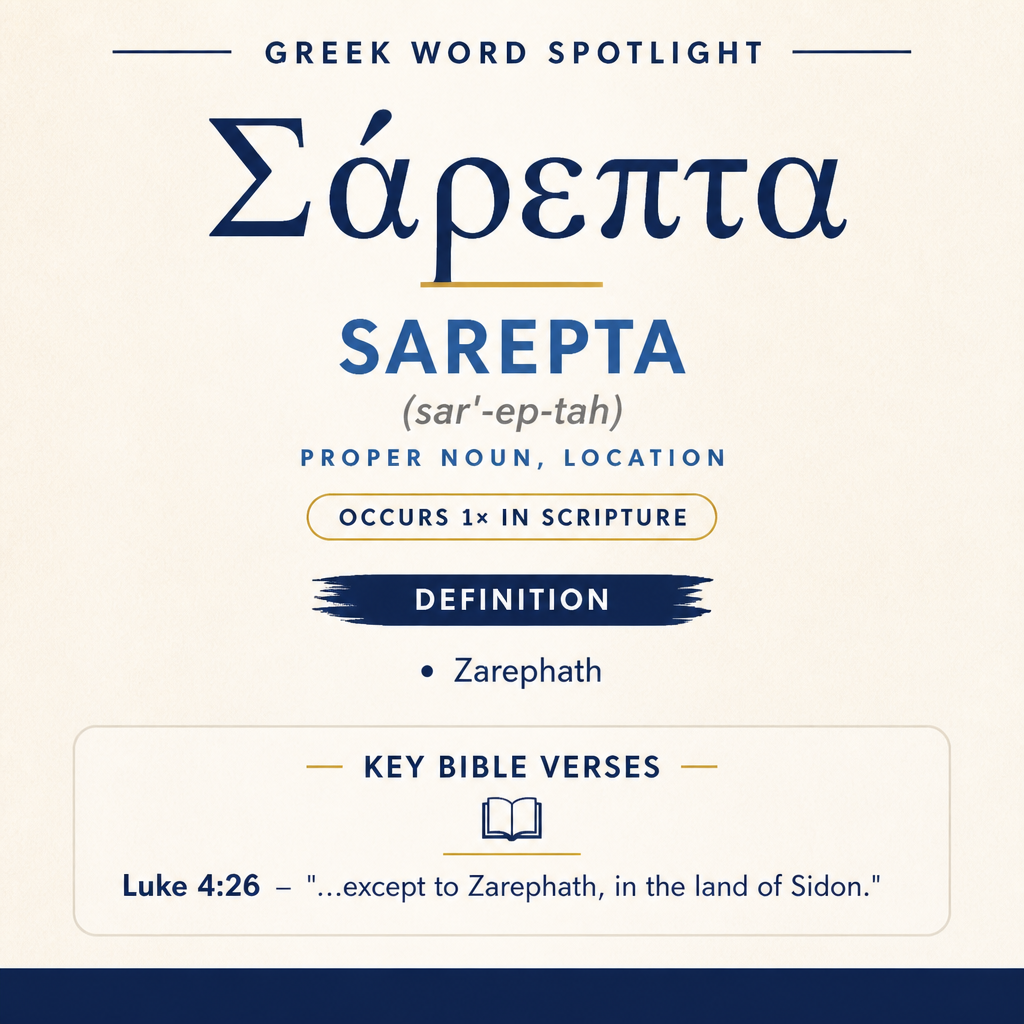
Σάρεπτα means Zarephath and appears once in Scripture at Luke 4:26.
Luke Context
Luke 4:26 says Elijah was sent to Zarephath in the land of Sidon, to a widow.
Learn More →Σάρεπτα refers to Zarephath and appears once in the New Testament, in Luke’s account of Jesus’ speech in Nazareth. In that setting, the place-name anchors a specific remembered destination tied to Elijah and to a widow.
Occurrences
“Elijah was sent to none of them, except to Zarephath, in the land of Sidon, to a woman who was a widow.” (Luke 4:26)
Here Σάρεπτα functions as a precise geographic marker inside a tightly framed sentence about where Elijah was sent. The clause “except to Zarephath” sets the town in contrast with “none of them,” marking it as the lone specified destination in the statement. The name does not stand alone, but is immediately clarified and located: it is “in the land of Sidon.” In Luke’s wording, this added locator keeps Zarephath from being heard as a vague or merely symbolic place; it is a defined point within a broader regional description.
The placement of Σάρεπτα also serves the movement of the sentence from prophet to destination to beneficiary. The sequence is deliberate: Elijah is “sent,” then the exception is stated with the place-name, and then the purpose of the sending is narrowed further—“to a woman who was a widow.” Zarephath therefore sits at the hinge between mission (“was sent”) and recipient (“to a woman”). The town becomes the narrative bridge that connects prophetic action to a particular person’s situation, and the detail of widowhood gives the destination a human face without naming the woman. In this single verse, Σάρεπτα gathers together three kinds of specificity: a prophet’s commission, a particular locale, and an individual described by social vulnerability (“a widow”).
Finally, the phrase “except to Zarephath” shows that the place-name carries rhetorical weight beyond mere travel information. “Except” marks the location as a selected alternative within a larger group left unserved. The statement is not constructed as “Elijah was sent to Zarephath” alone, but as an exclusion-and-exception claim. That makes Σάρεπτα the named site where the exception occurs, the point at which the general pattern (“none of them”) is interrupted by a singular, specified act of sending.

Sense and Usage
As a proper place-name glossed “Zarephath,” Σάρεπτα contributes to Luke 4:26 by fixing the action of “was sent” in a concrete location that can be further situated (“in the land of Sidon”). Within the verse, the meaning is carried not by descriptive vocabulary about the town but by its role as a named destination: it identifies where the exception takes place. The term therefore operates in a way characteristic of many place-names in narrative and speech—its semantic content is simply the identification of a locale—yet its pragmatic force in context is stronger because it is embedded in an “except” construction.
The immediate apposition “in the land of Sidon” shows how Σάρεπτα can be used with an explanatory geographic frame. The town is not presented as self-explanatory to every hearer; Luke’s sentence supplies an orienting label that places it within a larger territory. This pairing indicates a common usage pattern: a specific town-name can be accompanied by a broader regional designation to secure comprehension and to control what the name evokes. In Luke 4:26, the combination of the local (Zarephath) and the regional (Sidon) makes the reference both precise and publicly intelligible.
Σάρεπτα also helps tighten the logic of Jesus’ illustration by making the exception concrete rather than abstract. The sentence contrasts an unnamed plurality (“none of them”) with a single named location (“Zarephath”) and then with a single described individual (“a woman who was a widow”). The place-name is the middle term that moves the thought from a broad population to a singular case. Used this way, Σάρεπτα does not merely add color; it helps structure the argument: the exception is anchored in space, then in a person’s condition. The place becomes the setting in which the exceptional sending is realized.
Because Σάρεπτα appears only in this brief mention, its usage here is compact: it is not developed with additional narrative detail in the verse itself. Yet even in that compressed form, Luke’s phrasing shows the kind of associations a place-name can carry in discourse. The town is tied to a prophetic mission (“Elijah was sent”), it is mapped within a recognized region (“the land of Sidon”), and it is linked to a household situation implied by the recipient (“a woman who was a widow”). In this single sentence, Zarephath is not merely where something happened; it is the named point where the purpose of the sending reaches a specific person.
Imagery
Luke 4:26 invites the reader to picture a journey with a fixed destination: a prophet being “sent” to a particular town, further located “in the land of Sidon.” The verse then narrows from landscape to domestic circumstance—arrival “to a woman who was a widow.” Σάρεπτα, as the named place, holds together that movement from map to doorway: a real locality set within a broader region, and a specific household reached by a directed mission.
Sources: Lexical data from Strong’s Exhaustive Concordance and the Translators Brief Lexicon of Extended Strongs for Greek (STEPBible, CC BY). Occurrence data from the Translators Amalgamated Greek New Testament (STEPBible, CC BY). Scripture quotations from the World English Bible (public domain).




