
Exploring the Meaning of Sardios in Greek
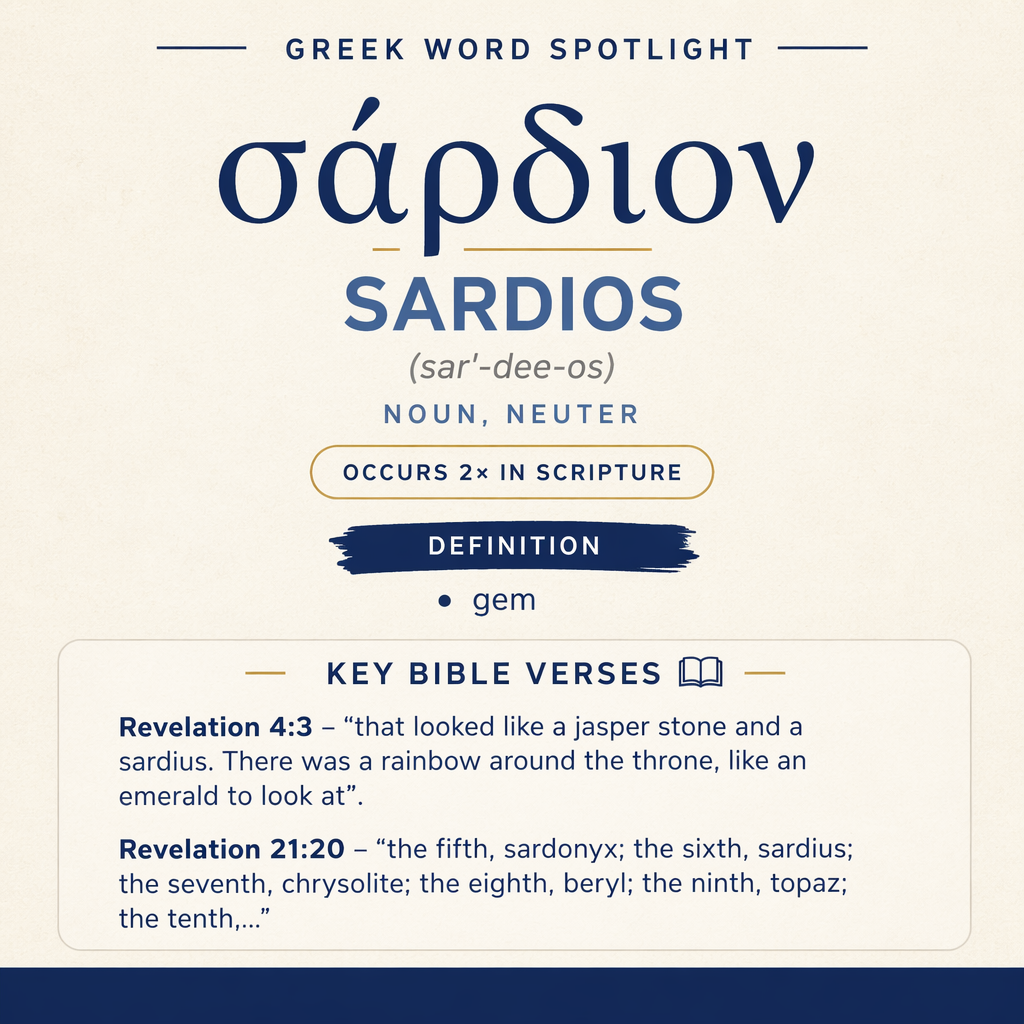
σάρδιον means “gem” and appears twice in Scripture, in Revelation 4:3 and Revelation 21:20.
Revelation 4:3
In Revelation 4:3, it is mentioned with jasper in a throne-room description.
Learn More →Revelation 21:20
In Revelation 21:20, it appears in a list of stones: “the sixth, sardius.”
Learn More →σάρδιον refers to a gem and appears in Revelation within two linked scenes of apocalyptic splendor: the heavenly throne-room vision and the description of the New Jerusalem’s foundations. In both settings it functions as part of a carefully arranged visual register—stones named and placed to communicate ordered beauty in what is seen.
Occurrences
“that looked like a jasper stone and a sardius. There was a rainbow around the throne, like an emerald to look at.” (Revelation 4:3)
Here σάρδιον is one of the two stones used to describe the appearance of the One on the throne: “like a jasper stone and a sardius.” The wording does not treat the gem as an object being carried or exchanged; it is invoked as a point of comparison for what is seen. In the immediate line, the rainbow “around the throne” is likewise rendered through gemstone comparison—“like an emerald to look at.” Within this tightly focused description, σάρδιον contributes to a threefold cluster of stone-imagery (jasper, sardius, emerald) that shapes how the throne scene is perceived: the throne is surrounded by visual brilliance and color-like intensity that is expressed through named gems. The gem term thus serves the passage’s descriptive purpose: it gives concrete, material language for an otherwise overwhelming sight, anchoring the vision’s radiance in the vocabulary of precious stones.
The construction “looked like… and a sardius” places σάρδιον alongside another stone-name, allowing the description to layer comparisons rather than settle on a single likeness. That layering fits the verse’s progression: the viewer’s attention moves from the enthroned appearance, to the encircling rainbow, to its emerald-like look. σάρδιον belongs to that movement of the eye around the throne scene, where the most important realities are presented as visually arresting and ordered.
“the fifth, sardonyx; the sixth, sardius; the seventh, chrysolite; the eighth, beryl; the ninth, topaz; the tenth, chrysoprase; the eleventh, jacinth; and the twelfth, amethyst.” (Revelation 21:20)
In Revelation 21:20 σάρδιον appears in a numbered catalogue: “the sixth, sardius.” The term is not part of a comparison (“looked like”) but part of a sequence of named foundation stones. The sentence fragment quoted is structured by ordinal numbering (“the fifth… the sixth… the seventh…”) and by the rhythm of listing, so σάρδιον’s immediate contribution is to occupy one fixed place in an ordered series. Unlike the throne-room vision, where the gem language functions to portray the appearance of the enthroned One and the surrounding rainbow, here the gem name functions architecturally: it identifies a particular foundation element within the city’s construction as it is being described.
The list places σάρδιον among other gem terms and ties it to a specific slot: “the sixth.” The effect is that the New Jerusalem’s foundations are portrayed not as an undifferentiated mass of “precious stones,” but as a layered, counted arrangement with distinguishable stones. σάρδιον therefore carries a sense of precision in this passage: it is one named component in a complete set, presented as part of the city’s beauty and stability. The verse’s pattern also gives the gem a relational meaning in context: σάρδιον is heard in contrast with what comes immediately before and after (“sardonyx… sardius… chrysolite”), so its identity is shaped by its placement among many gems, each singled out by name.
Sense and Usage
Across these two occurrences, σάρδιον functions as a concrete term for a gem within Revelation’s visual and architectural imagery. In Revelation 4:3 it belongs to the language of likeness: gem names are used to render the appearance of heavenly realities in sensory terms—what is seen “looked like” jasper and σάρδιον, while the rainbow is “like an emerald to look at.” In such a setting, the gem term’s role is descriptive rather than transactional: it lends the vision material vividness, indicating that the appearance being described is brilliant and precious enough to be compared with gemstones.
In Revelation 21:20 the same gem term participates in a measured enumeration. The numbered list treats gem names as the vocabulary of the city’s foundations, where each stone is part of a complete and carefully ordered structure. σάρδιον’s sense remains the same—still a gem—but its function changes with the discourse: it is no longer one of several comparisons for a radiant appearance; it is a designated element in a sequence that contributes to the city’s depicted magnificence and order.
The two uses together show how gem language can carry both immediacy and structure. In the throne scene, σάρδιον is heard in the moment of seeing: it contributes to a snapshot of what surrounds the throne, alongside the rainbow imagery. In the city scene, σάρδιον is heard in the steady cadence of counting and naming: it contributes to the sense of completeness created by the progression from “the fifth” through “the twelfth.” In both cases, the gem term signals value and beauty within the narrative’s imagery, but it does so through two distinct rhetorical modes—comparison in a visionary description and identification in an enumerated architectural list.
Imagery
σάρδιον participates in Revelation’s practice of communicating glory through stones that can be named, counted, and pictured. In Revelation 4:3 it helps present the throne area as a place where what is seen is beyond ordinary materials, yet described through the most precious and visually striking objects available in common experience: “a jasper stone and a sardius,” with “a rainbow around the throne.” In Revelation 21:20 it helps present the city as not only radiant but also ordered—its foundations described through a sequence of gems, σάρδιον taking its place as “the sixth.” Together these two passages allow σάρδιον to evoke both the immediacy of visionary sight and the settled beauty of a constructed dwelling whose foundations are themselves worthy of wonder.
Sources: Lexical data from Strong’s Exhaustive Concordance and the Translators Brief Lexicon of Extended Strongs for Greek (STEPBible, CC BY). Occurrence data from the Translators Amalgamated Greek New Testament (STEPBible, CC BY). Scripture quotations from the World English Bible (public domain).




