Exploring the Meaning of Salpigx in Greek
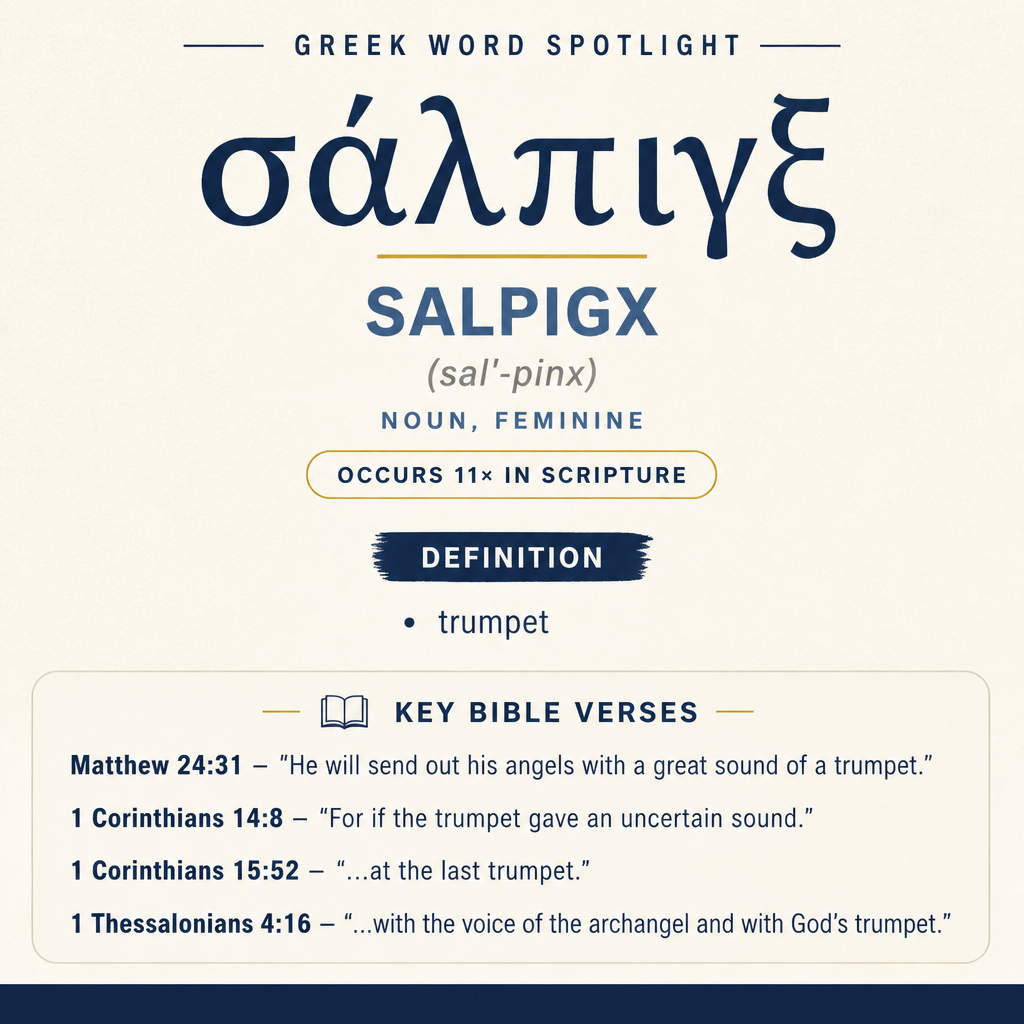
σάλπιγξ (Salpigx) means “trumpet” and appears 11 times in Scripture, including Matthew 24:31, 1 Corinthians, 1 Thessalonians, Hebrews, and Revelation.
Key Occurrences
It appears in Matthew 24:31; 1 Corinthians 14:8 and 15:52; 1 Thessalonians 4:16; Hebrews 12:19. It also occurs in Revelation 1:10; 4:1; and 8:2.
Learn More →Contextual Uses
It describes a trumpet’s sound (Matthew 24:31; Hebrews 12:19) and imagery tied to the last trumpet and God’s trumpet (1 Corinthians 15:52; 1 Thessalonians 4:16). Revelation uses it for loud, trumpet-like speech and for trumpets given to angels (Revelation 1:10; 4:1; 8:2).
Learn More →σάλπιγξ refers to a trumpet, an instrument whose sound functions as a public signal in narrative and prophetic scenes. In the New Testament passages where it appears, the trumpet’s sound gathers, warns, marks decisive moments, and frames heavenly messages.
Root and Related Words
σάλπιγξ (Salpigx) is related to σάλος (salos, “tossing”; Strong’s G4535).

Occurrences
Matthew 24:31 — “He will send out his angels with a great sound of a trumpet, and they will gather together his chosen ones from the four winds, from one end of the sky to the other.”
Here the trumpet is defined by its “great sound” and by what that sound accompanies: angelic sending and the gathering of “his chosen ones.” The trumpet functions as an audible marker of a worldwide summons—its reach matches the scope of the gathering “from the four winds,” spanning “from one end of the sky to the other.”
1 Corinthians 14:8 — “For if the trumpet gave an uncertain sound, who would prepare himself for war?”
In this rhetorical question, the trumpet is treated as a tool for clear communication. Its sound is assumed to be directional and practical: a trumpet that is “uncertain” fails to produce a corresponding response, so no one “would prepare himself for war.” The verse depends on the trumpet’s expected capacity to convey a recognizable signal.
1 Corinthians 15:52 — “in a moment, in the twinkling of an eye, at the last trumpet. For the trumpet will sound and the dead will be raised incorruptible, and we will be changed.”
The trumpet here is paired with suddenness (“in a moment”) and finality (“at the last trumpet”). Its sounding is presented as the event that coincides with resurrection and transformation: “the dead will be raised incorruptible, and we will be changed.” The trumpet’s role is not merely atmospheric; it is the announced sound-point at which the described change takes place.
1 Thessalonians 4:16 — “For the Lord himself will descend from heaven with a shout, with the voice of the archangel and with God’s trumpet. The dead in Christ will rise first,”
σάλπιγξ appears as part of a cluster of sounds: “a shout,” “the voice of the archangel,” and “God’s trumpet.” The trumpet is attributed to God (“God’s trumpet”), placing it among the audible features that accompany the Lord’s descent “from heaven.” As in the previous occurrence, the trumpet’s sound stands next to resurrection language: “The dead in Christ will rise first.”
Hebrews 12:19 — “the sound of a trumpet, and the voice of words; which those who heard it begged that not one more word should be spoken to them,”
In this setting, the trumpet is heard as “the sound of a trumpet” alongside “the voice of words.” The reaction is emotional and urgent: those who heard “begged that not one more word should be spoken to them.” The trumpet’s sound contributes to the intensity of the auditory experience that provokes fear and restraint, amplifying the scene’s overwhelming character.
Revelation 1:10 — “I was in the Spirit on the Lord’s day, and I heard behind me a loud voice, like a trumpet”
σάλπιγξ is used as a comparison to describe a voice: “a loud voice, like a trumpet.” The point of the simile is loudness and attention-commanding clarity. The trumpet provides a sonic image for a voice that is not private or faint but arresting and unmistakable.
Revelation 4:1 — “After these things I looked and saw a door opened in heaven, and the first voice that I heard, like a trumpet speaking with me, was one saying, “Come up here, and I will show you the things which must happen after this.””
Again the trumpet serves as a comparison for “the first voice” heard, now further characterized as “speaking with me.” The command “Come up here” is delivered by a voice described in trumpet-like terms, linking σάλπιγξ with authoritative summons and the initiation of revelation: “I will show you the things which must happen after this.”
Revelation 8:2 — “I saw the seven angels who stand before God, and seven trumpets were given to them.”
This verse introduces multiple trumpets as assigned instruments: “seven trumpets were given to them.” The distribution of trumpets to “the seven angels who stand before God” presents σάλπιγξ as a bestowed item with an intended function in what follows, marking preparation for a sequence of angelic actions.
Revelation 8:6 — “The seven angels who had the seven trumpets prepared themselves to sound.”
The trumpets are now in the angels’ possession (“had the seven trumpets”), and the angels’ posture is readiness: they “prepared themselves to sound.” σάλπιγξ is tied to deliberate, ordered action—an instrument to be sounded at the proper time by designated agents.
Revelation 8:13 — “I saw, and I heard an eagle, flying in mid heaven, saying with a loud voice, “Woe! Woe! Woe for those who dwell on the earth, because of the other voices of the trumpets of the three angels, who are yet to sound!””
Here the trumpets are explicitly linked with “voices”: “the other voices of the trumpets of the three angels.” The eagle’s proclamation interprets the coming trumpet-sounds as impending trouble for “those who dwell on the earth,” and it frames them as still future—“yet to sound.” The trumpet is thus associated with an anticipated series of audible warnings whose effects fall on the earth’s inhabitants.
Revelation 9:14 — “saying to the sixth angel who had the trumpet, “Free the four angels who are bound at the great river Euphrates!””
σάλπιγξ identifies the angel addressed: “the sixth angel who had the trumpet.” The trumpet here functions as a marker of role within the sequence, and the scene centers on a spoken command—“Free the four angels who are bound at the great river Euphrates!”—issued in connection with the trumpet-bearing angel’s moment in the unfolding events.
Sense and Usage
Across these passages, the trumpet is consistently tied to public audibility: it is “great,” “uncertain” or (by implication) certain, “loud,” and repeatedly linked with voices and commands. In the Pauline contexts (1 Corinthians 14:8; 1 Corinthians 15:52; 1 Thessalonians 4:16), the trumpet functions as an intelligible signal: it can fail when unclear, and it can mark decisive action when it sounds—whether preparation for conflict or rapid transformation and rising. In Hebrews 12:19, the trumpet’s sound belongs to an overpowering auditory environment that elicits a plea for silence, showing that trumpet-sound may be experienced not only as guidance but also as fearful intensity.
In Revelation, σάλπιγξ moves between metaphor and object. It describes the quality of a voice (“like a trumpet”) that issues summons and discloses future events (Revelation 1:10; 4:1). It also appears as a set of concrete instruments “given” to angels and “prepared… to sound” (Revelation 8:2, 8:6), whose coming “voices” are tied to pronounced woes and to commands that set further actions in motion (Revelation 8:13; 9:14). The word thus supports both vivid description—trumpet-like speech—and structured sequencing—trumpets assigned and sounded in order.
Imagery
The imagery attached to σάλπιγξ is consistently auditory and commanding. Whether it gathers “his chosen ones” across the sky (Matthew 24:31), demands readiness through a recognizable signal (1 Corinthians 14:8), accompanies resurrection and change (1 Corinthians 15:52; 1 Thessalonians 4:16), overwhelms hearers (Hebrews 12:19), or frames heavenly speech and angelic action (Revelation 1:10; 4:1; 8:2; 8:6; 8:13; 9:14), the trumpet’s sound is portrayed as a force that cannot be treated as background noise: it calls, it marks, and it advances what is being spoken and done.
Sources: Lexical data from Strong’s Exhaustive Concordance and the Translators Brief Lexicon of Extended Strongs for Greek (STEPBible, CC BY). Occurrence data from the Translators Amalgamated Greek New Testament (STEPBible, CC BY). Scripture quotations from the World English Bible (public domain).