Exploring the Meaning of Pseusma in Greek
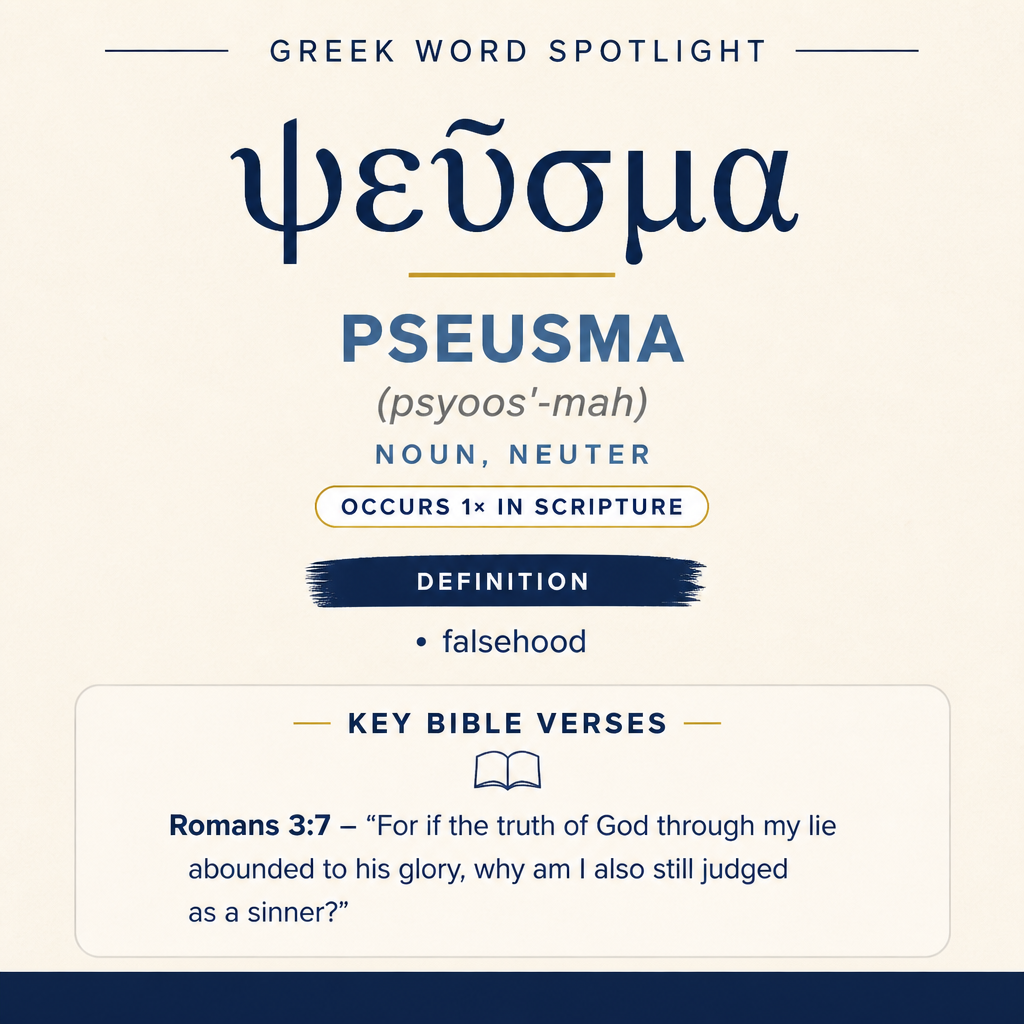
ψεῦσμα means “falsehood” and appears once in Scripture in Romans 3:7.
Scripture Occurrence
This word occurs 1 time in Scripture. Its single occurrence is in Romans 3:7.
Learn More →Verse Context
In Romans 3:7, it appears in the phrase “my lie,” contrasted with “the truth of God.”
Learn More →ψεῦσμα means “falsehood,” and it appears in the midst of Paul’s tightly reasoned exchange about God’s truth and human wrongdoing. Its single New Testament occurrence comes in Romans 3:7, where it functions as a concrete example within a rhetorical question.
Root and Related Words
ψεῦσμα corresponds to the verb pseudomai (ψεύδομαι), “to lie” (Strong’s G5574). The noun form expresses the product or instance associated with that action within discourse.

Occurrences
“For if the truth of God through my lie abounded to his glory, why am I also still judged as a sinner?” (Romans 3:7)
Here ψεῦσμα is presented in direct contrast with “the truth of God.” The verse places two claims side by side: God’s truth, and “my lie.” The noun is framed as something belonging to the speaker (“my”), locating the falsehood in personal agency rather than in God. At the same time, it is brought into a larger argument about outcomes: Paul speaks of God’s truth “abounded to his glory” through that “lie,” and then presses a question about judgment—“why am I also still judged as a sinner?”

In this rhetorical setting, ψεῦσμα functions as a test case: if one were to argue that a personal falsehood could somehow serve as a channel through which God’s truth is shown to be even more glorious, would that change the moral assessment of the liar? The verse itself keeps the categories sharp by continuing to speak of judgment “as a sinner,” so ψεῦσμα remains aligned with culpable human wrongdoing even while it is hypothetically connected with an outcome (“abounded to his glory”) that pertains to God’s honor. The noun thus contributes a pointed moral and logical tension: it names a falsehood attributed to the human speaker, and it is positioned within a question that challenges any attempt to use beneficial consequences as a defense against being judged.
Sense and Usage
In Romans 3:7, “falsehood” is not an abstract idea floating free from responsibility; it is grammatically owned (“my lie”) and set opposite “the truth of God.” This contrast gives ψεῦσμα a relational force: it is understood in its collision with divine truthfulness, not merely as an inaccurate statement. Within the verse, the noun works in the realm of speech and moral accountability. The falsehood is something that can be spoken or maintained by a person, and it is discussed in the same breath as being “judged” and being “a sinner.”
The verse also shows how ψεῦσμα can be invoked within a hypothetical argument without losing its moral weight. Paul’s reasoning allows the claim “through my lie” to stand long enough to press the rhetorical question, but the question itself (“why am I also still judged as a sinner?”) keeps the falsehood tied to the category of sin. In other words, even when ψεῦσμα is placed inside an argument about how God’s truth may be magnified, the term still names an act or product that belongs to the human speaker and sits under the possibility of judgment.
Because this is the word’s lone attested New Testament appearance, its semantic profile here is concentrated: ψεῦσμα is a “falsehood” that can be contrasted with God’s truth, possessed by an individual (“my”), and evaluated within the court-like language of judgment. The verse’s phrasing implies that ψεῦσμα is not merely a private internal error but something that can be considered in public moral reckoning—something that can be weighed in the question of why someone is “still judged.”
Finally, ψεῦσμα in this line functions as a precise term in argumentation. Paul’s sentence is constructed to draw out a possible objection and then expose its inadequacy: the objection leans on results (“abounded to his glory”), but the presence of ψεῦσμα anchors the discussion in the character of the action itself. The noun, therefore, helps sharpen the distinction between God’s truthfulness (which leads to glory) and human falsehood (which remains subject to judgment), even when someone tries to connect the two for self-justifying purposes.
Imagery
The imagery in Romans 3:7 is verbal and judicial: truth and falsehood are placed in opposition, and the question of being “judged” stands over the speaker’s claim. ψεῦσμα evokes the picture of a spoken distortion set beside God’s truth, and then brought before the bar of moral evaluation where the speaker is still reckoned “a sinner.”
Sources: Lexical data from Strong’s Exhaustive Concordance and the Translators Brief Lexicon of Extended Strongs for Greek (STEPBible, CC BY). Occurrence data from the Translators Amalgamated Greek New Testament (STEPBible, CC BY). Scripture quotations from the World English Bible (public domain).