Exploring the Meaning of Pseustes in Greek
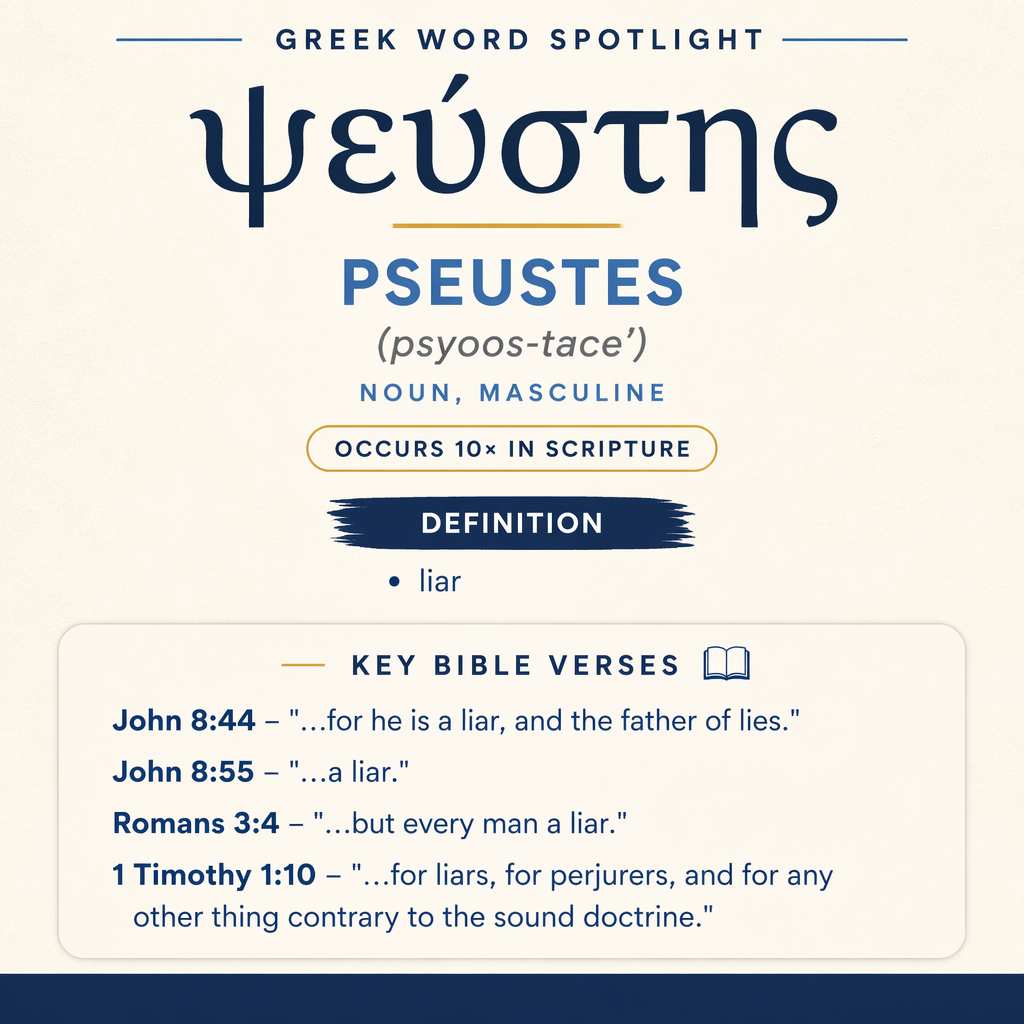
ψεύστης (Pseustes) means “liar” and occurs 10 times in Scripture, including John 8, Romans 3, 1 Timothy 1, Titus 1, and 1 John.
Core Meaning
ψεύστης means “liar.” It is used of individuals described as speaking or embodying falsehood.
Learn More →Where It Appears
It occurs in John 8:44 and 8:55, Romans 3:4, 1 Timothy 1:10, Titus 1:12, and 1 John 1:10; 2:4; 2:22.
Learn More →Key Contexts
In Romans 3:4 it contrasts God found true with every man a liar. In 1 John 2:22 it identifies the liar as one who denies Jesus is the Christ.
Learn More →ψεύστης means “liar,” a blunt label for a person characterized by falsehood. Across its New Testament uses, it names the devil as the archetypal liar, exposes religious and moral pretenses, and frames unbelief and denial as the act of calling God a liar.
Occurrences
John 8:44: “You are of your father, the devil, and you want to do the desires of your father. He was a murderer from the beginning, and doesn’t stand in the truth, because there is no truth in him. When he speaks a lie, he speaks on his own; for he is a liar, and the father of lies.”
Here ψεύστης functions as an identity term: the devil “is a liar,” set in direct contrast to “the truth.” The verse defines his speech as self-sourced (“he speaks on his own”) and presents lying as consistent with his character; the word anchors the charge that those who share his “desires” align themselves with falsehood.
John 8:55: “You have not known him, but I know him. If I said, ‘I don’t know him,’ I would be like you, a liar. But I know him and keep his word.”
ψεύστης is used as a comparison (“like you, a liar”) to mark a hypothetical denial as false speech about knowing God. The label is tied to the contrast between saying and reality: claiming ignorance would contradict Jesus’ actual knowledge, while “keep his word” presents truthfulness as coherence between confession and obedience.
Romans 3:4: “May it never be! Yes, let God be found true, but every man a liar. As it is written, “that you might be justified in your words, and might prevail when you come into judgment.””
In Romans, ψεύστης is broadened from an individual accusation to a sweeping verdict: “every man a liar” stands opposite God being “found true.” The word serves Paul’s rhetorical contrast, intensifying the claim that human reliability fails where divine truth stands; “judgment” and “words” place the issue in the arena of accountable speech.
1 Timothy 1:10: “for the sexually immoral, for homosexuals, for slave-traders, for liars, for perjurers, and for any other thing contrary to the sound doctrine,”
Here ψεύστης appears in a vice list alongside “perjurers,” grouping the liar with other actions “contrary to the sound doctrine.” The word identifies a recognizable moral type within a catalog of behaviors that violate the teaching Timothy is to uphold, treating lying as a serious disruption of communal and doctrinal integrity.
Titus 1:12: “One of them, a prophet of their own, said, “Cretans are always liars, evil beasts, and idle gluttons.””
In Titus, ψεύστης occurs in a quoted, sweeping characterization: “Cretans are always liars.” The force lies in the adverb “always,” making the label depict a settled reputation rather than an isolated act; it is paired with other harsh descriptors, portraying lying as part of a broader pattern of moral disorder.
1 John 1:10: “If we say that we haven’t sinned, we make him a liar, and his word is not in us.”
ψεύστης is applied not to the speaker but to God as a consequence of the speaker’s claim: denying sin “make[s] him a liar.” The term is sharpened by relational language—“his word is not in us”—so that rejecting the truth about sin is framed as a breach with God’s truthful testimony and indwelling word.
1 John 2:4: “One who says, “I know him,” and doesn’t keep his commandments, is a liar, and the truth isn’t in him.”
This use targets hypocrisy: claiming “I know him” while not keeping commandments earns the label ψεύστης. The word exposes a mismatch between professed relationship and lived obedience, and the clause “the truth isn’t in him” connects lying to an internal absence of truth, not merely an external slip of speech.

1 John 2:22: “Who is the liar but he who denies that Jesus is the Christ? This is the Antichrist, he who denies the Father and the Son.”
Here ψεύστης is defined by a specific denial: “he who denies that Jesus is the Christ.” The question form (“Who is the liar but…?”) makes the label decisive, and the verse presses the denial outward to its implications—denying “the Father and the Son”—so that “liar” marks theological rejection, not merely personal deceit.
1 John 4:20: “If a man says, “I love God,” and hates his brother, he is a liar; for he who doesn’t love his brother whom he has seen, how can he love God whom he has not seen?”
ψεύστης again unmasks contradiction, this time between claimed love for God and actual hatred for a brother. The reasoning appeals to the seen/unseen contrast: refusal to love the visible brother undermines the credibility of professed love for the unseen God. The word therefore functions as a moral verdict on inconsistent confession.
1 John 5:10: “He who believes in the Son of God has the testimony in himself. He who doesn’t believe God has made him a liar, because he has not believed in the testimony that God has given concerning his Son.”
In 1 John 5:10, ψεύστης describes what unbelief does: not believing God “has made him a liar.” The verse anchors the charge in “testimony…concerning his Son,” so that rejecting that testimony implicitly calls God false. By contrast, belief is depicted as inwardly possessed “testimony,” emphasizing an internalized reception of God’s truthful witness.

Sense and Usage
Across these passages, ψεύστης operates as more than a casual insult; it is a judicial-sounding label that fixes a person’s speech and stance in relation to truth. John 8:44 places the liar in stark polarity to “the truth,” portraying the liar’s speech as springing from his own nature and desires; within that framework, calling someone a liar is to name a kinship with falsehood. Romans 3:4 then extends the contrast by setting God as “true” over against the universal human condition, so that “liar” becomes a category for human unreliability in the face of divine truthfulness.
In the Pastoral Epistles, the term fits into community formation: “liars” sit among practices “contrary to the sound doctrine” (1 Timothy 1:10), and Titus 1:12 cites a cultural stereotype that treats persistent lying as socially corrosive. In these contexts ψεύστης highlights the practical damage of untruth within a community shaped by teaching; it belongs to the realm of conduct that must be addressed, not a mere intellectual mistake.
1 John concentrates the word’s force on the intersection of confession, ethics, and belief. Several scenes present a simple test: what someone “says” is weighed against reality—whether about sin (1 John 1:10), knowing God (2:4), loving God (4:20), or receiving God’s testimony (5:10). The label ψεύστης is applied where speech denies what is true or where lived behavior contradicts stated allegiance. Notably, 1 John can place “liar” either on the speaker (“he is a liar”) or, by implication, on God (“make him a liar”) when human claims or unbelief contradict God’s word and testimony. In 1 John 2:22, the term becomes sharply doctrinal: denying “that Jesus is the Christ” is presented as the defining instance of the liar, a denial that extends to the relationship between “the Father and the Son.”
Imagery and Emphasis
The passages consistently frame ψεύστης with the imagery of truth present or absent: “there is no truth in him” (John 8:44), “the truth isn’t in him” (1 John 2:4), and “his word is not in us” (1 John 1:10). Lying is pictured not only as a spoken act but as a condition tied to what inhabits a person—truth, word, testimony—or what is missing. The word thus carries the weight of exposure: it names the moment when a claim (“I know him,” “I love God,” “we haven’t sinned”) collapses under the reality of commandments ignored, love withheld, or testimony rejected.
Sources: Lexical data from Strong’s Exhaustive Concordance and the Translators Brief Lexicon of Extended Strongs for Greek (STEPBible, CC BY). Occurrence data from the Translators Amalgamated Greek New Testament (STEPBible, CC BY). Scripture quotations from the World English Bible (public domain).