Exploring the Meaning of Proteuo in Greek
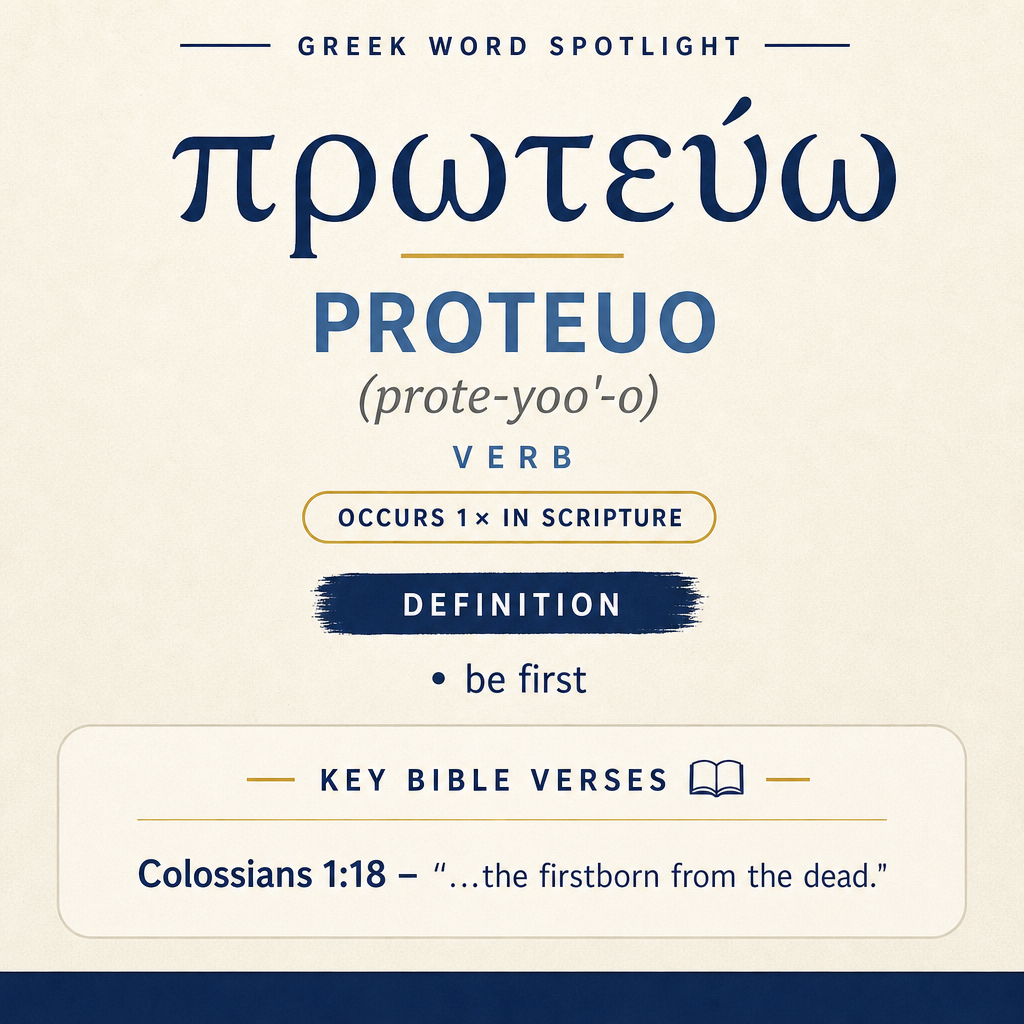
πρωτεύω means “be first” and appears once in Scripture, in Colossians 1:18.
Biblical Usage
πρωτεύω occurs one time in Scripture. Its single occurrence is in Colossians 1:18.
Learn More →Context Snapshot
In Colossians 1:18, the verse ends, “that in all things he might,” where πρωτεύω occurs.
Learn More →πρωτεύω expresses the idea “be first.” It appears once in the New Testament, in Paul’s statement about Christ in Colossians 1:18.
Root and Related Words
πρωτεύω derives from protos (πρῶτος), “first” (Strong’s G4413). The verb form draws the adjective’s idea of “first” into an action or state expressed by the clause in which it stands.

Occurrences
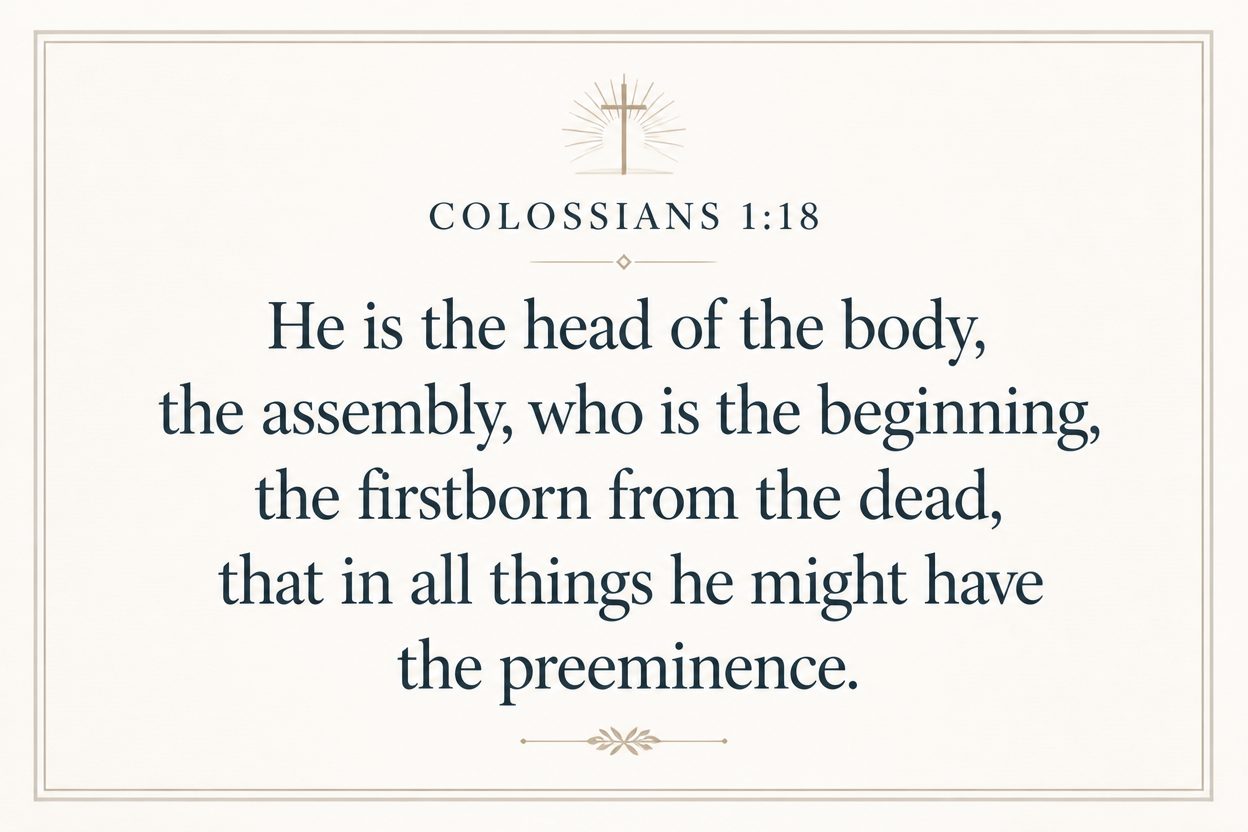
Colossians 1:18 He is the head of the body, the assembly, who is the beginning, the firstborn from the dead, that in all things he might have the preeminence.
In this sentence, πρωτεύω is the verbal idea standing behind “have the preeminence,” and it is framed by a series of descriptions that concentrate authority and priority in one subject: “He is the head of the body, the assembly,” “who is the beginning,” and “the firstborn from the dead.” The clause “that in all things he might have the preeminence” gives the stated purpose or result that gathers those preceding titles into a single direction: the one described is to be first “in all things.”
The wording “in all things” broadens the reach of the verb beyond a single domain. The verse first locates him in relation to a community (“the body, the assembly”), and then speaks of beginnings and the dead (“the beginning,” “the firstborn from the dead”). The aim expressed by πρωτεύω is not a narrow first place within one area, but a firstness that matches the sweep of the preceding claims and is meant to characterize the totality of “all things.”
Because the verse stacks relational and temporal language (“head,” “beginning,” “firstborn”), the verb’s contribution is to articulate the intended outcome of those realities: the one who is head and firstborn is to be first. Within the sentence’s logic, πρωτεύω functions as the capstone: the earlier phrases describe who he is; the final clause states what that identity means for the whole order of things—he is to occupy first place throughout.
Sense and Usage
The sense “be first” in πρωτεύω is used here with an explicit scope marker (“in all things”) and with a telic framing (“that … he might …”), presenting firstness as the fitting, intended standing of the subject described. The surrounding predicates give content to what “first” looks like in the passage: it is not presented as a mere comparison with others but as the proper position that corresponds to being “the head of the body, the assembly” and as the one connected with origin and new life (“the beginning,” “the firstborn from the dead”).
In this verse, “be first” is not left as an abstract ranking detached from the rest of the statement. The line moves from metaphor (“head of the body”) to foundational language (“beginning”) to a declaration involving death and life (“firstborn from the dead”), and only then states the purpose: “that in all things he might have the preeminence.” πρωτεύω thus operates as a summary verb that draws these strands together and points to their comprehensive implication. The term “preeminence” in the translation functions as the idiomatic expression of being first, and the verb’s force is to express firstness as an active, recognized primacy rather than as a passive label.
The immediate context also shows that this “being first” is meant to be all-encompassing. The phrase “in all things” does not allow the reader to confine the statement to the “assembly” alone or to the realm of resurrection alone; instead it links those spheres and any others implied by “all things” under a single ordering in which the subject is first. Within the verse, πρωτεύω therefore communicates a kind of primacy that aligns with headship and with the initiating, leading position implied by “beginning” and “firstborn.”
Imagery in Context
Colossians 1:18 depicts an ordered whole (“the body, the assembly”) with a single governing point (“the head”), and it places that ordering alongside the language of origin and new life (“the beginning,” “the firstborn from the dead”). Within that picture, πρωτεύω gives voice to the intended arrangement: across the full range of “all things,” the one described is to be first.
Sources: Lexical data from Strong’s Exhaustive Concordance and the Translators Brief Lexicon of Extended Strongs for Greek (STEPBible, CC BY). Occurrence data from the Translators Amalgamated Greek New Testament (STEPBible, CC BY). Scripture quotations from the World English Bible (public domain).